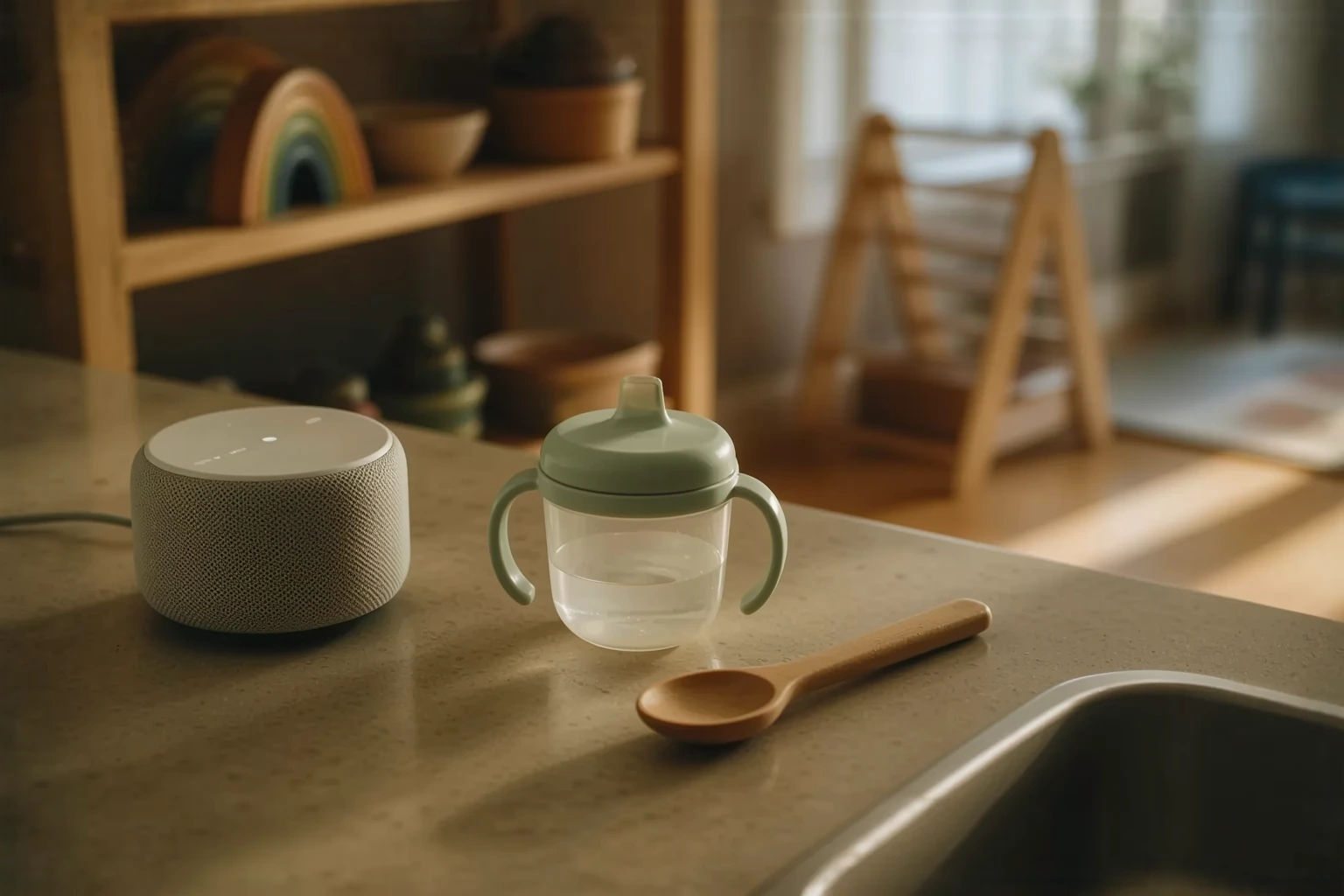

She found it on a Sunday afternoon. I’d left the smart speaker on the counter — just for a moment, just to check a timer — and when I turned around, my two-year-old was standing on her tiptoes with her face about three inches from the fabric grille, shouting “SING SONG. SING SONG.” Not asking. Demanding. The speaker, to its credit, obliged. She looked thrilled and a little bit powerful, which is its own kind of unsettling when you’re watching a person who still needs help with her shoes.
I moved the speaker to a drawer that same week. But the image stayed with me — that specific posture, the authority in her voice — and I started pulling research. What does the science actually say about toddlers and voice assistants? What do we know, what don’t we know, and where are people stating opinions as though they were studies? This post is what I found. It’s long because the question deserves a real answer, not a hot take.
As of mid-2026, the honest summary is this: the research on voice assistants and young children is thin, genuinely interesting in places, and frequently misrepresented. I want to walk you through what the studies actually show, flag the one widely-shared “finding” that is not actually a finding, and tell you what we do at home — including the parts I’m not consistent about.
What children actually believe about smart speakers
The most clarifying piece of research I found came out of the University of Edinburgh. A 2023 mixed-methods study, published in Computers and Education: Artificial Intelligence, looked at children ages six to eleven and their mental models of smart speakers. About three in ten believed the device could think for itself. About four in ten were unsure. Roughly two-thirds thought devices might have feelings or be capable of making decisions — and yet those same children, often in the same breath, said devices aren’t alive and can’t breathe. The researchers called this an “in-between” category, and they weren’t dismissive about it. Their concern was specific: human-like design — a warm voice, a name, a conversational cadence — actively misleads children about what they’re interacting with.
My daughter is two, so she’s outside this study’s age range. But I don’t think that makes it less relevant. If six-year-olds are holding genuinely contradictory beliefs about whether a speaker can feel things, I’m curious what a two-year-old is building in the years before that. She can’t tell me. That uncertainty is part of why I’m paying attention now.
How children decide what to trust — and what to ask
A 2020 study from Judith Danovitch’s lab at the University of Louisville — “Phone a Friend or Ask Alexa?” — tested 40 four-and-five-year-olds and 40 seven-and-eight-year-olds on when they’d prefer a device over a human for information. The finding was nuanced: with age, children increasingly trusted the device for stable factual questions, but still preferred a person for personal information. Younger children, notably, weren’t making that distinction as cleanly yet. They’re still sorting out what different sources are good for.
What I find interesting alongside this is how kids actually probe these devices. Researchers have documented children around age four asking a voice assistant what color shirt they’re wearing — a question designed to catch it out. Northwestern researcher Silvia Lovato found kids being both skeptical and genuinely creative in testing reliability, asking things like “Hey Google, do unicorns exist?” This is not credulity. This is scientific method in miniature. Children are not simply accepting these devices at face value — they’re running experiments. That’s reassuring, and it’s also a reminder that they’re paying close attention to the answers they get.
If your child is already talking to a smart speaker regularly, do you know what they’re asking it — and what it’s telling them?
How toddlers actually talk to these devices (and what it might mean)
This is where the research gets practically interesting. A 2024 study in Nature Scientific Reports found that children use higher pitch and more effortful “device-directed speech” when talking to voice assistants — a distinct register, similar to how adults shift their speech patterns for different audiences. And a 2022 study looking specifically at preschoolers ages three to five found something that stuck with me: when a smart speaker misunderstood them, most kids tried to fix it by getting louder. Only about a third rephrased. In other words, they weren’t adapting their communication — they were just turning up the volume.
I watched exactly this with my daughter and the timer incident. “SING SONG” was already at full volume. When the speaker didn’t immediately respond to her liking, she went louder still. Whether that habit, practiced over time, has any downstream effect on how a child learns to communicate when misunderstood by a person — we genuinely don’t know yet. I want to be careful not to speculate that into a finding. But it’s the kind of question worth holding.
The “harms language development” claim — and why I need to be straight with you about it
You may have seen articles — I certainly did — citing research showing that voice assistants impede children’s language development or social-emotional growth. Here’s what I found when I traced those claims back: the most widely shared piece making this argument was a 2022 article in Archives of Disease in Childhood. It’s a Viewpoint article. That means it’s an opinion piece, not original research. Fact-checkers and the Science Media Centre both stressed at the time that it presented little new evidence. There is currently no good empirical evidence of language deficits from voice assistant use in children.
I say this not to reassure anyone into complacency, but because I think parents deserve accurate information. If a claim doesn’t have research behind it, calling it research is a disservice. What we can honestly say is that this is an understudied area, the devices are relatively new, long-term studies don’t yet exist, and the Edinburgh research does raise real questions about how human-like design shapes children’s understanding of what they’re talking to. That’s enough to be thoughtful. It’s not enough to be frightened.
The politeness question — genuinely contested, not settled
In April 2018, Amazon introduced a “Magic Word” feature to its Echo Dot Kids edition — positive reinforcement when children say “please,” with no penalty for rudeness, developed after consulting child-development experts. It was a direct response to parent concerns about children barking commands at devices.
The debate among experts hasn’t resolved since. Some researchers and educators worry that practicing a demanding, command-only register — even with a machine — normalizes that style of speech. Others argue the opposite: that mandatory courtesy to something that cannot be affected by your rudeness actually cheapens what politeness is for. Courtesy, on this view, is about your impact on another person’s experience. A speaker has no experience. Teaching “please” to a device might hollow out the concept rather than reinforce it. I find both arguments genuinely reasonable, which is its own kind of answer — this one’s a values call, not a science call.
What we actually do in our house
The speaker lives in a drawer. That’s the policy. When I use it — for a timer, for a unit conversion, occasionally for a song when my hands are covered in something — I treat it the way I’d treat a calculator. Appliance, not interlocutor. I don’t talk to it in front of her if I can help it, because I’m not ready to have that conversation about what it is and isn’t. She’s two. We have time.
Is this perfectly consistent? No. There have been a few times I’ve forgotten, a few times she’s seen me ask it something and looked very interested. I don’t spiral about those moments, but I notice them. Common Sense Media’s practical guidance on this — supervise use, set expectations, disable voice purchasing, and explicitly tell children the assistant is not a person — is good and I try to follow it for the moments I do use the device. Their parent guidance page on smart speakers is worth bookmarking.
What’s hard: my husband is less concerned about this than I am, and that’s fine, but it means we’re not always operating from the same page. What I try to hold onto is that the drawer policy isn’t about fear — it’s about not wanting a voice-interface to be a normalized feature of her early environment before she has any framework for what it is. That’s a preference, not a prescription.
Questions I keep getting
Is there actual research showing smart speakers harm toddlers?
As of mid-2026, no — not in the way that phrase implies. The most-cited piece making a harm argument was a 2022 Viewpoint article in Archives of Disease in Childhood, which the Science Media Centre and fact-checkers noted was an opinion piece presenting little new evidence. There is currently no good empirical evidence of language deficits from voice assistant use. What does exist is early, interesting research on how children conceptualize these devices and how they communicate with them — worth knowing, not worth panicking over.
Do young children actually think Alexa is alive?
Not exactly — but the picture is complicated. The 2023 University of Edinburgh study found that roughly two-thirds of children ages six to eleven thought devices might have feelings or make decisions, while simultaneously saying devices aren’t alive and can’t breathe. Researchers called this an “in-between” category. Children aren’t simply fooled; they’re holding genuinely unresolved beliefs, and the researchers flagged that human-like design — a name, a warm voice, conversational responses — contributes to that confusion. For toddlers specifically, we don’t yet have equivalent data.
Should I make my kid say “please” to the smart speaker?
Genuinely contested — experts land on both sides. Amazon built positive reinforcement for “please” into its Echo Dot Kids feature starting in 2018, after consulting child-development specialists. Some researchers worry that commanding a device trains a demanding register. Others argue that insisting on “please” to something that cannot be affected by your behavior might actually dilute what politeness means, since courtesy is fundamentally about its impact on other people. There’s no research that settles this cleanly. It’s a values question, and reasonable parents answer it differently.
What’s one practical thing I can do if we keep our smart speaker?
The most concrete advice I’ve seen — from Common Sense Media’s guidance on smart speakers — is to talk explicitly with your child about the assistant not being a person, supervise use, and PIN-protect or disable voice purchasing. I’d add: notice what your kid is asking it, and what it’s answering. The Edinburgh research suggests children are forming real mental models of these devices; a brief, honest conversation about what the speaker actually is goes further than any setting you can toggle.
About This Article

Written by Lucy Bamboo. Lucy Bamboo is a parent of two who decided her kids would grow up without AI assistants doing their thinking for them — then spent the next four years finding out how hard that actually is. She writes about homework without ChatGPT, creative projects without image generators, and the kitchen-table arguments that come with drawing those lines. Not anti-technology, just paying attention. More about this site.
Verify this against a primary source
Specifics change, and your situation may differ from the one described here. These are the authorities worth checking directly:
- AAP HealthyChildren — pediatric screen time and development guidance
- Common Sense Media — age ratings and family technology research