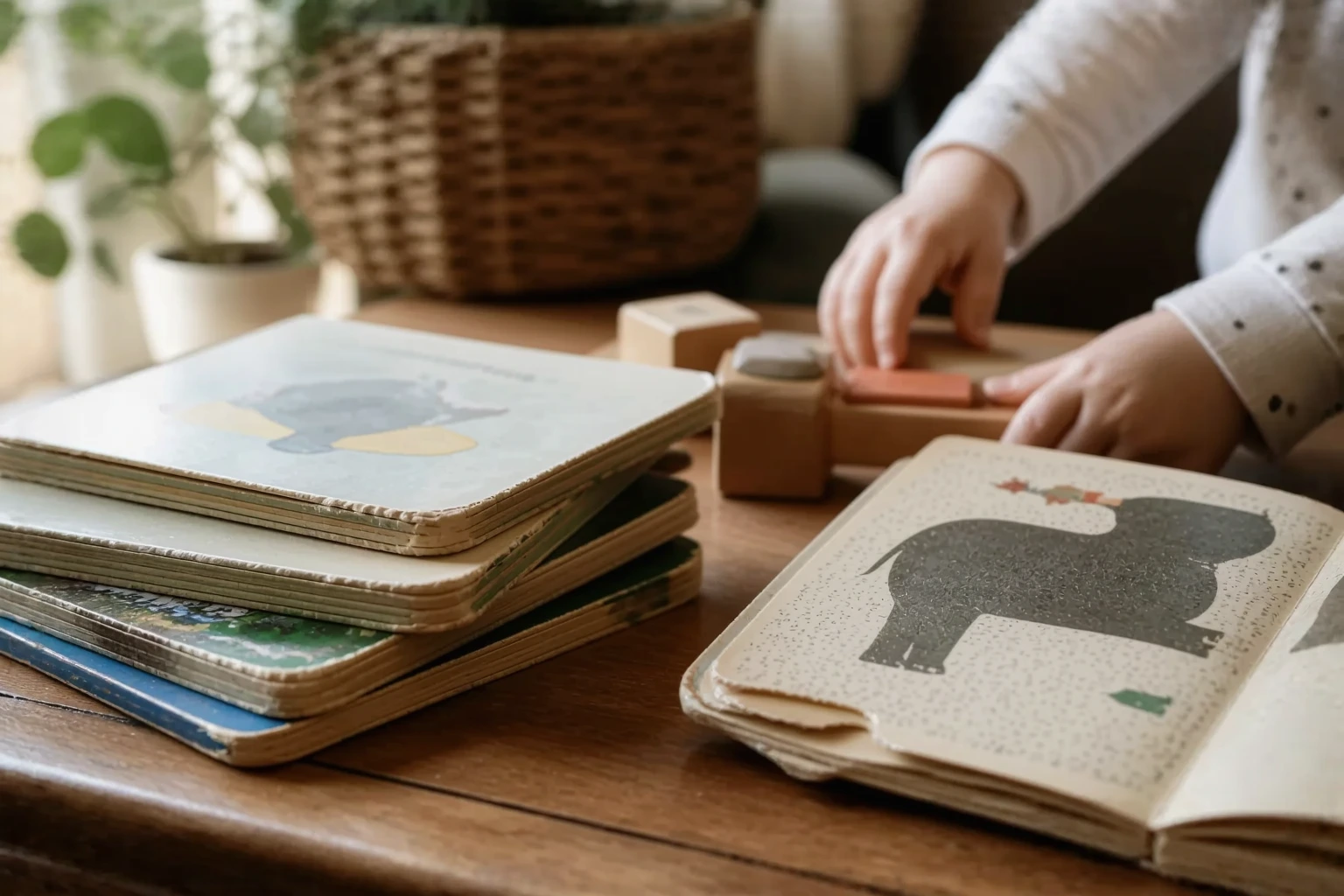

The board book was on the kitchen floor when I came downstairs, spine-up, played open like something exhausted. One corner had been worked down to the cardboard beneath — the paper coating gone, the grey-brown fibre of the board itself exposed and slightly damp. I picked it up and held it for a moment. The cover image was a dog with enormous eyes. Half the dog’s ear had been, at some earlier point, partially consumed.
This is not a complaint. This is a field report.
We have been doing this for two years — the reading, the carrying-of-books-to-random-locations, the inexplicable submerging of books in the dog’s water bowl, the throwing-of-books as a conversational gesture. And I have learned things about board book construction that I did not know I needed to learn. Things that matter, practically, for any family trying to fill a house with books instead of screens and finding that the books keep dying.
So: here is what I know. Not from research, not from any expert. From our specific floors, our specific bathtub, and one small person with exceptionally dedicated gums.
The Construction Question
Board books are not all made the same way, and this turns out to matter enormously once a toddler enters the picture. The simplest and most durable construction is a single thick piece of board for each page — not layers glued together, but one solid piece, sometimes called single-ply or solid board. You can feel the difference when you flex the page. A layered page has a slight give at the edge, a whisper of separation. A solid-board page resists. It does not peel. When my daughter bends a page back on itself, which she does, often, with complete conviction, a solid-board page will spring back. A laminated or multi-layer page will eventually separate at the edge, and once that edge has lifted, a curious two-year-old will find it immediately, the way they always find the one loose thread, the one unstuck corner, the one thing you were hoping they wouldn’t notice.
Check the edges of any board book before you commit to it. Run your thumbnail along the corner. If it catches on a seam, you are looking at a layered construction. This is not automatically a dealbreaker — some laminated books are finished with enough compression that they hold for a long time — but it is information worth having.
Corners are the next thing. Rounded corners survive. Squared corners do not. A squared corner will be chewed to a point within days, and after that the page develops a split that travels slowly inward like a crack in plaster. The books in our house that have lasted longest all have corners that are gently, definitively rounded — not decorative, just practical, the way a good tool is shaped around how it will actually be used. Some books have corners that are only slightly rounded, more of a gesture toward rounding, and those fall somewhere in the middle. Still better than square. But the books with real, generous corner radius have come through genuinely intact.
Then there is the coating. Glossy versus matte is partly an aesthetic question, but it also affects what happens when the book gets wet — which it will. In our house, glossy pages shed water better in the short term. A quick dip, a splash, a wet-handed page-turn: glossy coating shrugs this off. The image underneath stays intact. Matte coating is more pleasant to touch, and my daughter does prefer to touch books, to run her fingers across illustrations as if reading them by feel, but matte coating absorbs moisture and, over time, starts to look cloudy and soft in the places she’s handled most. Neither is wrong. But if your child is the kind of person who reads in the bath — and I use the word “reads” loosely — glossy pages will last longer.
Is there something in you that resists the idea of caring about these things — the corner radius, the coating — as though loving books should be above durability concerns?
I had to get past that. The books are not museum objects. They are tools of a particular season, and they survive the season better if they’re built well. A book my daughter cannot destroy is more likely to be read to pieces, which is the actual goal.
Water, Specifically
I want to say something plainly here: we do not let our daughter read books in the bathtub without us right there. Books that have been in water can become heavy and slippery, and wet board pages can separate into layers with edges that are briefly sharp. None of this is dramatic risk, but it is worth keeping in mind if you have a child who treats the bathtub as a library annex, as ours does. We stay close. We let her have one book at a time in the water, we watch, and we take the book when bathtime is over and stand it upright to dry.
A board book that gets fully submerged and is then left lying flat will warp as it dries. Standing it upright — pages loosely fanned if you can manage it — lets air reach the pages and reduces warping. The books that have been through the bath and survived in our house were all dried this way, propped against the wall beside the tub, slightly ridiculous-looking, smelling faintly of whatever we washed her hair with that night. They dried. They are still in circulation.
A book that warps badly will eventually refuse to lie flat. The pages bow, the whole thing becomes slightly sculptural. We have two like this. She still reads them. They sit in the basket at a strange angle, thick and warped, and she still pulls them out and carries them to me and drops them in my lap with the specific weight of a request.
The Repair Kit
Book tape. That is the whole answer. Not regular tape — the yellowing, the brittleness, the way it lifts within a week. Book tape is a different material: wider, archival, usually cloth-backed, with an adhesive that does not degrade the same way. You can find it in any office supply store or online. I keep a roll in the kitchen drawer, next to the rubber bands and the takeout menus we never throw away.
When a spine starts to separate, I tape it before it goes further. When a page corner has been peeled back to the board beneath, I tape the edge down flat. The tape does not make the book look new — it makes it look repaired, which is a different thing, and I have come to prefer it. A repaired book has a history. The tape is a record of how much it was wanted.
There is a book in our house — the dog with the enormous eyes, the one from the kitchen floor — that is almost entirely held together by book tape at this point. Three corners reinforced. A spine that has been retaped twice. Half an ear gone permanently. She asks for it regularly. She knows it by the feel of it in her hands, by the specific weight and thickness, in a way that I find quietly extraordinary. To her it is not damaged. It is just the book.
I think this is the thing worth saying about worn books: the wear is the evidence. A pristine board book on a shelf is not doing its job. A board book that has been chewed and dropped and taken into the bath and had its corners reinforced with cloth tape — that book has been inside a childhood. The destruction, where it happens slowly and with clear enthusiasm, is not failure. It is exactly the thing you were hoping for when you filled the basket in the first place.
None of this is easy, by the way. Replacing a cracked phone with a functioning phone takes thirty seconds and complete silence. Replacing a destroyed board book with a reading experience requires showing up with your whole self, your voice, your lap, your willingness to read the same forty words eleven times in a row without letting your attention drift to the counter where your own phone is sitting. I am not always good at this. Some nights I read through the dog-with-enormous-eyes book on something approaching autopilot, my voice doing the work while my mind is elsewhere entirely. She does not seem to notice. Or maybe she does notice and has decided to read along anyway, which is its own kind of generosity.
The books keep surviving. We keep taping them back together. She keeps finding them on the floor and carrying them somewhere new.
About This Article

Written by Lucy Bamboo. Lucy Bamboo is a parent of two who decided her kids would grow up without AI assistants doing their thinking for them — then spent the next four years finding out how hard that actually is. She writes about homework without ChatGPT, creative projects without image generators, and the kitchen-table arguments that come with drawing those lines. Not anti-technology, just paying attention. More about this site.
Verify this against a primary source
Specifics change, and your situation may differ from the one described here. These are the authorities worth checking directly:
- AAP HealthyChildren — pediatric screen time and development guidance
- Common Sense Media — age ratings and family technology research