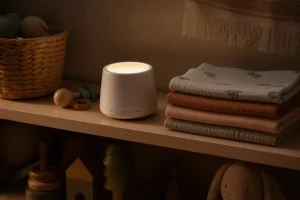
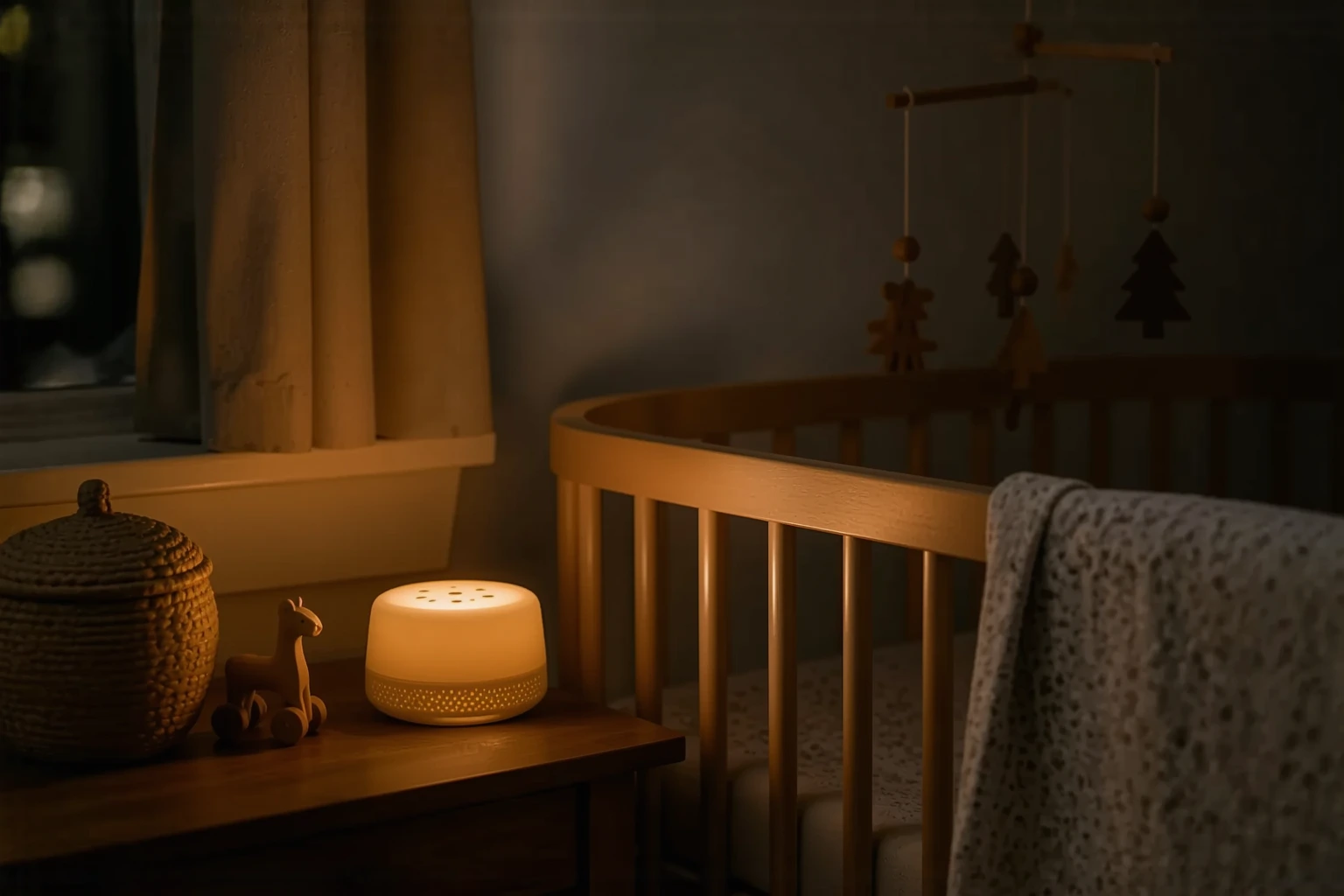

She slept through the smoke alarm test. Not our alarm — the neighbors’, two units down, audible through two walls and a hallway. I was in her doorway, heart in my throat, and she didn’t move. The white noise machine hummed from her dresser, doing exactly what it was supposed to do, and I stood there thinking: wait. What is that sound actually doing in there?
We’d moved the machine across the room a few weeks earlier after her pediatrician mentioned — offhandedly, not as a warning, more as a “have you thought about it” — that she’d been seeing it closer to cribs than she’d like. I’d nodded, moved it, and then, the way you do at 11pm when the question finally gets traction, started actually reading. Not the reassurance articles. The papers. This post is what I found, organized for whoever else is awake at midnight with the same question.
I want to be honest upfront: this isn’t a piece that ends with a verdict. Some of the science here is solid. Some of it is animal models that may or may not translate to humans. Some of it is genuinely open — researchers actively disagreeing, questions not yet answerable with current tools. I’ll tell you which is which.
What White Noise Actually Is
The term gets used loosely, but it has a technical definition. True white noise contains equal acoustic energy at every frequency across the audible range — roughly 20Hz to 20,000Hz — the audio equivalent of television static. Every pitch present, all at once, all equally loud. Pink noise is different: it reduces energy at higher frequencies, distributing it equally per octave instead, which produces that softer, steady-rain sound. Brown noise reduces the high end further still, giving you the deeper, rumbling quality of a strong shower. Most commercial “white noise” machines actually produce something closer to pink or brown — the sharp hiss of true white noise is fairly unpleasant — but the category label has stuck. For the purposes of the science below, I’ll use “white noise” the way the studies do: as shorthand for broadband sound, regardless of which flavor.
How a Baby’s Brain Hears Differently Than Mine Does
In 2001, Lynne Werner and Kumiko Boike at the University of Washington tested 73 infants ages 7–9 months against 40 adults ages 18–30 on a straightforward listening task. The finding was striking: infants listen broadband, processing all frequencies at once, rather than selectively attending to one narrow frequency band the way adults do. Werner described it plainly: “Babies have a different way of listening to the world… they always seem to be listening broadband or to all frequencies simultaneously.”
The ability to tune in selectively — to focus on one voice in a noisy room, to filter out the refrigerator hum while tracking a conversation — develops gradually and, per that study, doesn’t reach adult-comparable performance until around age 10. My daughter is two. She isn’t filtering the white noise machine the way I do when I tune out background noise and stop consciously registering it. She’s taking all of it in, all the time.
The Filter That’s Still Being Built
There’s a related mechanism worth understanding: sensory gating. It’s the brain’s pre-attentive process for filtering out repetitive, unchanging stimuli — the system that, in adults, stops you from consciously registering the hum of an HVAC system after a few minutes. A 2024 study by Cheng, Campbell, and Liu in Biology looked at auditory sensory gating in detail: the mechanism is driven largely by top-down inhibitory signals from the prefrontal and frontal cortex, and it’s measurable via specific brainwave components (P50, N1, P2 auditory evoked potentials). The study found that background noise measurably degrades this gating function even in adults who have it fully developed.
The catch: sensory gating is itself still maturing through childhood. The prefrontal cortex — the part doing the top-down inhibition — is famously one of the last brain regions to fully develop. So my daughter doesn’t yet have a robust, adult-calibrated filter for repetitive sound, and the noise she’s surrounded by during sleep degrades even the partial filter she does have. Whether that has any lasting consequence is a different question, but that’s the mechanism.
What Happens to a Brain Raised in Constant Noise
This is the section I read most carefully, and the one I want to be most precise about. In 2003, Chang and Merzenich published a study in Science that has been widely cited ever since. They reared infant rats in continuous, moderate-level noise and found that it delayed the normal maturation of the primary auditory cortex’s tonotopic organization — the brain’s internal map for sorting pitch. More specifically, it left the brain’s critical-period plasticity open long past the normal closing point. The authors described this as an “indefinite prolongation” of the critical period. The implication is mechanistic and worth stating clearly: the auditory cortex needs structured, changing sound to refine itself. A steady, undifferentiated wash of noise doesn’t provide the varying signal the developing auditory map uses to tune up.
Here is where I want to be careful with you: this is a rat study. The authors themselves framed their findings as implicating noise as “a risk factor,” not a proven human harm. Direct translation from rat auditory development to human auditory development is not established. I’m not dismissing the finding — it’s a legitimate mechanistic signal worth taking seriously — but I’d be doing you a disservice if I presented rat pup data as settled human neurology. It isn’t.
Why It Actually Helps Her Sleep
If the mechanism raises questions, why do so many pediatricians still recommend it?
Because the sleep benefit is real and the mechanism is straightforward. A 2017 study by Messineo et al. in Frontiers in Neurology found that in adults with transient insomnia, broadband sound cut time to reach stable sleep by 38% — from 19 minutes down to 13 — with an effect size the authors compared to a low dose of a prescription sleep medication (eszopiclone 2mg). The mechanism is auditory masking: broadband sound narrows the volume gap between the ambient background and any sudden disruptive noise. A dog barking, a door closing, a car alarm — the relative jump in volume is smaller, which raises the threshold needed to trigger an arousal response. It doesn’t eliminate sound. It cushions the spikes.
For a baby whose sleep cycles surface to light sleep every 45 minutes or so, that spike-cushioning is genuinely useful. I’m not arguing against the machines. I’m arguing for using them with eyes open about what else they’re doing.
Now the Harder Question: Could Years of This Cost Her Hearing?
In 2014, Hugh, Wolter, and colleagues published a measurement study in Pediatrics that should be required reading for anyone who owns one of these machines. They measured 14 commercial infant sleep machines at three distances — 30cm, 100cm, and 200cm — and applied correction factors for a 6-month-old’s ear canal rather than using raw adult-calibrated readings. Why bother correcting? Because a child’s external ear canal has a higher natural resonance peak frequency than an adult’s, one that decreases with age until reaching adult values around age 7. The canal itself acoustically amplifies a different part of the frequency spectrum more intensely in a small child, which means an adult dB reading doesn’t necessarily reflect what’s actually arriving at a baby’s eardrum.
What they found: at 30cm and maximum volume, every single machine exceeded 50 dBA — the recommended noise limit for hospital nurseries. Three of the 14 exceeded 85 dBA at that distance. That 85 dBA number matters for the next section.
Doing the Math on “Years”
This is my own arithmetic, not a cited study’s conclusion — I want to flag that clearly. But I think it’s worth doing.
NIOSH, the CDC’s occupational safety research arm, recommends an 8-hour time-weighted-average noise limit of 85 dBA, using a 3dB exchange rate: every 3dB increase halves the safe exposure duration. So 85dBA for 8 hours, 88dBA for 4 hours, 91dBA for 2 hours, and so on. OSHA’s legally enforceable standard is looser — 90dBA over 8 hours with a 5dB exchange rate — but even NIOSH’s own model calculates an 8% excess risk of noise-induced hearing loss at its 85dBA limit modeled over a 40-year working life, versus a 25% excess risk at OSHA’s 90dBA limit.
Now consider: those standards were built around an adult 8-hour workday, 5 days a week, over a 40-year career. A white noise machine running all night runs 8–10 hours per day, 365 nights a year. If we use it from birth through, say, age four or five, that’s somewhere in the range of 1,460 to 1,825 nights. At 10 hours per night, that’s 14,600 to 18,250 hours of exposure — before kindergarten — starting decades earlier in a life than any adult occupational model contemplates. I’m not saying this arithmetic proves harm. I’m saying the occupational exposure standards were not designed with this use case in mind, and the gap in the modeling is real.
The More Cautious Number Some Researchers Argue For
In a 2024 perspective piece in the Journal of Exposure Science & Environmental Epidemiology, researcher Daniel Fink argued that the genuinely lifetime-safe noise level is closer to 55–60 dBA as a 24-hour time-weighted average — well below both NIOSH’s 85 dBA and OSHA’s 90 dBA. Fink explicitly grounded his argument in an older analysis by researcher Karl Kryter from around 1994 and acknowledged that his proposal relies on data that “need[s] to be confirmed by laboratory studies.”
This has not been adopted by NIOSH, OSHA, or WHO. It is a minority, contested position in the research literature. I include it not because it’s settled but because it represents the outer edge of the precautionary argument — and because a parent doing a thorough reading will encounter it and deserves to know exactly what it is and isn’t.
The Damage a Hearing Test Wouldn’t Catch
This is the finding I find most genuinely unresolved, and I want to handle it carefully. In 2009, Kujawa and Liberman published a study in the Journal of Neuroscience using mice. They exposed them to noise strong enough to cause a temporary hearing threshold shift — the kind that fully recovers on a standard hearing test within days — and then looked at what happened at the synapse level. What they found was that even though the sensory hair cells survived and hearing test results returned to normal, up to half of the nerve synapses connecting inner hair cells to the auditory nerve had been permanently destroyed. The wiring, not the cells, didn’t regenerate. This phenomenon is now called cochlear synaptopathy, or sometimes “hidden hearing loss,” because it wouldn’t show up on a conventional audiogram.
The predicted human consequences include difficulty hearing in background noise and tinnitus. Whether everyday, moderate, non-occupational noise — a nightly sound machine at a sensible volume — causes cochlear synaptopathy in humans is not an established fact. It is a genuinely open research question. Confirming cochlear synaptopathy in living humans has proven so difficult that researchers have titled review papers asking whether it’s “Mission Impossible.” I don’t think the honest answer is “definitely fine” or “definitely dangerous.” I think the honest answer is: we don’t know yet, and the mechanism by which it could happen is real.
What We Actually Do in Our House
We still use a white noise machine. I want to be honest about that, because this post could read as a long argument against them and it isn’t meant to be. The sleep benefit is real and sleep deprivation has its own developmental costs. What changed after I did this reading is how we use it.
The machine is on the far side of her room, not near the crib — the distance rule matters, and the Hugh et al. measurements make that viscerally clear. Volume is set at what I’d describe as a heard-from-inside-the-bathroom shower level: audible but not competing with conversation. If you want the specific volume and distance rules we follow, I wrote them out in the white noise myths post, along with the reasoning behind each one. I’m not going to re-litigate all of that here.
What I’ve also started doing — imperfectly, inconsistently, as things go in our house — is turning the machine off after she’s in deep sleep rather than running it all night. Some nights I remember. Some nights I don’t. I try not to be precious about the inconsistency; a flexible approach probably serves her better than a rigid one either direction. But the cumulative-hours arithmetic changed how I think about this as a long-term habit, and I’d rather be someone who thought it through than someone who defaulted without asking the question.
Questions I Keep Getting
Is 65 dBA safe for a baby’s room all night?
By NIOSH and OSHA occupational standards, yes — 65 dBA is well below the 85–90 dBA thresholds those agencies set for adult workers. By the American Academy of Pediatrics’ nursery standard (50 dBA), no. And if you apply Daniel Fink’s contested 2024 proposal of 55–60 dBA as a lifetime-safe 24-hour average, it’s right at the edge. I’d say 65 dBA is in a range where the mainstream consensus is “probably fine at typical distances,” but the honest answer is that the research wasn’t designed around this specific use pattern, and the more precautionary researchers would want you lower.
Does the type of noise matter — white vs. pink vs. brown?
For sleep masking, the studies suggest broadband sound generally works regardless of exact spectral shape — the mechanism is about narrowing volume gaps, not about any specific frequency profile. For the developmental concern from Chang and Merzenich’s rat work, the issue was continuous, undifferentiated noise of any type rather than a specific flavor. Pink and brown noise have less energy in the higher frequencies, which means the ear canal resonance amplification that the Hugh et al. study identified in infants may matter less for those varieties — but that’s my inference from combining two separate findings, not a single study that tested all three types head-to-head in infants.
My pediatrician says it’s fine. Should I trust that over what you’re describing here?
Your pediatrician is working from the mainstream consensus, which genuinely does consider white noise machines safe when used at reasonable volumes and distances. Nothing in this post contradicts that consensus. What I’m doing here is going one layer deeper into the mechanism and the edges of the evidence — the animal models, the contested lower thresholds, the hidden-hearing-loss research — because I think parents who want to understand the science rather than just receive a verdict deserve access to that layer. These are not contradictory projects. Talk to your pediatrician; also read the primary sources if you want to. You can do both.
When can I stop using it?
That’s mostly a sleep question, not a hearing question — and it depends entirely on your child and your household. From a pure hearing-exposure standpoint, less cumulative time is less cumulative exposure, so earlier would be better. From a developmental neurology standpoint, the Werner/UW finding that selective-listening ability reaches adult performance around age 10 is interesting context, but it doesn’t translate into a specific recommendation. Most families I’ve heard from wean the machine around age 2–4, usually prompted by the child’s sleep consolidating rather than by a deliberate safety decision. There’s no cited study I can point you to that gives a specific “stop by X age” number — and I’d be making something up if I offered one.
About This Article

Written by Lucy Bamboo. Lucy Bamboo is a parent of two who decided her kids would grow up without AI assistants doing their thinking for them — then spent the next four years finding out how hard that actually is. She writes about homework without ChatGPT, creative projects without image generators, and the kitchen-table arguments that come with drawing those lines. Not anti-technology, just paying attention. More about this site.
Verify this against a primary source
Specifics change, and your situation may differ from the one described here. These are the authorities worth checking directly:
- AAP HealthyChildren — pediatric screen time and development guidance
- Common Sense Media — age ratings and family technology research