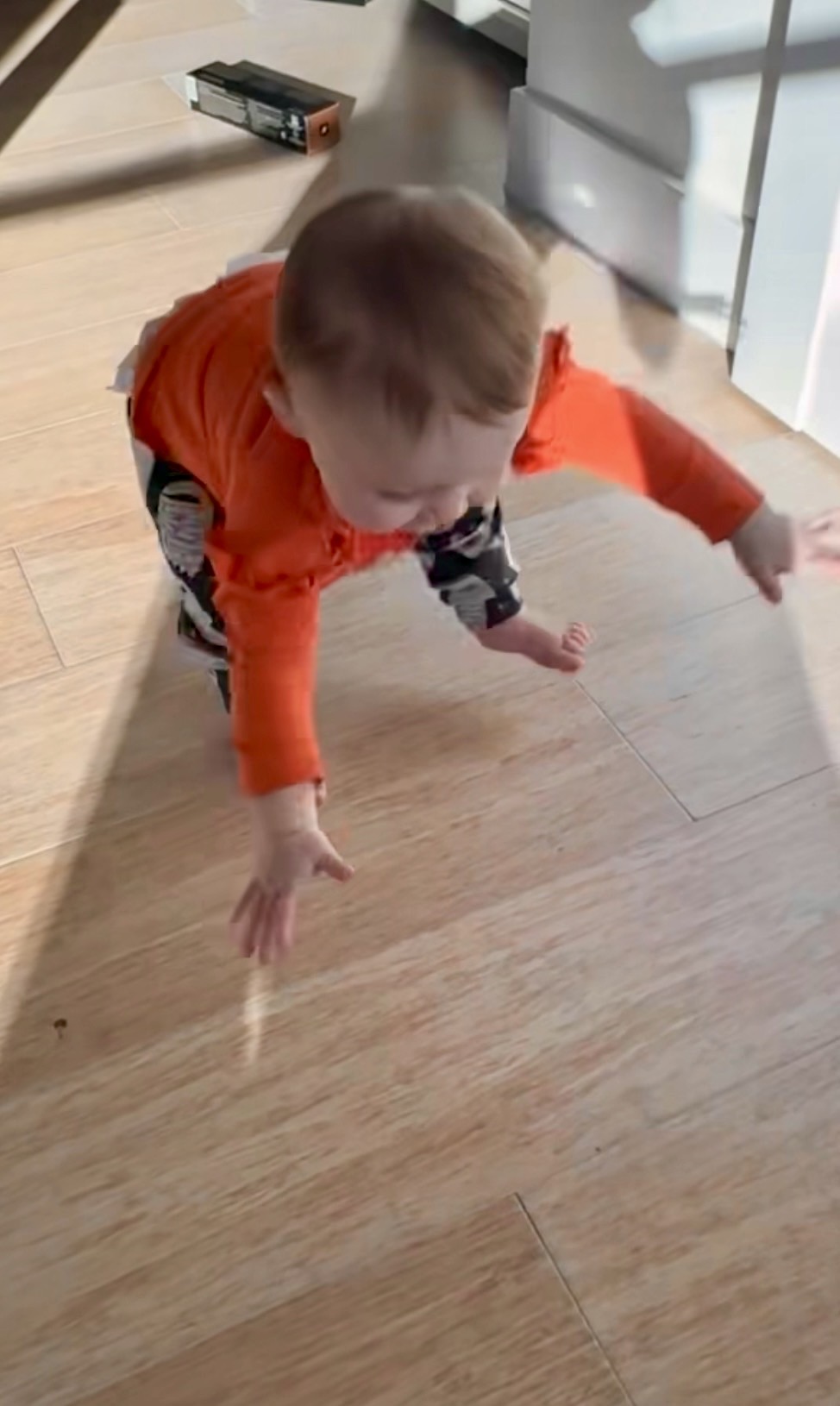

She was at the top of a boulder at the edge of the playground — not a big-for-a-toddler pebble, a real one, taller than she is and then some, with a flat top she’d hauled herself onto using footholds she’d worked out on her own. I could see her knees shaking from a few feet below. My hands came up. Not all the way up, just sort of… floated out in front of me, like they were making a decision without asking the rest of me first. The mom next to me said it: “Oh, be careful, sweetie!” in that cheerful, reflexive way that we all do. I felt the same words right there in my throat. And then I swallowed them. My hands dropped back to my sides. It took everything I had. That moment — the hover and the drop — is the whole practice of risky play and natural consequences compressed into about half a second.
That hovering-hands moment is one I live in constantly now. It’s not comfortable. It doesn’t get easier, exactly. What changes is that I’ve gotten better at recognizing that the discomfort is mine — not hers. She was concentrating. She was problem-solving in real time with her whole small body. She didn’t need me to narrate the danger. She could feel it in her knees.
She made it down. Slowly, one hand at a time, with this look of total focus that I wish I could photograph and keep. Then she hit the ground and looked up at me, and I gave her a thumbs up, and she immediately turned around to do it again. That’s the part that used to terrify me. Now it’s the part I try to hold onto.
Risky Play: There’s Actually a Name for What She Was Doing
I went down a research rabbit hole one night after I’d bitten my tongue at the park for the fourth time that week. I needed to know if I was doing something reckless or if there was actually something to this whole “let kids climb things” philosophy. That’s when I found Ellen Sandseter, a Norwegian psychologist who basically spent years just watching kids play and documenting the stuff that makes us nervous. She categorized six types of risky play — climbing high, moving fast, playing near water or fire, rough-and-tumble, playing near dangerous elements, and disappearing from your sight.
Here’s the thing that stopped me mid-tea: she wasn’t just cataloguing what she saw. She was arguing that these kinds of play aren’t side effects of childhood — they’re essential to it. Kids who skip the risky play don’t grow up braver and safer. They grow up more anxious. Their nervous systems never learn to calibrate what’s actually dangerous versus what just feels scary, so everything becomes a threat.
The research reframed something I’d been feeling but couldn’t name. The constant “be careful!” isn’t neutral — it’s us transferring our fear into their bodies when they were managing just fine with their own. I think about that every time I feel the words form in my mouth.
When do you find yourself calling out warnings at the park, and how often do you think it’s about what’s actually dangerous versus what makes you uncomfortable?
Natural Consequences: The Other Name in This Story
What I’m practicing — badly, inconsistently, but practicing — is called natural consequences. And I want to be clear that I don’t mean the parenting-book version where you say “natural consequences” as a technique while still hovering. I mean the physics version. When she climbs too high and gets scared, the fear is the feedback. It’s not a punishment. It’s not a lesson I designed. It’s just information — direct, immediate, and 100% hers. She earned it. I didn’t give it to her.
When she trips on the uneven pavement and bumps her knee, the knee is the teacher. Not me saying “I told you to slow down.” The knee. The information travels from ground to body to brain in about a second, and she files it. Kids are extraordinary at this when we let them do it. The problem is that we keep stepping in before the lesson lands. We catch them before the stumble completes. We warn them before the consequence arrives. And then we wonder why they don’t seem to learn from experience.
What’s one time you let her experience the consequence instead of protecting her from it — and what did you notice afterward?
I used to think that stepping back was passive parenting. It felt like laziness dressed up in philosophy. But here’s what I actually know now: staying out of it takes more effort than catching her. The lunge is easy. It’s automatic. Choosing not to lunge — that’s the work. That’s me actively deciding, in about half a second, that the world gets to teach this lesson instead of me. It is the most deliberate parenting choice I make all day, and I make it constantly.
The Part That Made Me Exhale
If you’re reading this with your shoulders up around your ears, here’s the part that helped me put them down. There’s solid research — Sandseter’s work included — showing what’s called an anti-phobic effect. Kids who get risky play don’t grow up more afraid of heights or speed or rough terrain. They grow up less afraid. They develop actual instincts about what’s dangerous because they’ve had real-time practice reading their own bodies in tricky situations.
There’s a newer piece of research I keep thinking about too. A 2026 study found that children willing to take physical risks in play were actually better at assessing real-world risk — they judged traffic more accurately, without making more dangerous decisions. Let that land: the kids most comfortable with risky play weren’t reckless in situations that actually mattered. They were more precise. It suggests the protective impulse might be quietly producing the opposite of what we’re aiming for.
Does that research square with what you see in your own kids, or does it feel like it contradicts your gut?
Risky Is Not the Same as Hazardous
I want to be clear about one thing, because I know how this sounds to a mom picturing the emergency room. Risky play is not the same as hazardous play. A bumped knee is risky — it’s the lesson. A car is not a lesson. A hot stove is not a lesson. Broken glass is not a lesson. Those are hazards, and hazards are mine to manage. The boulder she scaled, with a flat top and soft landing below? Risky. That same boulder over concrete, or twice the height? Hazardous. The line exists. I hold it. But I’ve had to learn where it actually is, rather than drawing it so wide that everything outside my arm’s reach becomes forbidden territory.
Here’s the Honest Part
I still lunge sometimes. My body does it before my brain checks in. And even so, I’ve started asking myself — right after — who that lunge was actually for. Because here’s the thing I keep coming back to: when I catch her before she slips, I’m the one who gets relief. The anxiety in my chest releases. I feel useful and fast and like a good mother. She gets something different. She gets the message that her body can’t be trusted. That the world will soften every landing. That she doesn’t need to read her own signals, because I’ll read them for her.
That’s a hard thing to sit with. It means that a lot of what I’ve called protection was actually about me. Not all of it — I’m not going full philosophical on myself here. And yet the more I pay attention, the more I can feel the difference between intervening because she genuinely needs me and intervening because I can’t stand the anxiety of watching her figure it out alone.
How would you describe the difference between protecting her and protecting yourself from the discomfort of watching her learn the hard way?
Stepping back is how I tell her I believe in her. I don’t say it out loud — she’s two, and the words wouldn’t land yet. But I say it with my hands at my sides. I say it every time I swallow the “be careful!” before it lands. I say it when I let the knee do the teaching and just crouch down after with a hug and no “I told you so.” It is the hardest sentence I don’t say out loud a dozen times a day: I trust you. I think you can do this. I’m right here, and I’m not going to take this from you.
About This Article

Written by Lucy Bamboo. Lucy Bamboo is a parent of two who decided her kids would grow up without AI assistants doing their thinking for them — then spent the next four years finding out how hard that actually is. She writes about homework without ChatGPT, creative projects without image generators, and the kitchen-table arguments that come with drawing those lines. Not anti-technology, just paying attention. More about this site.
Verify this against a primary source
Specifics change, and your situation may differ from the one described here. These are the authorities worth checking directly:
- AAP HealthyChildren — pediatric screen time and development guidance
- Common Sense Media — age ratings and family technology research