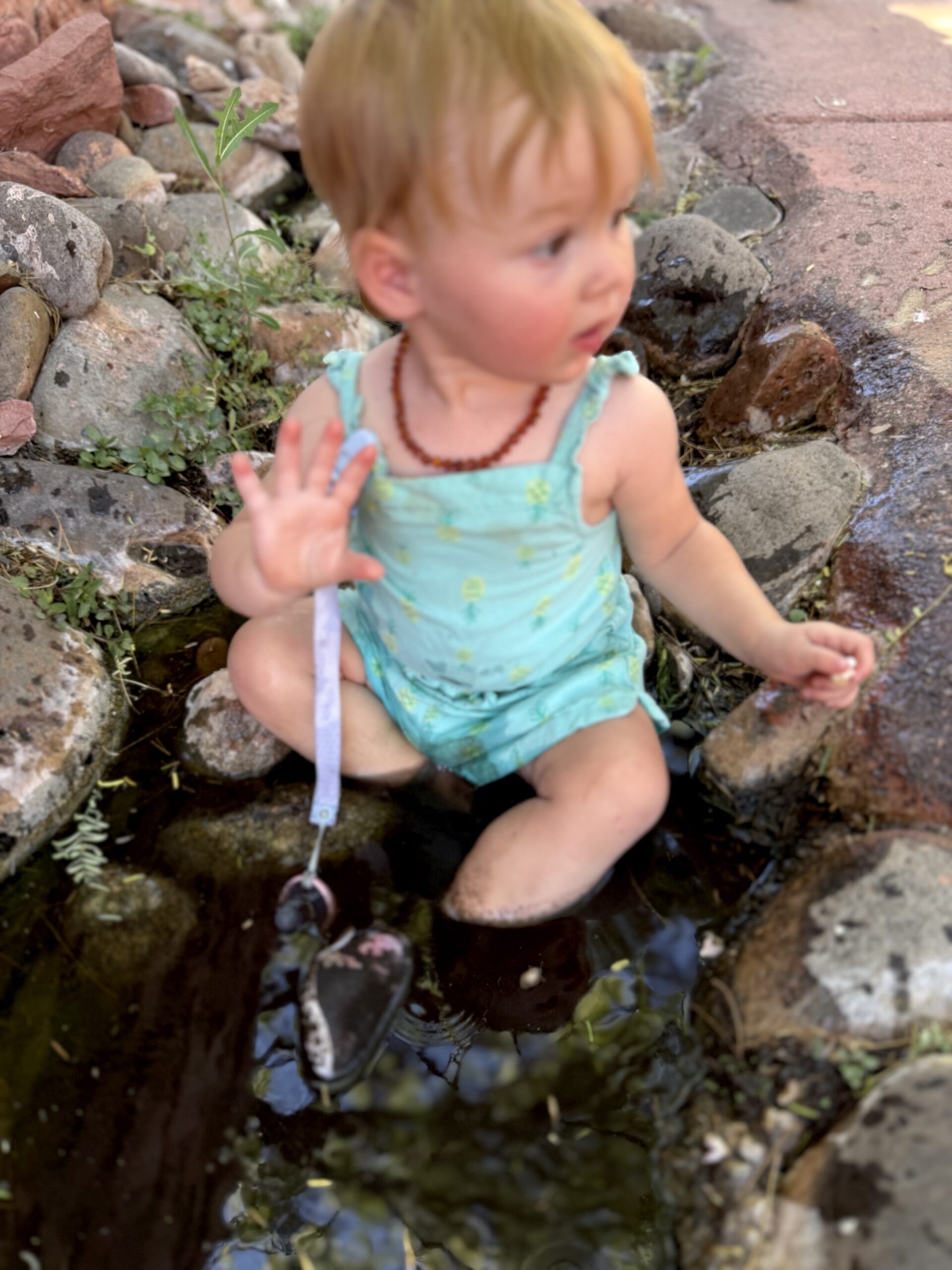

There’s a creek at Oak Creek, at the Red Rock Crossing in Sedona, Arizona, shallow and slow, with a soft muddy bank where the water goes still. Last April I took my daughter there on a whim, the day too good to stay inside, and within about ninety seconds she had lowered herself straight down into it — not the edge, not a careful toe, but sat, full-bottomed, in the mud, in the yellow dotted cotton dress I’d put real thought into. The water came up around her thighs. She put both hands in. She looked up at me with an expression of total, uncomplicated contentment, and then went back to whatever she was doing, which was nothing, and everything.
My whole body moved to lift her out. I want to tell you about the half-second where I didn’t, because that half-second is the whole thing.
She didn’t care. I cared. That gap is worth examining.
She was not uncomfortable. Not cold, not upset, not asking to be cleaned. The distress in that moment was entirely mine. She was having one of the better experiences of her week, and the only problem was the one I was importing into it.
So I made myself ask: whose discomfort is this, and is it telling me something true? When I traced it back, the urge to scrub her clean was coming from three very different places.
The first was plain disgust — that reflexive “ugh, dirty” that fires before you even think about it. It’s an old reflex built when dirt reliably meant disease, and honestly it can’t tell creek mud from something actually dangerous. It’s not real information. It’s just an alarm bell ringing.
The second was other people. A clean child reads as a competent parent. Half my urge to lift her out was about some imagined audience in my head, not about her at all.
The third is the one I keep running into on this site: the urge to manage. To improve things, tidy them up, intervene — to do something to an experience that was already complete without me.
None of those three is about her wellbeing. Two are about me, and one is about strangers.
What do you notice yourself reaching in to fix, just out of habit or nerves?
What the mud was actually doing for her
Mud has weight. It resists her hands, holds a fist-shape, then slumps — physics that water and dry sand can’t demonstrate. She was balancing on a surface that shifts and sucks and isn’t solid, which is real physical work. And mud is the most open-ended material a child can get her hands on: it becomes soup, cake, paint, road, then soup again. There is no less prescriptive thing to hand a two-year-old.
That deep, self-directed absorption she dropped into — that’s the flow that happens when no adult is steering. The single fastest way to end it is to reach in and start managing.
Do you see that kind of absorption in your own kid, and what usually interrupts it?
The part I had to look up: is the mud good for her, or just not-bad?
It turns out the mud isn’t just harmless. Researchers spent twenty-eight days enriching daycare yards with soil and forest floor, and the children’s immune markers shifted toward better regulation — more of the cells that keep the immune system from overreacting. It’s real-world support for the idea that growing up too clean is part of why allergies and autoimmune conditions have climbed in modern childhoods. Those first years are a critical window, and dirt, pets, siblings, and the outdoors are how the microbiome is meant to be built.
She wasn’t getting dirty in spite of her health. She was getting dirty for it.
Has knowing there’s actual science behind something made it easier for you to let it happen?
The one real line: wearing mud is not the same as eating it
Everything above is about mud on her — skin, hands, clothes, the incidental bit that ends up in a mouth during normal play. That’s the low-risk, probably-beneficial zone. The risk lives in eating soil deliberately. Contaminated soil can carry parasites and heavy metals, and persistent dirt-eating can signal an iron or zinc deficiency worth asking a doctor about.
A creek adds one wrinkle: moving water can carry contamination from upstream, so it sits a notch higher on the caution scale than backyard dirt. The rule I landed on isn’t “never intervene.” It’s: let her wear all the mud she wants, watch what’s actually going in her mouth, know what’s upstream, and save real intervention for the narrow cases that earn it.
Where do you draw your own lines between letting it happen and stepping in?
So I left her there
I sat down on a dry red rock a few feet away — close enough to catch her, far enough not to hover — and let her be filthy for as long as she wanted. When she was done, she stood up looking like she’d been assembled from the creek itself, reddish-brown from thigh to hem, and I carried her back to the car muddy and perfectly satisfied.
She won’t remember that afternoon. But her hands learned the weight of mud, her body learned to balance on something that moves, and her immune system met a few hundred new microbes it was built to meet. The only person who had to get over anything was me — and what I had to get over was mostly about who might be watching.
The same question — whose discomfort is this, and whose experience am I interrupting — comes up in almost everything else I’ve written here. The monitor went in the drawer for the same reason I didn’t lift her out of the creek. That’s in this essay, if you want the sleep version.
About This Article

Written by Lucy Bamboo. Lucy Bamboo is a parent of two who decided her kids would grow up without AI assistants doing their thinking for them — then spent the next four years finding out how hard that actually is. She writes about homework without ChatGPT, creative projects without image generators, and the kitchen-table arguments that come with drawing those lines. Not anti-technology, just paying attention. More about this site.
Verify this against a primary source
Specifics change, and your situation may differ from the one described here. These are the authorities worth checking directly:
- AAP HealthyChildren — pediatric screen time and development guidance
- Common Sense Media — age ratings and family technology research