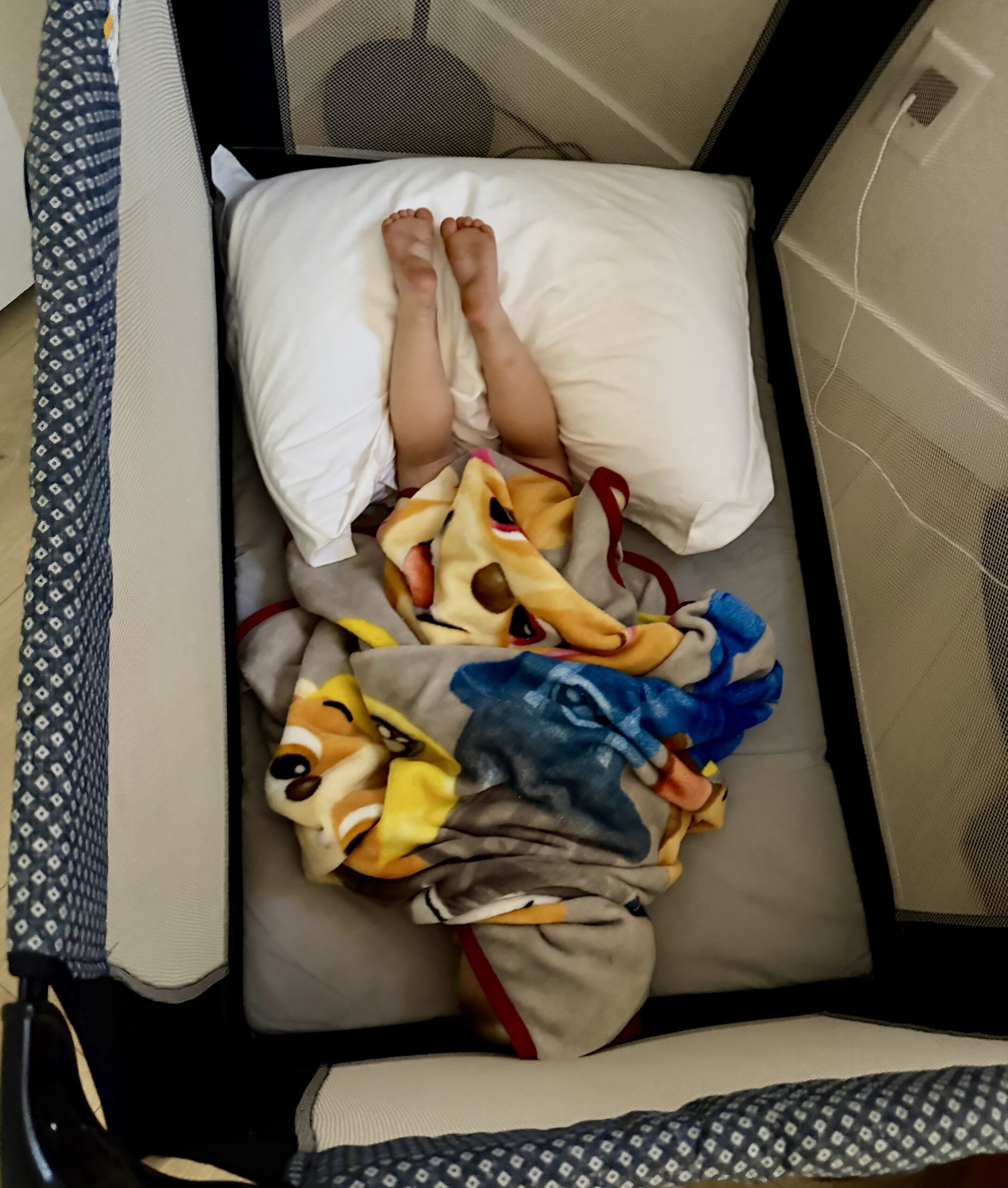
I went in to check on her and found her like this: face completely down, head buried so deep into the mattress I could not see a single feature, legs sticking entirely out from under the blanket, bare feet catching the faint light from the hallway. The cartoon animal blanket — the one with the bright bears and the improbable giraffes — was bunched into a knot beside her, not covering anything, not serving any obvious purpose. She had apparently decided against it at some point in the night and moved on. The pack-and-play held her the way a held breath holds itself: everything still, the dark mesh sides framing her, the whole small structure suddenly feeling like the most important object in the house.
The room had the specific quiet of a sleeping child — not silence exactly, but something denser than silence, the kind that has weight and temperature. It smelled like her. Warm and faintly sweet, the way small children smell when they’ve been asleep long enough for the day to fully leave them.
My first reflex was to reach for the monitor on the nightstand. Some screen that would tell me what I was already seeing with my own eyes: that she was fine, that she was breathing, that the night was proceeding exactly as nights should. I caught the reflex before my hand moved. The urge to verify was entirely mine. She was just asleep — thoroughly, completely, with the total commitment of someone who has never once worried about being asleep.
When you check on your kid at night, how often are you reaching for a device instead of just standing there in the dark?
A word before we go any further. My daughter is two. She rolled herself into that position, and for a toddler, that’s completely normal — their bodies regulate sleep position on their own. But if you’re reading this with a baby under twelve months, the rules are genuinely different: back to sleep, firm flat surface, bare crib, no loose blankets or soft objects until twelve months. That’s the AAP’s safe sleep guidance, and it belongs here at the top. Everything else I’m about to say is about toddlers.
The sleep you can’t install
There is an entire industry aimed at the bedroom of a sleeping child, and I say that as someone who has contributed to it. At two in the morning, six weeks into new parenthood, I bought a sensor that promised to track breathing through a pad slid under the mattress. I already had a video monitor. This was a second device, for the specific anxiety the first one wasn’t answering.
The market has since expanded. Smart socks that track oxygen levels. AI monitors that learn sleep patterns and send a nightly score. Apps that generate a graph of the night — light sleep, deep sleep, awake minutes — delivered like a report card you didn’t ask for but cannot stop reading.
Here’s the thing that finally clicked for me: the one room I most wanted to keep calm and dark is the room I aimed the most screens at. Every single night. Every notification, every glance, every moment I picked up the phone instead of just breathing through the 3 a.m. worry — all of it was happening in the space where I was supposed to be calming down.
What sleep gear are you using, and honestly, has it changed how you actually feel at night or just given you something else to worry about?
And consumer monitors don’t reduce the risk of sleep-related infant death — the FDA has said it, pediatricians say it. The anxiety these products treat is the parent’s. The child was never their customer.
Her body already knows how
What she does at night is not passive. She moves through sleep cycles, surfaces partway, and returns without waking. She finds a position — this one, apparently, face down and blanket-free — and stays in it. Nobody taught her this. Her nervous system worked it out.
It’s the same argument the chopsticks post was making. The implicit learning that lets a two-year-old figure out how to grip a chopstick without being shown the physics of it — that same system is running at night. Sleep is something her body does. She is not waiting for me to administer it correctly.
The monitoring impulse comes from love, and from the genuine terror of the early months. But it serves me, not her. The graph the app generates is mine — a record of my anxiety, formatted to look like data about her. The sleep is hers. Let her find her position in the dark. She already has.
How would it feel to trust that the body you made knows how to do the thing it’s been doing since birth?
Why we say she sleeps like a baby
The phrase was never really about newborns. It names what my daughter does now — drop into sleep so total you could carry her from the car to the crib, peel off her shoes, and she wouldn’t stir.
The reason is quietly astonishing: young children spend far more of the night in slow-wave sleep — the deepest, hardest-to-wake stage — than adults do. Their arousal threshold is high, and deep sleep peaks in early childhood and falls off as we age, which is exactly why a toddler sleeps through the thunderstorm that has you wide awake at 2 a.m.
And the deep sleep isn’t just rest. Roughly 70–80% of growth hormone is released during slow-wave sleep, concentrated in the first half of the night. She is literally growing while she sleeps — her brain filing everything her hands did that day into something more permanent. The label isn’t sentimental. It names something her body is doing on purpose, on a developmental clock that closes a little every year.
The analog wind-down
The screen-free bedtime routine we landed on is genuinely boring, in the best way. A dark room — genuinely dark, not dim. The cartoon-animal blanket she ignores half the time and clings to the other half. A board book, same two or three on rotation, read in the same low voice at the same pace. The body learns to read these as a sequence and starts preparing before the book is even finished.
The contrast with screens isn’t theoretical. Screen exposure before bed suppresses melatonin and delays sleep onset in young children — that’s a documented, measured effect. The light does something biochemical, and the content does something on top of that: activates attention, raises arousal, makes the transition harder. A screen before bed is working against the process. It just requires not reaching for the phone.
We’ve read Goodnight Moon so many times I can feel her body soften partway through, before we’ve reached the bowl of mush. That’s the routine working. The oldest sleep technology is a parent who reads the same book in the same low voice every night. No app required.
What would happen if your bedtime routine had nothing to measure, nothing to record, and nothing to prove?
What I actually did about it
Committing to a screen-free bedtime routine meant starting with the monitor. I put it in the nightstand drawer — not in another room, just in the drawer, face down, where I couldn’t see the green light from the bed. Then I lay there and did not check it.
The first few nights, I woke at 3 a.m. with the specific low-grade dread of someone who has misplaced something important. No number to look at, no graph, no breathing confirmation. Just the dark, and the quiet, and the understanding that she was in the next room doing exactly what she’d been doing every night of her life whether I was watching or not.
The urge to manage was real, and it was entirely mine. The sleep was entirely hers. Sitting with the difference between those two things was the actual work. The most useful thing in the room that night was a parent who let it be dark.
What’s the hardest part for you about not monitoring — the fear itself, or admitting that the monitoring never actually helped?
Face down in the pack-and-play
I stood there for another minute before I left the room. No data. No score. Just a child doing the oldest thing bodies know how to do, doing it better than I will ever do it again — face buried, blanket abandoned, bare feet catching the light, utterly committed to being asleep.
We say “sleeps like a baby” like a compliment for heavy sleepers. But it names a window — the deepest, most restorative sleep a human gets — and it is open right now, tonight, in that dark room. It closes a little more each year. The slow-wave sleep recedes. The thunderstorm starts waking her up.
Let it close on its own. It will anyway.
If you want to know what we actually keep in the room — the sleep sack, the pack-and-play, the blackout curtains, the book we’ve read two hundred times — that list is here: The Sleep Setup We Actually Use.