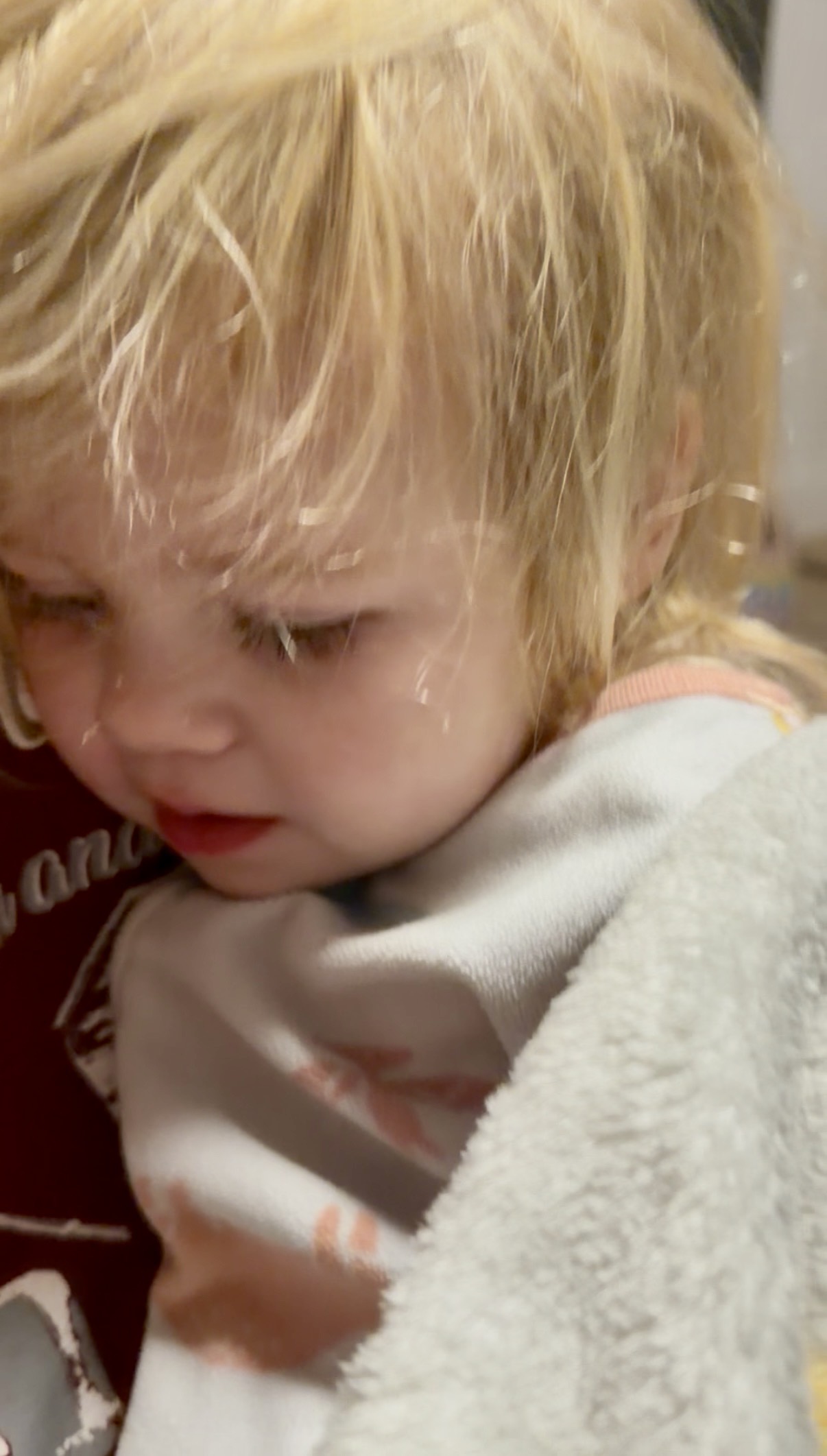

Seventeen. That’s the number I kept landing on when I went down a full rabbit hole about how toddlers learn to walk one night after my youngest had what felt like her four hundredth tumble before lunch. Seventeen falls per hour. And that’s not the number for a kid who is struggling, or tired, or wearing socks on a hardwood floor. That’s the documented baseline. That’s what learning to walk actually looks like from the inside of the data.
There’s a researcher at NYU named Karen Adolph who has basically built her career around filming babies learning to walk, and I cannot stop thinking about her work. Her lab found that new walkers take somewhere between 2,000 and 2,500 steps a day. They cover the length of roughly nine football fields. And they fall about seventeen times every hour while doing it. Not occasionally. Not on bad days. Every single hour, as a statistical baseline, while they are learning.
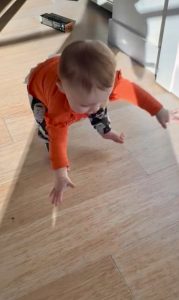
I remember sitting on the kitchen floor watching my younger one at that stage — maybe fourteen months, so proud of herself, so absolutely unsteady — and I started counting under my breath without even meaning to. And I thought: oh. This isn’t a rough patch she’ll get through. This is the thing. The falling isn’t happening despite the learning. It’s happening because of it.
How Toddlers Learn to Walk: Falling Is the Method
Here’s the thing Adolph’s work kept pointing me toward: the falls aren’t noise in the system. They’re signal. Every single time a baby goes down, her body collects a data point. Where was my center of gravity? What did that surface do that I didn’t expect? What happens when I reach for something and shift my weight? The nervous system is solving a physics problem, live, with no manual. And the only way to solve it is to run the experiment.
You cannot coach your way around this. I tried, in my first-time-mom way, with my older daughter. I would narrate things. “Bend your knees a little, baby. Watch the step. Careful, careful.” And she would look at me with those enormous patient eyes and then fall anyway. Because my words were not the data she needed. Her body needed to feel the shift, catch the correction, miss it, try again. Adolph’s research on infant locomotion makes this crystal clear: observation doesn’t transfer. Instruction doesn’t transfer. The reps have to happen inside your own body, in real time, on real ground.
That hit me harder than I expected. Because my instinct — still, even now, even knowing this — is to spot her. To hover a hand near her back. To cushion the falls. And I had to slowly, genuinely reckon with the fact that reducing the falls was reducing the learning. Not protecting her from something bad. Reducing the very input her nervous system was trying to collect.
Have you ever caught yourself doing this too — trying to prevent the very stumbles that might actually teach her something important?
The Part That Really Got Me: The Knowledge Doesn’t Transfer Between Postures
Okay, this is the part I texted three people about at ten o’clock at night. Because I thought I understood the falling thing. And then I learned about posture-specific learning and my whole framework cracked open a little.
A baby who has completely mastered going down a step on her hands and knees — who does it confidently, smoothly, every time — has to start from zero when she tries it upright. The motor knowledge doesn’t port over. It doesn’t transfer between body positions. Which means a kid who has crawled down that particular step in your living room a hundred times can stand at the top of it as a new walker and genuinely, honestly have no data. She’s not being dramatic. She’s not being difficult. She just doesn’t know yet, because she’s never done it in this body configuration, and her nervous system is too honest to pretend otherwise.
Does that change how you think about those moments when she seems suddenly scared or clumsy — like she’s regressing instead of learning something new?
I find this both completely humbling and kind of quietly amazing. The body doesn’t generalize lazily. It doesn’t say “close enough.” It requires the actual experience, in the actual posture, on the actual terrain. That specificity used to look like regression to me — why is she scared of that step again? — and now it looks like integrity. The system is being exactly as accurate as it should be. She doesn’t have the data. So she stops.
Fast Forward to the Two-Year-Old: Meet Thorndike
I did not know who Edward Thorndike was until I started trying to understand why my toddler kept doing the risky things that went fine and stopped doing the risky things that hurt her. I mean, I could observe the pattern. I just didn’t have a name for it. Thorndike named it in 1898: the law of effect. Behaviors that produce satisfying outcomes get repeated. Behaviors that produce discomfort get dropped. That’s it. That’s the whole engine.
The head-bonk, it turns out, is one of the most efficient teachers in the house. It is immediate — no delay between action and consequence. It is honest — it doesn’t depend on my mood or my consistency or whether I happened to be watching. And it is entirely hers. She owns that data in a way she will never own my anxious “be careful.” I have said “be careful” approximately ten thousand times. I’m not sure it has ever once updated her risk model. The one time she misjudged the coffee table edge, though? That updated her model immediately and permanently.
What’s one thing you’ve watched your kid learn from experience that no amount of your warnings ever could have taught her?
I want to be clear: I am not celebrating my kid getting hurt. Even so, I have found myself genuinely marveling at how good this system is. It’s calibrated. It’s responsive. It connects action to consequence in real time, in her actual body, in a way that no amount of my narration can replicate. Thorndike figured this out by watching cats in puzzle boxes. I figured it out watching my two-year-old learn the exact height at which a jump becomes a problem.
And Then There’s the Tablet
Here’s what a screen cannot do: give her the proprioceptive feedback of dropping a real block on her real foot. An app can demonstrate stacking. It can show her a cheerful animation of blocks going up and falling down. But it cannot close the loop the way the actual block does. The screen is a demonstration. It is not an experiment. And her nervous system — this beautifully calibrated, data-hungry, posture-specific system she is running around in — learns from experiments, not demonstrations. Which means the tablet isn’t just less effective. It’s a different category of thing entirely.
She’s Not Wobbly: Toddlers Learning to Walk Run the Only Experiment That Works
I counted the falls. I didn’t count them because I was worried. Honestly, I counted them because once I understood the seventeen-per-hour baseline, I needed to see it with my own eyes. And what happened when I counted was that I stopped flinching. That’s the thing I didn’t expect. I thought knowing the number might make me more anxious. Instead, it made me less. Because I wasn’t watching disaster anymore. I was watching data collection.
How might your own anxiety shift if you started thinking of her stumbles as experiments instead of emergencies?
That reframe changed how I stand in the room with her. I’m not braced. I’m not hovering with my hand six inches from her back. I’m watching someone run an experiment — patiently, relentlessly, with a sample size that would make a researcher weep with joy — and occasionally look up at me to confirm that the world is still okay. And I get to be the person who confirms that. Not the person who prevents the fall. The person who says, with my face and my posture: yes, that happened, and you’re fine, and you can try again.
Seventeen times an hour. Two thousand steps a day. A nervous system that won’t generalize, won’t accept shortcuts, and will not pretend to know something it doesn’t yet know. That’s not a kid who needs rescuing. That’s a kid who is doing the work. And honestly? Every time I remember that, I feel like I can breathe a little more, hover a little less, and just — watch. Watch her figure it out. It’s one of the more extraordinary things I’ve ever had a front-row seat to.
About This Article

Written by Lucy Bamboo. Lucy Bamboo is a parent of two who decided her kids would grow up without AI assistants doing their thinking for them — then spent the next four years finding out how hard that actually is. She writes about homework without ChatGPT, creative projects without image generators, and the kitchen-table arguments that come with drawing those lines. Not anti-technology, just paying attention. More about this site.
Verify this against a primary source
Specifics change, and your situation may differ from the one described here. These are the authorities worth checking directly:
- AAP HealthyChildren — pediatric screen time and development guidance
- Common Sense Media — age ratings and family technology research