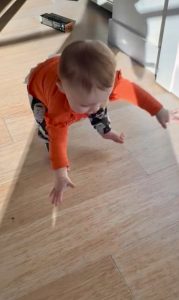
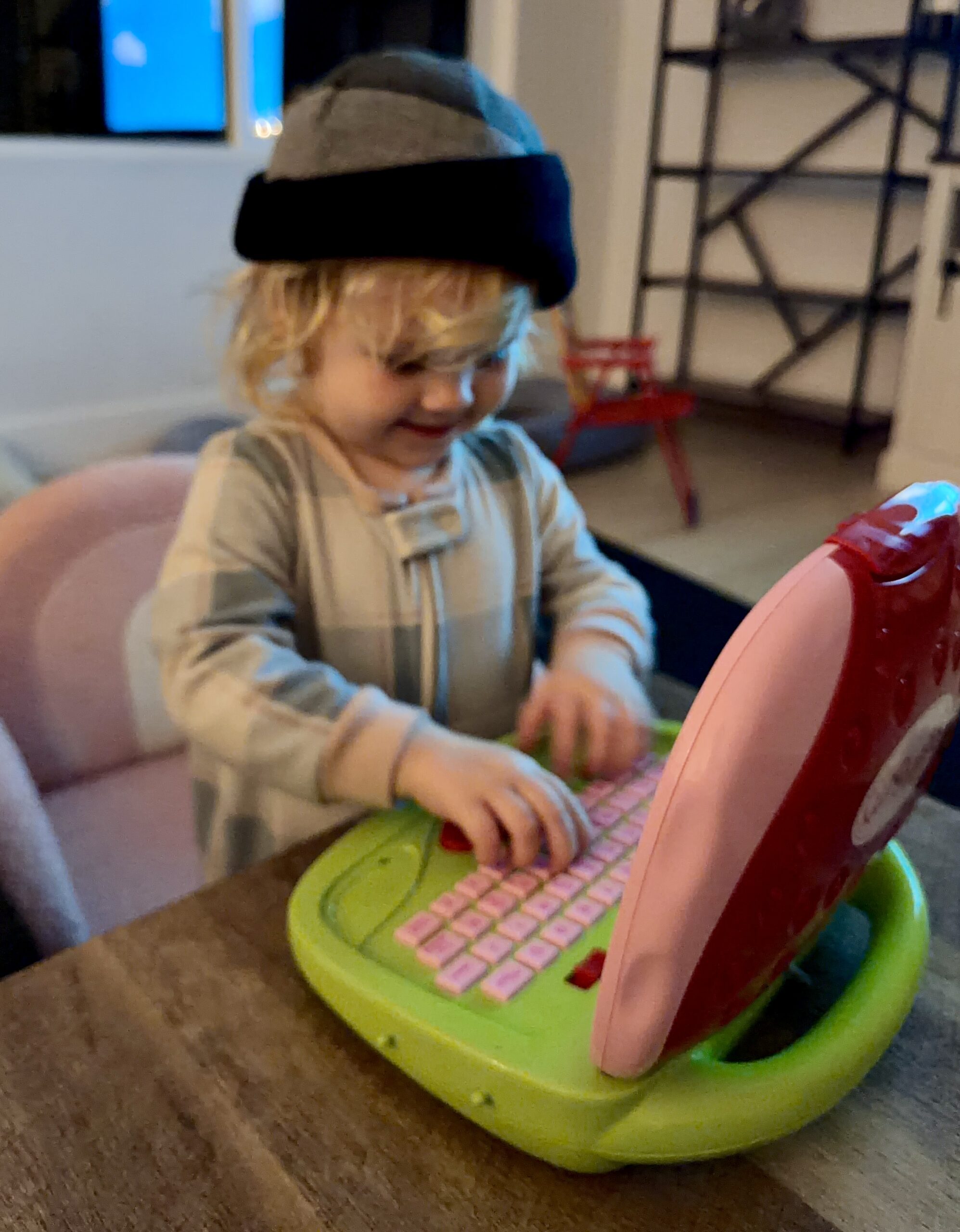
It’s 5:30. There’s a two-year-old at my feet, a baby on my hip, an onion half-chopped, and the Paw Patrol theme song coming from the next room. My daughter is parked in front of it, three feet from the stove, and for the next thirty minutes I am going to get dinner made.
I’ve written to you about wooden bears and muddy creeks. I’ve told you I put the baby monitor in a drawer. I have not, until now, mentioned the part where a screen goes on so one adult can cook for three people without the house coming down. So let me tell on myself, because I’m done treating it like a thing to hide.
For a long time I did hide it, because “screen-free” had quietly become my whole identity. Then I read what the research actually says — not the headlines, the research — and I realized I’d been apologizing for the wrong thing.
“Screen-free” was never the actual goal
The goal was always intentional. Screen-free was just the bluntest possible proxy for it — and like most blunt proxies, it’s wrong at the edges.
Content and context matter far more than raw minutes. The most consistently documented harm in the under-two research isn’t a child watching a show — it’s background television, which reliably cuts the amount and quality of talk between parent and child. There’s also a real signal that more total screen time at two and three tracks with poorer developmental screening later. But high-quality, child-centered content watched near a present parent lands very differently from a tablet handed over as a silencer.
A screen running in the background all day: harmful. A screen as a babysitter for a child who’s otherwise alone: not great. A bounded, predictable show with a parent three feet away narrating “ope, careful, hot pan” between scenes: that’s the gentlest version of screen time there is. Mine is the third kind. I’d spent two years feeling guilty about being in the safest lane on the road.
There’s a class point hiding in here too: “screen-free” is partly a luxury of staffing. Two parents, a nanny, or the money to not cook make screen-free easy to perform. A solo adult with a toddler and a baby and a dinner to make is not failing the philosophy. Intentional doesn’t mean resourced.
What would “intentional” actually look like in your own kitchen at that witching hour?Which is the better thirty minutes? I ranked my daughter’s shortlist.
Once I forgave myself for the screen, a more useful question replaced the guilt: if she’s going to watch something, what should it be? I looked at what child-development people actually say about the three shows on heaviest rotation in our house. They do not rate them equally, and the differences are worth knowing about.
Sesame Street / Elmo — the one with the deepest evidence. This is the most-researched children’s show in history, and it earned the title. A meta-analysis across fifteen countries and more than ten thousand kids found real gains in cognitive, learning, and social-emotional outcomes. It was designed from day one with educators and researchers in the loop — exactly the quality marker the research keeps pointing to. The AAP consistently singles out programs built by people who understand young minds — PBS, Sesame, Blue’s Clues — as the ones linked to better language and school readiness. If I’m optimizing, this is the strongest pick.
Bluey — the one the experts can’t stop praising. Developmental psychologists rave about it, and when I watched closely I understood why: it models exactly the things I write about here. There’s an episode where Bluey can’t ride her bike and instead of the tidy “try and instantly succeed” arc, she and her dad watch other kids struggle — and that’s the lesson. That’s my mud post. A developmental psychologist from Alison Gopnik’s lab noted that the later seasons quietly aim their epiphanies at the parents watching. It trusts kids with real emotional content — frustration, consent, an aunt’s infertility — and models co-regulation instead of perfect parenting.
Not everyone genuflects, though. At least one behavioral expert argues Bluey lets the kids run the household and that the dad gets disparaged more than is comfortable. I don’t fully agree, but it’s a good nudge to watch the thing your kid is watching yourself rather than taking the fan consensus on faith.
Does the show you’re gravitating toward actually align with what you’d want your kid internalizing — or are you just relieved it’s playing?Paw Patrol — the one my kid loves and the experts rate lowest. Her favorite is the weakest of the three. It’s fast — rapid cuts, every crisis raised and resolved in eleven minutes — and pacing and style aren’t neutral. It’s formulaic, its gender lineup is thin, and it exists substantially to sell toys. A class-action suit has accused the Paw Patrol app of using kids’ favorite characters to push purchases with manipulative design.
Two pieces of fairness: that executive-function study found it was fantastical content, not fast pace alone, that caused the effect — and it was immediate and temporary, not proven lasting damage. And that app lawsuit named the Bluey app too. The predatory app machine is a problem of the whole commercial ecosystem, not a unique Paw Patrol sin.
What I actually changed (and what I didn’t)
I didn’t quit the thirty minutes. It’s load-bearing, and the research gave me no good reason to.
What I changed was which thirty minutes. The dinner slot is Bluey or Elmo now, with Paw Patrol as the occasional Friday exception — because if a screen is going on anyway, I’d rather it be the one that models persistence than the one engineered to sell a toy. I kept myself in the room and talking. And I dropped the guilt entirely, because it was never tracking a real harm — it was tracking my self-image as a screen-free mom.
When you’re honest with yourself, what’s the screen rule actually protecting — your kid or your identity?The screen time I genuinely worry about still exists: a device handed over to end a tantrum. Background TV nobody’s watching. YouTube’s autoplay sliding from a nursery rhyme into something neither of us chose. Those are different animals from thirty co-located minutes of a vetted show while I make dinner — and collapsing all of it into one scary word kept me from seeing the difference.
What would shift in your parenting if you stopped apologizing for the difference between actual harm and mere compromise?Intentional was always the goal. Some nights it looks like a muddy creek. Some nights it looks like Bluey and a knife and a pot of water coming to a boil. I’m at peace with both.