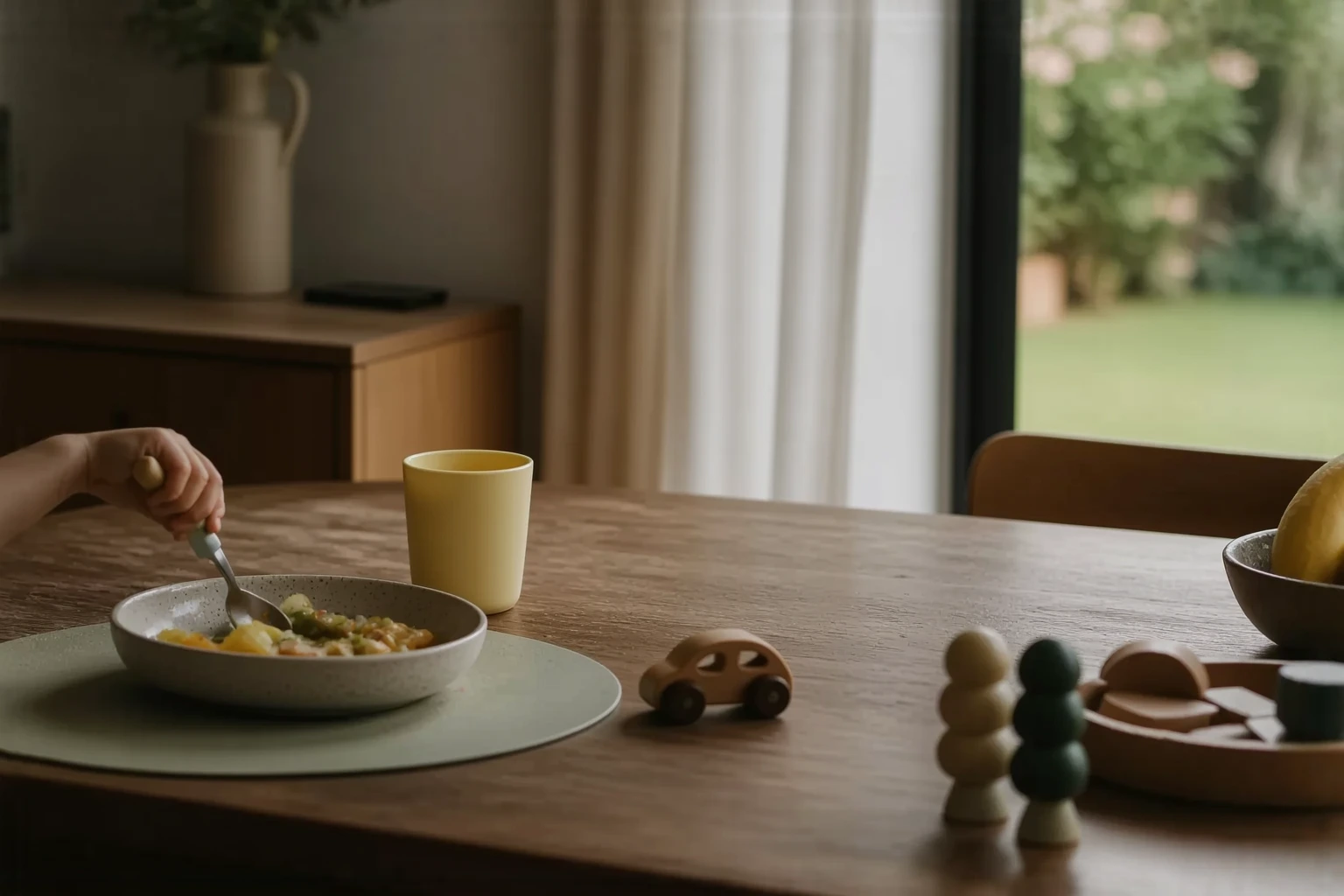

The peas went first. Not thrown exactly — more released, deliberately, over the edge of the tray with a kind of scientific detachment, one at a time, each one landing with a small tick on the kitchen tile. Maren watched each one fall. Then she looked at me. Then she looked at the place on her tray where the peas had been. Then she swept the rest off with one flat palm.
This was dinner. This was dinner without a screen on the table, which means I saw every pea go.
We’d had a tablet, before. Not always, not every night, but in the way that things accumulate — one hard evening becoming a habit becoming infrastructure. Some show about animals, usually. Maren parked in her high chair with the glow on her face, eating with reasonable compliance while my husband Dan and I ate with our eyes also trained on the screen, because of course they were, because the screen was right there, because that’s what screens do. The food got eaten. Nobody cried. It was fine. It was the specific kind of fine that makes you a little uneasy when you think about it in the dark later.
We stopped in January. Not dramatically. We just didn’t put it on one night, then didn’t the next, then it had been two weeks and we were committed in the accidental way that most real changes happen — not by decision so much as by accumulation of small non-reversals.
What followed was not some blossoming of family connection. I want to be clear about that.
The first week was loud and long. Maren, at two, does not have a lot of patience for the gap between hungry and fed, and without the screen to bridge that gap she filled it with sound. She wanted down. She wanted up. She wanted the water cup and then did not want the water cup and pushed it to the very edge of the tray with one finger, looking at me the whole time. (Reminder, if your child is self-feeding near liquids at height: make sure the high chair harness is fastened and you’re within arm’s reach — obvious, but the obvious things are the ones we forget when we’re tired and trying to get dinner on the table.) I gave her a piece of bread to hold. She held it for thirty seconds and then set it in her hair.
Dan and I ate in shifts, essentially. One of us eating while the other did maintenance — wiping, redirecting, returning the water cup from the edge. We talked, but only in the practical register: can you grab the — and she hasn’t had any protein yet and is there more of that. It was dinner as logistics operation. The candle I had lit — briefly, optimistically — got blown out by Maren, who found the flame interesting and then non-optional to extinguish, repeatedly, until I moved it to the counter.
Here is what I noticed about myself, which was harder to look at than the peas on the floor: my hand kept moving toward my phone. Not because I needed it. Not because anything urgent was happening. Just because dinner had become, in my body, a time for looking at something. The habit lived below thought. I’d feel the pull — not even as desire, more like a mild itch — and then catch it and put my hands around my water glass instead and sit with the faint weirdness of just being there.
Dan did it too. I watched him reach for his pocket twice in the first week and then pull his hand back and look slightly embarrassed, the way you look when you’ve said someone’s name wrong and both of you noticed.
This is the part nobody says out loud: the screens weren’t just for the kid. They were for us. The tablet on the table meant we didn’t have to fill every inch of the dinner hour with presence, and presence, it turns out, is not always comfortable. Being looked at by a two-year-old while she eats — really looked at, assessed, found either interesting or wanting — is its own kind of exposure. There is nowhere to go.
When did eating together start to feel like something that needed to be survived rather than simply done?
By week three, some things had shifted. Not transformed — shifted. Maren started handing us things. A piece of her quesadilla, extended across the tray toward Dan with a very serious expression, as if conducting a transaction of great importance. A torn piece of bread offered to me, taken back, offered again. She began narrating in her partial, approximate language — sounds and partial words and pointing — at things in the kitchen behind us, insisting we turn and confirm that yes, the mixer was still on the counter, yes, the plant was still in the window. She had opinions about the songs we sometimes put on in the background. She would stop eating entirely and look at the speaker when something came on that she knew.
None of this is remarkable. I know that. Kids have always done this, at dinner tables without tablets, for all of human history until about fifteen minutes ago. But it felt remarkable, which I think is its own kind of data point — about how thoroughly even a partial abdication of attention can close off the small ordinary things that only appear when there’s space for them.
In our house, for our kid, what changed most was not the quality of what she ate but the quality of what she felt like during it. This is my impression only, not a claim I can prove: she seemed less frantic when there was no screen pulling her attention into a particular fixed channel. She looked around more. She threw food less — though she still threw food, including the notable pea incident and a later event involving hummus that I will not describe in detail except to say the wall was involved. But the throwing felt different. More like experimentation than frustration. I could be wrong about all of this. I probably am, about some of it.
Dan and I started actually talking by around week four. Not about logistics. About things. It started because we had to say something, because we were sitting there, because the silence without the screen had to be filled with whatever we had. He told me about something strange a coworker had said. I told him about a paragraph I’d been trying to write all day that kept coming out wrong. Maren ate her rice with her fingers and occasionally tried to insert herself into the conversation by banging her cup on the tray, which we allowed within reason and which she found satisfying.
I don’t think dinner is fixed. I’m not even sure fixed is the right frame. Some nights it’s still a grind — the food wrong, the mood wrong, all of us ground down by the day and just trying to get to bedtime. Some nights I really, genuinely want to put something on and sit in the numbing glow of it. I don’t think that impulse is shameful. I think it’s honest.
But I also think there’s something in the friction itself. The peas on the floor, the hand pulled back from the phone, the moment when Maren holds out a piece of her food like it’s a gift — which maybe it is. The table without a screen is just a table with people at it, which sounds like nothing, and some nights feels like nothing, and other nights turns out to be exactly enough.
About This Article

Written by Lucy Bamboo. Lucy Bamboo is a parent of two who decided her kids would grow up without AI assistants doing their thinking for them — then spent the next four years finding out how hard that actually is. She writes about homework without ChatGPT, creative projects without image generators, and the kitchen-table arguments that come with drawing those lines. Not anti-technology, just paying attention. More about this site.
Verify this against a primary source
Specifics change, and your situation may differ from the one described here. These are the authorities worth checking directly:
- AAP HealthyChildren — pediatric screen time and development guidance
- Common Sense Media — age ratings and family technology research