
She stopped for the first time about four feet from our front door. Not because anything had happened — no sound, no movement — but because there was a crack in the concrete, and the crack was interesting, and that was that.
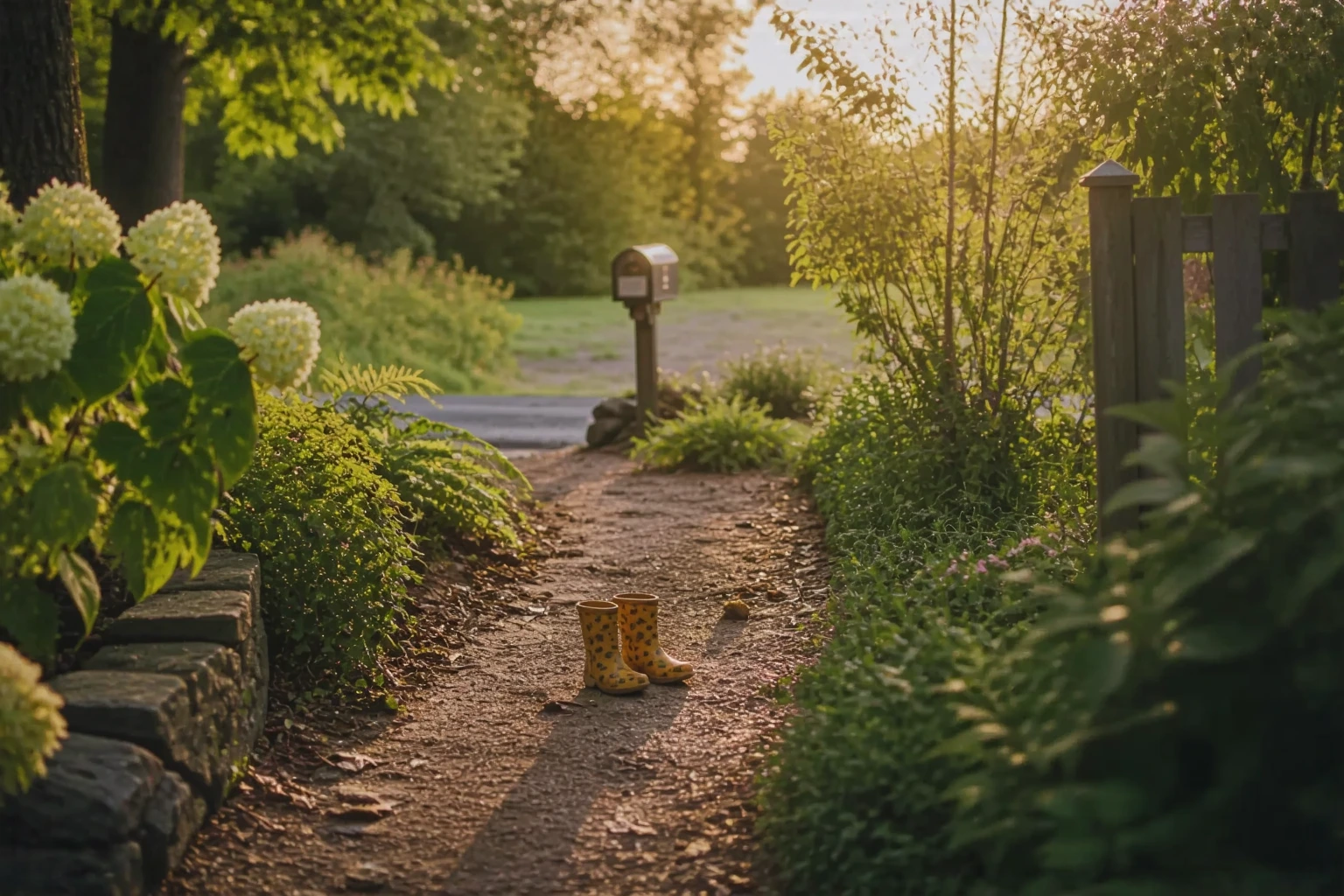
It was a Tuesday morning in late September, the air still warm but with something cooler underneath it, the way fall announces itself before you can quite name it. I had the mail key in my hand. I had maybe twelve other things I was planning to do before noon. The mailbox is at the end of our front path, past the gate, perhaps forty feet from where we were standing. I had not packed snacks. I had not mentally prepared for an expedition.
She crouched down over the crack. Her knees went wide in that particular toddler squat — the one that looks anatomically impossible for anyone over the age of four — and she put her face very close to the concrete, close enough that I thought briefly and irrationally about her nose touching the ground. She studied the crack for a long time. Then she looked up at me to confirm that I was also aware of the crack. I said yes. She looked back at the crack.
We were already behind schedule on a walk that has no schedule.
The gate is old iron, painted black so many times that the paint has become part of the metal, thick and slightly raised at the hinges. When you open it, it makes a sound — not quite a squeak, more of a low complaint, something between a creak and a groan. I have opened that gate maybe a thousand times. I have never once looked at it while I was doing it.
She stopped at the gate for four minutes. I timed it, not because I was annoyed exactly, but because I was curious how long she would actually stay. She worked the latch with both hands. She opened the gate partway, listened to it groan, closed it. Opened it. Closed it. She found the hinge where the paint had cracked and bubbled and she pressed her finger into it. She looked at her finger. She pressed it again. She looked at me, apparently to report the finding, in a language I could not parse but received anyway, something like: this texture is different from what I expected, I wanted you to know.
The paint chip that came off on her finger was very small. I watched myself want to wipe it away and then not.
There were ants on the front path, a trail of them moving along the seam where the paving stone meets the border of the garden bed. She found these after the gate. She found them by nearly stepping on them, and then stopping, the way she stops — sudden and total, all momentum simply cancelled, like a sentence that ends mid. She crouched again. She watched the ants for what I can only describe as a geologically long period of time. She did not try to touch them, which surprised me. She just watched. The ants did not alter their route for us. They had places to be.
I should tell you that I had my phone in my pocket the whole time. I want to be accurate about this. I did not take it out — I had made that particular agreement with myself before we left the house — but I was aware of it. The weight of it. The specific awareness that there was a rectangle of glass and light and unread things against my hip, and that any number of messages might be accumulating there, and that I had decided, for this walk, not to look. That decision is not free. It costs something small and dull and continuous, a low-grade itch you learn to leave alone.
When did ninety seconds become something we need to protect ourselves from?
I thought about that while she watched the ants. The honest answer, for me, is that it happened gradually and then entirely, the way most changes do. At some point — I could not locate the exact point if I tried — the pause became uncomfortable. The unscheduled moment became something to fill. I became a person who checks her phone while waiting for the kettle. Not because anything urgent is ever there, but because the habit had laid itself down so smoothly that it was no longer a choice I was making. It was just what the pause was for.
She looked up from the ants. She had found, near the edge of the path, a small brown leaf that had curled into itself and dried that way, into a shape like a tiny closed hand. She picked it up. She turned it over. She offered it to me with the mild seriousness she brings to these exchanges, and I took it and looked at it the way you look at something when someone has decided it matters. And here is the thing: it did matter, or it started to, in my hands. The curl of it. The dry weightlessness. The way it had kept its shape even after everything that had made it green was long gone.
I put it in my pocket. Not the phone pocket. The other one.
We made it to the mailbox. There was nothing in it worth mentioning — a bill, a circular, something from a vet we stopped seeing two years ago. The trip back took longer than the trip out because she had identified, on the way, a second crack that deserved a second look. She confirmed that the gate still made its sound. She checked in on the ants, who were still going, still committed to their seam in the pavement, still completely indifferent to the observation.
Back inside, I made coffee and she sat on the kitchen floor with a wooden spoon and a pot lid, doing something purposeful and loud. I thought about the fifteen minutes we had just spent. I tried to remember the last time I had looked at a gate hinge. I could not.
There is a discipline in this that I want to name plainly, because I think the word discipline is important here — not joy, not gift, not miracle. Those words are true but they let me off the hook too easily. The joy was real. But before the joy there was the moment where she stopped and I felt the first small flicker of impatience, the internal voice that noted we were forty feet from the front door and already stationary, that noted the time, that noted the phone in my pocket. The discipline was in not letting that flicker win. Not performing patience, not performing wonder, but actually staying in the forty feet. Actually looking at what she was looking at long enough for it to become interesting.
I cannot tell you this is always easy, in our house, on a given morning. Some mornings the ants are too much and I am too behind and the whole slow walk becomes something I am surviving rather than noticing. I am writing this on a Tuesday when it went well. I am trying to remember that Tuesdays when it goes well are also just Tuesdays. That the crack in the concrete will be there on the harder days too. That the gate hinge will still make its sound whether or not I am in any condition to hear it.
She is two, in our house, right now. She is not going to slow down forever. At some point the cracks will become unremarkable and the ants will just be ants and she will walk to the mailbox at something approaching adult speed with something approaching adult efficiency and I will have gotten exactly what I was impatient for all those mornings. I would like to not want that yet. I would like to keep being the person who follows her to the gate and waits while she works the latch and receives the paint chip on her finger like news.
The dry curled leaf is still in my pocket. I found it tonight when I was changing out of my jeans. Still holding its shape. Still, somehow, keeping.
About This Article

Written by Lucy Bamboo. Lucy Bamboo is a parent of two who decided her kids would grow up without AI assistants doing their thinking for them — then spent the next four years finding out how hard that actually is. She writes about homework without ChatGPT, creative projects without image generators, and the kitchen-table arguments that come with drawing those lines. Not anti-technology, just paying attention. More about this site.
Verify this against a primary source
Specifics change, and your situation may differ from the one described here. These are the authorities worth checking directly:
- AAP HealthyChildren — pediatric screen time and development guidance
- Common Sense Media — age ratings and family technology research