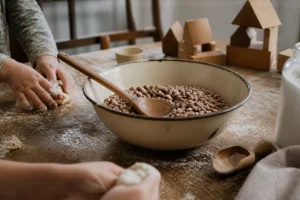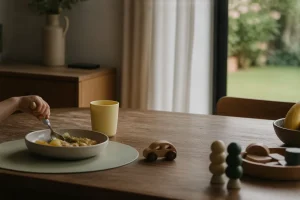

She is standing in the middle of the living room holding a wooden spoon, and she has been standing there for almost three minutes. I know because I have been watching the clock on the microwave from the kitchen doorway, which is perhaps not a thing I should admit, but there it is. The spoon came from the play kitchen, the small red one in the corner that she is usually devoted to, and now she is just holding it. Not doing anything with it. Not stirring an imaginary pot or feeding an imaginary baby or pointing it at the dog. Just holding it and looking at the middle distance with the particular expression toddlers get when they are between thoughts — mouth slightly open, eyes tracking something that isn’t in the room.
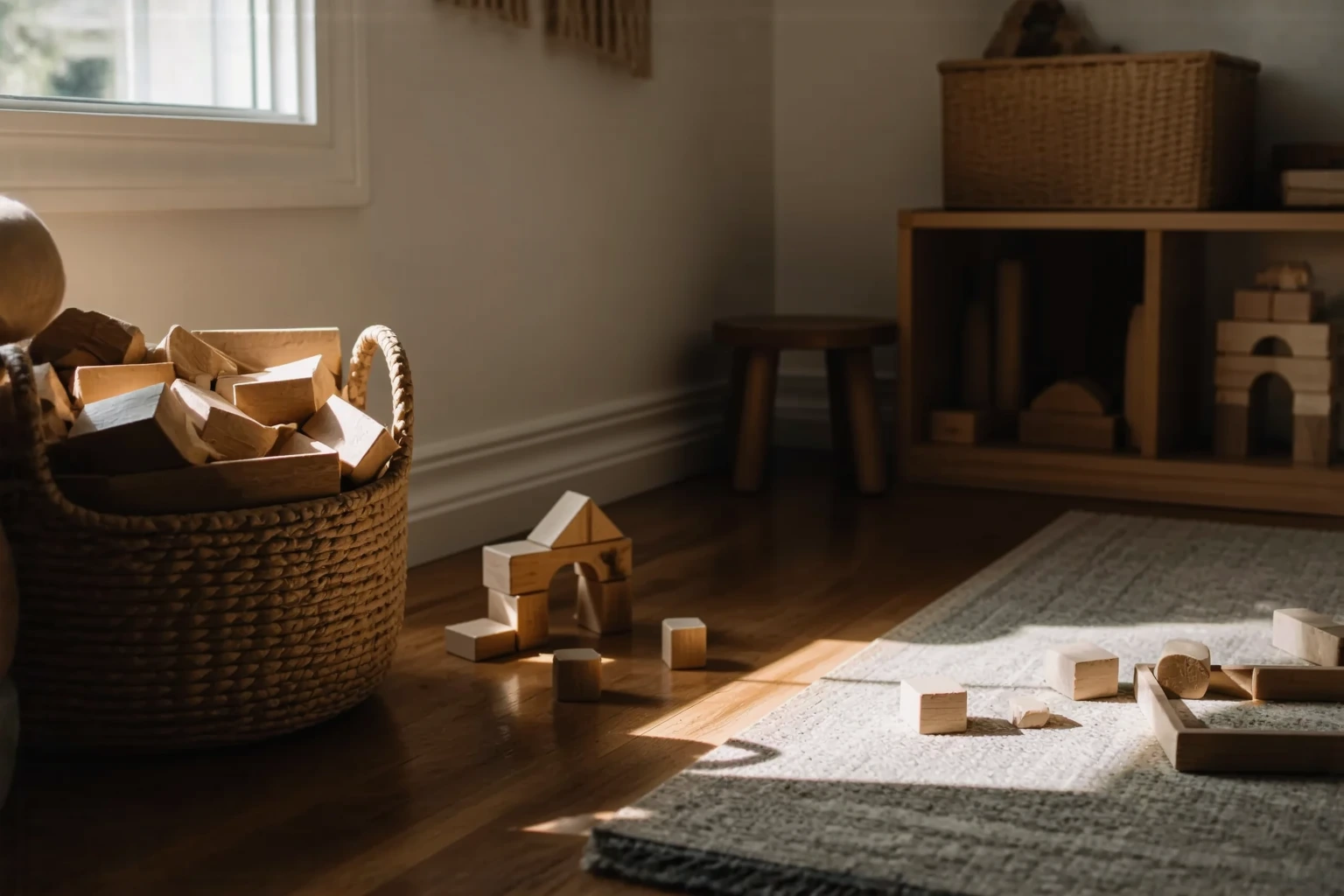
I know what she needs. I know, in the same cellular way I know when she’s getting a cold before she’s running a temperature, that something is about to happen if I don’t interrupt it. She’s going to find something. She’s right on the edge of it. I also know — this is the part where I have to be honest — that every cell in my body wants to go in there and say, Hey, do you want to make some soup? or Should we get the blocks out? or anything, really, anything to end the specific discomfort of watching a small person be at a loss.
I stay in the doorway. I hold my coffee with both hands and I stay in the doorway.
There is a particular texture to a toddler’s boredom that I did not anticipate before I had one. It isn’t quiet. It’s this low, ambient restlessness — a kind of weather system moving through the house. She makes sounds that aren’t words and picks things up and puts them down and sometimes lies flat on the floor for no reason and stares at the ceiling fan, which isn’t on. Sometimes she says Mama in the tone of a question rather than a summons, not because she wants me specifically but because she is checking, I think, whether the world is still populated. I answer. She doesn’t look at me. She goes back to the ceiling fan.
In our house — and I can only speak to our house, our particular kid, this one specific afternoon — boredom lasts somewhere between four and seven minutes before it cracks open into something else. I have timed it enough times now to trust the pattern, but trusting the pattern does not make the four to seven minutes feel short. They feel like a waiting room. They feel like the last minutes before a flight boards. I have cleaned the same section of countertop three times during those minutes just to give my hands a reason to exist.
What I have noticed is that when I fill the space — when I show up with an activity or a suggestion or even just my body, offering myself as entertainment — the thing that was about to happen doesn’t happen. She takes whatever I’ve brought instead. She’s grateful for it, or something that looks like grateful, and then twenty minutes later the restlessness is back because it was never actually resolved, only postponed. The boredom got covered over rather than passed through.
When did filling silence start to feel like an act of kindness rather than what it sometimes actually is, which is an act of relief for ourselves?
I don’t ask this to be hard on any parent, including myself. I ask it because I think about it genuinely. Because I have put on a show — I have done this, I’m not pretending otherwise — mostly so I could finish a thought or make a phone call or just not hear the low-grade hum of her restlessness for a few more minutes. Because screens work. They work immediately and completely and the quiet they produce is luxurious in a way that is hard to give up, which is the only reason a site like this one needs to exist. If it were easy, nobody would need to think about it.
Back to the living room. Back to the wooden spoon.
At some point — I can’t pinpoint the moment, I was looking at the countertop — she walks to the bookshelf and pulls out a board book, not to read it but to use it as a flat surface. She sets it on the floor. She puts the spoon on top of it. She goes back to the play kitchen and returns with a small plastic tomato and a cup with a broken handle that she has always inexplicably loved, and she arranges these things on the board book with a seriousness that I recognize from her father’s face when he’s doing something technical. She is making something. I don’t know what. I don’t think she knows what yet. She crouches over it for a long moment and then says something in the half-language she still uses, the words that are almost words, directed at the cup.
This is the thing I would have interrupted.
This is the room she found on the other side of the restlessness, and she found it herself, without me. It has its own logic, its own furniture, its own small seriousness. She plays in it for almost forty minutes, which at two years old is — in our experience — a very long time. She adds a sock at some point. She removes the book and replaces it with a coaster. She talks to the cup with increasing specificity.
I drink my cold coffee in the doorway and I watch, and I try to do the thing I find genuinely difficult, which is to believe that the watching is enough. That presence without intervention is still a form of being there. That she does not need me to make this for her, only to be close enough that the room feels safe while she figures out that it exists.
I do not always manage this. Some days I am in there before the four minutes are up, offering blocks or suggestions or myself as a distraction, and she accepts, and the afternoon moves forward in its ordinary way. I’m not sure those afternoons are worse. I genuinely don’t know. What I know is that on the afternoons I manage to wait, something specific happens that I don’t see on the afternoons I don’t — a look on her face when she first begins to play, before she notices I’m watching, that I can only describe as private. Like she’s somewhere I can’t follow. Like she has a room in her that I don’t have a key to.
I find this astonishing and also a little grief-adjacent, the way most true things about raising small people are. She is two. She already has rooms I haven’t seen.
The wooden spoon is still in there. I just checked. It’s on the coaster now, next to the cup with the broken handle, and she is asleep in the next room, blanket fully deployed for once, face actually visible. Sometime in the night she will relocate it, rearrange everything into some new configuration I’ll find in the morning before she’s awake. I’ll try not to tidy it before she sees it. I’ll try to leave the room exactly as she made it, available for whatever comes next.
About This Article

Written by Lucy Bamboo. Lucy Bamboo is a parent of two who decided her kids would grow up without AI assistants doing their thinking for them — then spent the next four years finding out how hard that actually is. She writes about homework without ChatGPT, creative projects without image generators, and the kitchen-table arguments that come with drawing those lines. Not anti-technology, just paying attention. More about this site.
Verify this against a primary source
Specifics change, and your situation may differ from the one described here. These are the authorities worth checking directly:
- AAP HealthyChildren — pediatric screen time and development guidance
- Common Sense Media — age ratings and family technology research