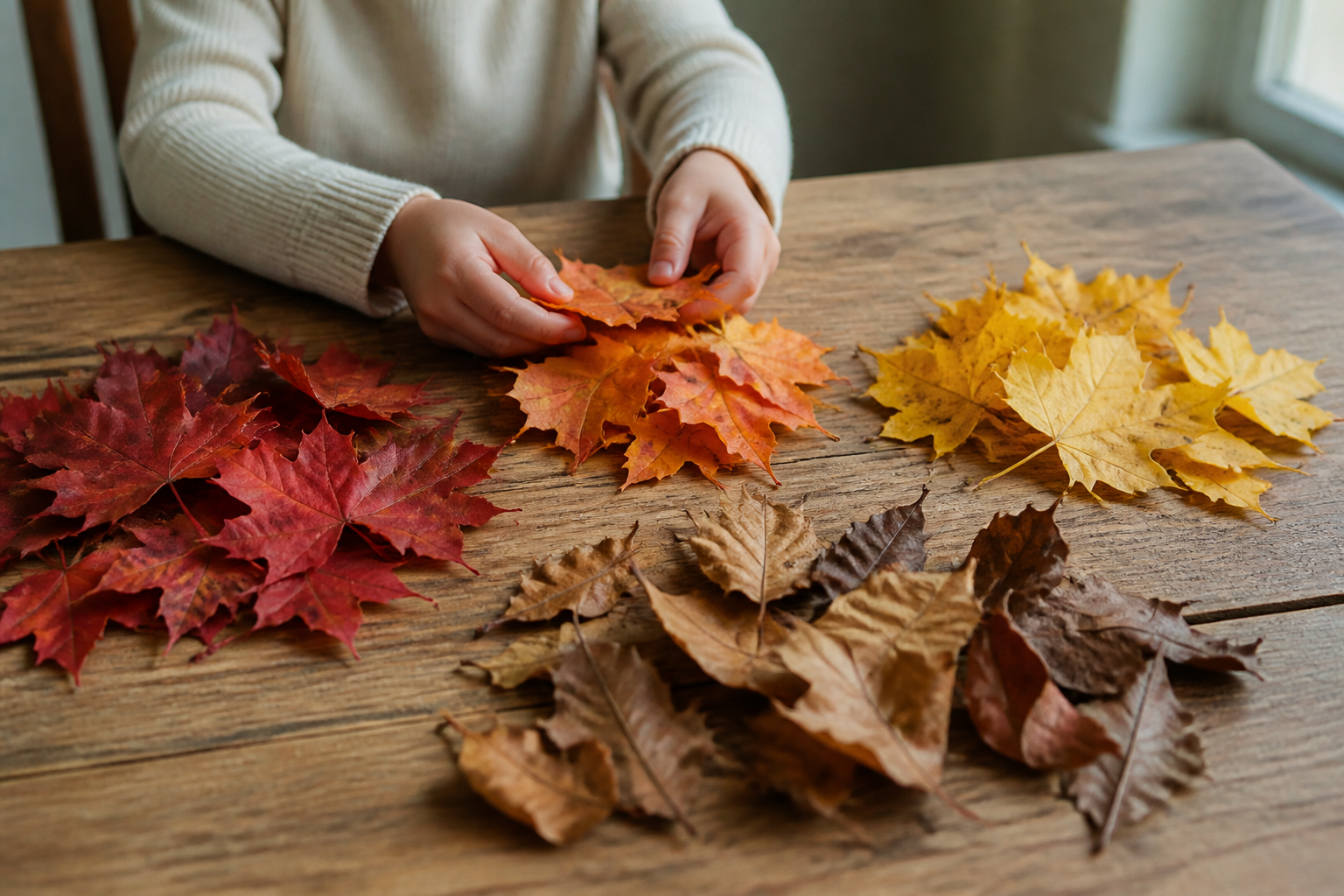

Your child comes home with pockets full of leaves. Some are crisp enough to crumble. Others are still slightly tacky. The colors range from yellow-gold to deep burgundy, and half of them are shapes you don’t have names for. Before you reach for a printed worksheet or a photo identification app, stop. That pile on your kitchen table is already doing real cognitive work—if you let it.
What’s Actually Happening in That Pile
When a child sorts leaves, they’re not just playing. They’re doing the foundational work of classification—grouping things by shared characteristics. This is how humans organize everything from animal species to grocery stores to arguments. The skills are the same whether the stakes are leaves or anything else.
But classification doesn’t happen automatically just because objects are present. It requires intention. Your child has to:
- Notice differences between similar things (these two are both red, but one has smooth edges and one has points)
- Decide what matters (am I sorting by color, or by texture, or by whether it still bends?)
- Stick to a system (if this one is “bumpy” then that one is too—and this one isn’t)
- Use language to describe what they’re seeing (finding the words for “the bumpy parts” or “kind of crinkly” or “has these little notches”)
That fourth point is crucial. Most children won’t naturally narrate what they’re sorting. They’ll make piles silently. Your role isn’t to quiz them or correct them. It’s to ask genuine questions that make them articulate their own thinking.
How to Ask Questions That Matter
There’s a difference between questions that check understanding and questions that invite it. Avoid:
- “Can you identify what kind of tree this came from?” (turns it into a test)
- “Is this one red or orange?” (yes/no shuts down thinking)
- “How many did you sort into each group?” (counts the behavior, not the thinking)
Instead, try:
- “What did you notice about the ones in that pile?” (asks them to articulate their own system)
- “Did any leaves almost go in a different group?” (reveals the edge cases—where classification gets interesting)
- “If someone else was going to keep sorting these the same way you did, what would you tell them to look for?” (asks them to teach it, which forces them to be precise)
These questions don’t have right answers. They invite your child to defend or explain their own choices. That’s the cognitive work.
Pattern Recognition Isn’t Just About Shapes
When you look at a pile of sorted leaves, you see color or size or texture. What you might miss is that your child is also recognizing what varies and what stays the same—which is pattern recognition.
Example: A child sorts all the leaves with “pointy bits sticking out” into one pile. They might not call them “serrated edges” or know the botanical term. But they’ve identified a consistent feature. Then another leaf comes along. It has one pointy bit on one side only. Does it go in the pile or not?
This is where real learning lives—in the edge cases and the decisions about exceptions.
Pattern recognition also shows up when a child rearranges the same pile three different ways. First by color. Then by size. Then by “dried out” versus “still bendy.” Each reorganization reveals that the same objects can be grouped by different features, depending on what question you’re trying to answer. That’s sophisticated thinking that doesn’t need a lesson plan.
The Language That Grows Here
Kids who sort leaves out loud—or who explain their sorting to you—are practicing descriptive language. They reach for words like “crumbly” or “bumpy” or “kind of see-through” because those words are precise in ways that “big” and “small” are not.
Over time, this habit builds vocabulary that’s actually useful, not academic. The words stick because they’re pinned to something your child can hold in their hand and see. A leaf is a better teacher than a flashcard.
When a child calls something “weird shaped,” that’s not vague—it’s an observation that something doesn’t fit the existing categories. Encourage them to say more: “Weird how? What would a non-weird version look like?” That follow-up is where the precision lives.
Why You Shouldn’t Turn It Into a Worksheet
The impulse is understandable. You see learning happening, and you think: what if we made it official? What if we added a data table, or a chart, or a “record” of what we found?
Here’s the problem: the worksheet becomes the task. The leaf collection becomes an illustration of the worksheet, rather than the worksheet being an attempt to capture the thinking that already happened.
When you ask a child to fill in a chart with leaf measurements or to number their piles or to write labels on each group, something shifts. The focus moves from “what do you notice?” to “can you fill this in correctly?” The classification stops being their system and starts being an exercise in following instructions.
This doesn’t mean you can’t write anything down. But if you do, let the child drive it. “Do you want to remember how you sorted these? How should we keep track?” If they suggest drawing it, great. If they say “take a picture,” take a picture. If they lose interest in recording it and want to move on, that’s also fine. The thinking happened. The record is optional.
What Comes After
Eventually, those leaves will dry out completely, get lost, or get swept up. That’s okay. The point isn’t to preserve them. The point was the sorting itself.
But the skills don’t disappear. A child who’s spent time genuinely classifying—asking their own questions about what belongs where—is practicing something they’ll use forever. Organizing a messy closet. Deciding what problems are similar enough to solve the same way. Understanding that the same information can be sorted by different rules depending on what you’re trying to figure out.
None of that required technology. None of it required a lesson plan. It required attention, questions, and leaves.
The Real Work: Staying Out of the Way
The hardest part of this is resisting the urge to make it official. To add structure or turn it into something that looks more educational because it has checkboxes or categories pre-drawn.
I’d start by sitting with the pile and asking one genuine question: “What did you notice?” Then listen to the answer. Ask what they’re going to do with all of it. Follow their lead.
The autumn leaf collection is already teaching. Your job isn’t to improve it—it’s to let it do what it’s built to do.
About This Article

Written by Lucy Bamboo. Lucy Bamboo is a parent of two who decided her kids would grow up without AI assistants doing their thinking for them — then spent the next four years finding out how hard that actually is. She writes about homework without ChatGPT, creative projects without image generators, and the kitchen-table arguments that come with drawing those lines. Not anti-technology, just paying attention. More about this site.
Verify this against a primary source
Specifics change, and your situation may differ from the one described here. These are the authorities worth checking directly:
- AAP HealthyChildren — pediatric screen time and development guidance
- Common Sense Media — age ratings and family technology research