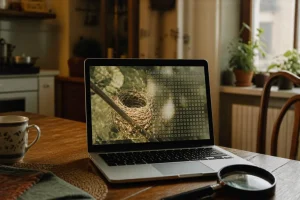

My mother-in-law’s face appeared on the laptop screen in pieces — her forehead first, then an ear, then a shoulder, while she negotiated the angle of her tablet from three thousand miles away. “Can you see me? Is this better? Wait — ” The kitchen in Oregon tilted through the frame. A refrigerator. The edge of a window with grey light behind it. Then finally her face, full and close, her reading glasses pushed up into her hair where she always keeps them, her expression already doing that particular thing it does when she’s about to see Mara — that bracing, almost pained kind of eagerness.
Mara, for her part, had wandered away from the laptop and was trying to push a wooden spoon through the handle of a colander. She had been interested in the screen for approximately forty-five seconds.
This is the video call problem, and it is not a technology problem. It is a love problem. The love is enormous and real and it cannot get through the glass.
We run a screen-light home. That phrase sounds cleaner than the reality, which is more like: we are trying, imperfectly and daily, to keep screens from becoming the default texture of Mara’s indoor life. We have reasons, and I’ve written about them elsewhere, and I’m genuinely not interested in defending them here. What I want to write about is the exception that sits in the middle of our intentions like a knot in wood: the grandparents are far away, they are getting older, and a two-year-old does not understand why the person who smells like cedar and hand lotion and who always brings the good crackers only exists, most of the time, as a voice on a phone.
We do the calls. Of course we do the calls.
What I’ve had to make peace with is what the calls actually are, as opposed to what the grandparents hope they are. My mother-in-law prepares for these calls. She has things she wants to show Mara — a book she found, the new bird feeder, the dog doing something the dog has been doing. She sits down with intention. She is present in a way that puts most of us to shame.
And Mara is present for about a minute. Then she is present for ten seconds every few minutes, when something in the audio catches her — a laugh, her own name said in a particular way, a dog bark. Then she wanders entirely into another room and I am left, me, having a lovely conversation with my mother-in-law while Mara’s muffled sounds arrive from the hallway.
I used to feel ashamed of this. I’d try to physically orient Mara back toward the screen, narrate her activities to bridge the gap, perform a cheerfulness I didn’t feel. Say hi to Grandma. Look, it’s Grandma. Grandma’s here. The here always stuck in my mouth a little, because she wasn’t here. That was the whole thing.
Here’s what I’ve come to believe, speaking only about our kid, in our house, with our particular version of this situation: Mara gets something from these calls, but it is not what we are giving her. We are trying to give her relationship continuity, the face of someone who loves her, the reassurance that her grandmother exists and is well and is thinking of her. What Mara actually receives is more ambient than that. It’s a voice she knows. A frequency. The word Grandma starting to accrue meaning the way all words do for her right now — slowly, through repetition, through the emotional weather that surrounds a word each time it’s said.
When we hung up last month and I closed the laptop, Mara came back into the room immediately — as if she’d felt the call end — and said, clearly, “Gamma.” Just that. Then went back to the colander and the spoon.
She knows. She just knows it differently than we do.
Is there a version of keeping someone present in a small child’s life that doesn’t require the child to perform the connection back to you on a schedule?
I’ve been thinking about this since the colander afternoon, and it has changed how we approach the calls, and also what we do around them.
What we do instead of performing the call
We keep them short. Shorter than feels polite, shorter than anyone wants. Fifteen minutes is about right for where Mara is right now. If the call goes longer, that’s because the adults are talking, which is fine — that’s just a phone call with a toddler loosely in the vicinity, which is a thing humans have always managed.
We do them at the same time on the same day when we can. Tuesday mornings, after breakfast, when Mara is fed and not yet in the tired-and-difficult part of the day. I cannot overstate how much the timing matters. A video call with a hungry or overtired two-year-old is a special kind of misery for everyone involved, including the grandparent on the screen who is watching a small person cry and cannot do anything about it.
We let her leave. This was the hardest thing to give ourselves permission to do. When Mara walks away from the screen, we no longer chase her. We might narrate — she’s gotten very into kitchen equipment lately, she carries this spoon everywhere — and then we talk, my mother-in-law and I, about real things. It has made the calls better for everyone. Less straining. Less performance.
And then there are the things that happen between the calls, which have come to matter more to me than the calls themselves.
My mother-in-law sends voice memos. Short ones — two minutes, three minutes — of her just talking. What she did that day. What the bird feeder brought in. A story about my husband when he was small. I play these for Mara while she’s doing something else: eating her breakfast, building her particular brand of block structure that always lists severely to one side. Mara doesn’t perform attention. She just hears the voice in the room, the way you hear music in a room, and I think something in her is absorbing it in a way that a scheduled screen appearance can’t quite reach.
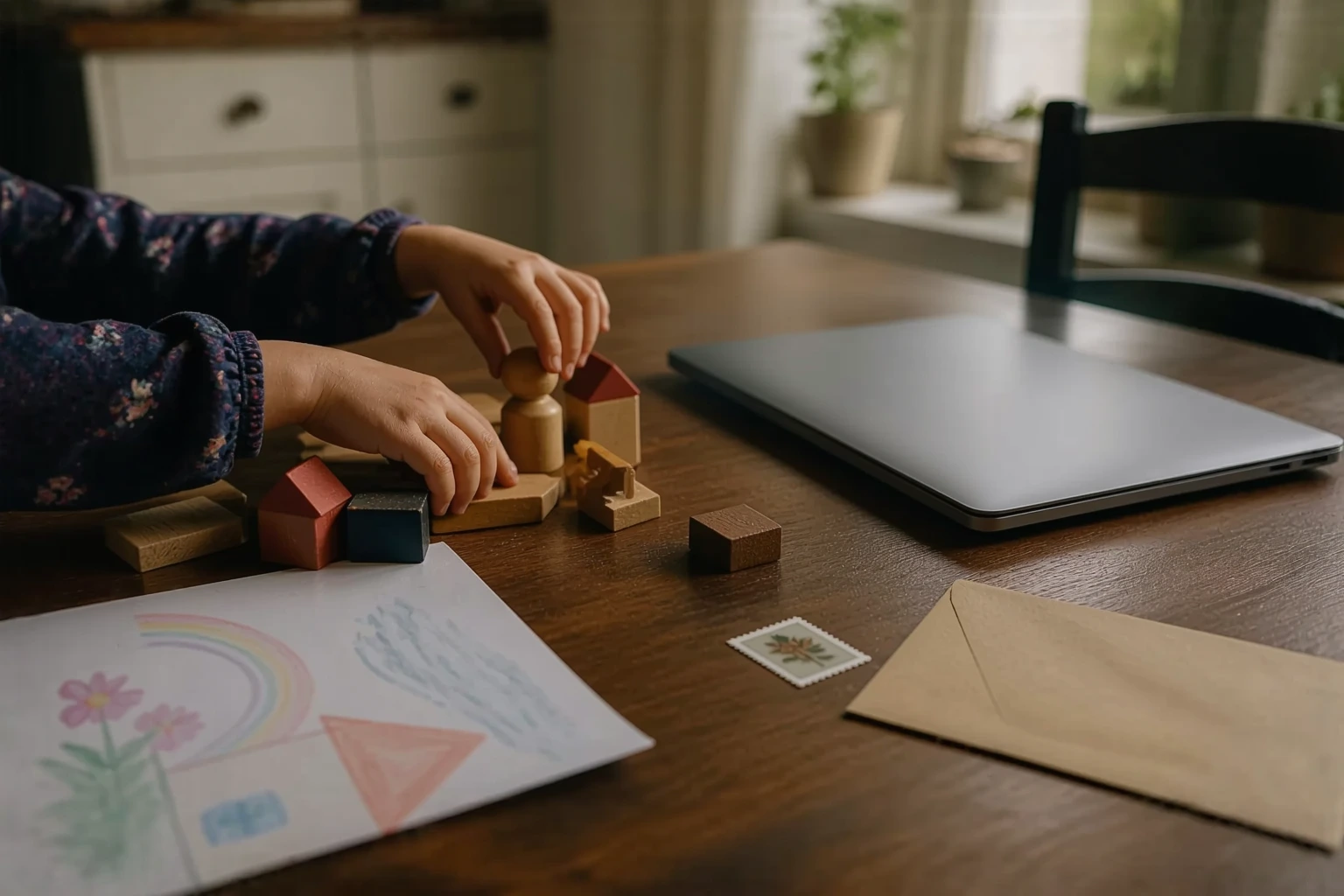
We send photographs in the post. Physical ones, printed at a drugstore, in an envelope. My mother-in-law has started doing the same back. Mara’s relationship with physical photographs is nothing like her relationship with images on a screen — she touches them, she carries them, she once tried to feed a photo of her grandmother a piece of cracker. The photo lives on the low shelf in her room now, next to the wooden elephant and the board books with the bent corners. She passes it many times a day.
Her grandmother’s face is in her room. Not behind glass. Just there, at her level, smelling faintly of the photo paper, available whenever.
None of this solves the real problem, which is geography, and which doesn’t have a solution. The video call is not a visit. The voice memo is not a voice in the kitchen. The photograph is not the hand that passes the crackers. I know this, my mother-in-law knows this, and Mara — in whatever way a two-year-old carries the shapes of things she doesn’t yet have words for — probably knows this too.
But I’ve stopped treating the screen as the only legitimate site of connection, and I’ve stopped apologizing when Mara won’t perform for it. The call ends, and I close the laptop, and Mara comes back into the room and says Gamma like she’s placing a word on a shelf for later. The photo is on her shelf. The voice is in her ears. The love is here, even when the person isn’t, moving through whatever channels it can find.
About This Article

Written by Lucy Bamboo. Lucy Bamboo is a parent of two who decided her kids would grow up without AI assistants doing their thinking for them — then spent the next four years finding out how hard that actually is. She writes about homework without ChatGPT, creative projects without image generators, and the kitchen-table arguments that come with drawing those lines. Not anti-technology, just paying attention. More about this site.
Verify this against a primary source
Specifics change, and your situation may differ from the one described here. These are the authorities worth checking directly:
- AAP HealthyChildren — pediatric screen time and development guidance
- Common Sense Media — age ratings and family technology research