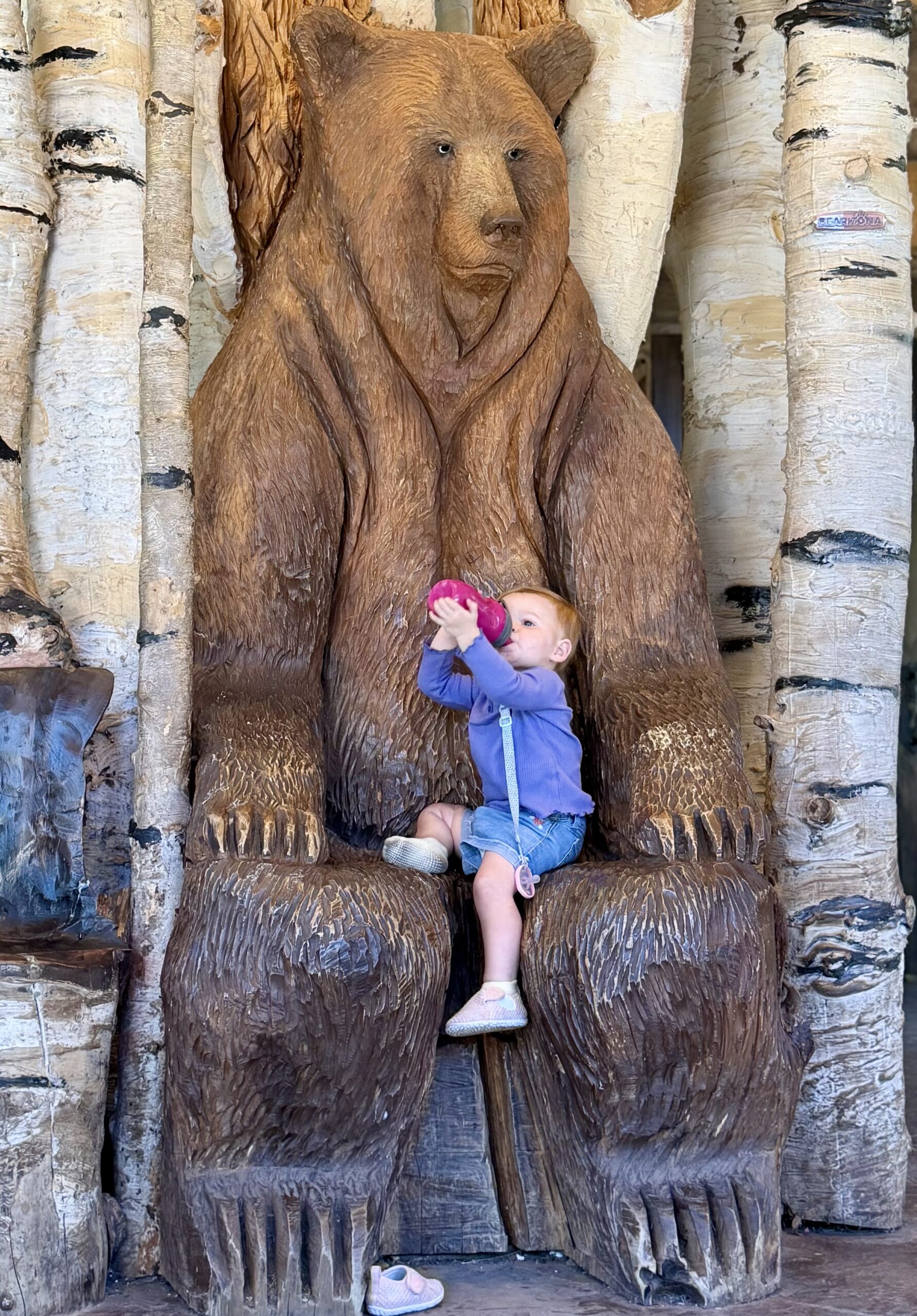
There is a carved bear in a mountain town we pass through, taller than I am, sitting forward on its haunches with its front paws curled like armrests. It’s carved from a single trunk, stained a deep amber-brown, flanked by a pair of carved birch trees so the whole thing reads as a forest scene, a place you could step into. My daughter found it before she could walk on her own. She’s two now, and on a cool morning last month, I watched her scramble up into its lap and disappear for the better part of an hour into somewhere I wasn’t invited. This is what sensory learning for toddlers actually looks like when nobody is managing it.
She was right there — I could see her small back against the bear’s chest, her hands moving. But her attention had gone somewhere else entirely. She settled back between those curled paws with her sippy cup and took a drink like she was at home, like the bear’s lap was a throne she’d claimed. She showed no interest in being photographed.
I stood maybe ten feet away, trying to look busy.
The bear tells the truth: sensory learning for toddlers through real materials
A toddler learns the world through skin before she has words for it. Texture is data — the raw material of sensory learning for toddlers. Not decoration. Data.
When my daughter puts her hands on that bear, she’s reading. The long grain runs down its shoulder. The smooth-worn patches where hundreds of children’s hands have been are burnished almost to shine, warmer in the sun than the shaded flank tucked against the birch trees. There’s a knot near its ear. A crack near its paw. Real variations.
A screen lies to her hands.
Every pixel looks like every other pixel — uniform, cool, flat. It responds to her touch, but the response is the same whether she taps gently or presses hard. No grain, no temperature change, no history you can feel. The bear gives her the world as it actually is: irregular, varied, worn in the places where it’s touched most. Her hands are smart, and they’re learning to read surfaces. She’s building a neural map of what’s real. The bear has something the screen doesn’t: truth about materials.
What textures did your hands need as a kid — do you remember anything you were always reaching for?The bear holds still so the story can move
I couldn’t see into her head while she sat there. But I could read her body.
She wasn’t being entertained. The bear was just holding still, the way objects do. And in that stillness, she was doing all the work — arranging a story, shifting to find the right position, negotiating with wood.
A screen is always performing. Always moving, always pulling toward the next thing. It does the heavy lifting; her job is just to react. The meanings come pre-made.
The bear gives her nothing. And in that nothingness, she gets to decide what the lap is — a nest, a throne, a hiding place. The wood doesn’t tell her. She tells the wood.
How hard is it for you to sit with boredom while your kid is playing — does that feel restful or do you feel like you should be doing something?What I actually did about it
Almost nothing. I didn’t narrate what was happening, didn’t film it, didn’t call her over to share the moment or help her along. I just let it be boring to me. Just a kid and a log.
Because boredom to the adult is oxygen to the child. If I’d been documenting and celebrating, the moment would have belonged to me. Her attention would have split, and the bear would have become a prop in a story about her learning. Instead, I gave her what the bear was giving her: I held still.
When’s the last time you let something your kid was doing stay private and unremarked — and how did that feel?When she finally climbed down, she didn’t come running to tell me about it. She came over, I offered her water, and we moved on. No processing. Just the quiet knowledge that her hands had learned something.
The grain stays in her hands
The warmth of a screen fades the moment she stops touching it. The texture is a lie. But the bear has grain, a history of being touched, variety and truth written into its surface. Her hands know the difference.
This is why sensory learning for toddlers demands real objects — not toys designed to teach lessons, but honest things with a history, a texture, a resistance. Logs. Rocks. Wooden blocks. Dirt. The surfaces have to be real, and the meaning has to belong to the child.
What’s one object in your house right now that has that kind of real history and texture — something that could hold a kid’s attention just by being itself?If you’re looking to give your own child something to learn from, start with the things that tell the truth to hands. If you want a starting list of the kinds of objects that have held up in our house — things with real texture, no batteries, and no pre-written story — we put four of them together: Four Real-Material Things We Keep in the House.