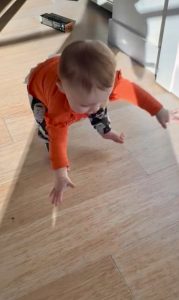
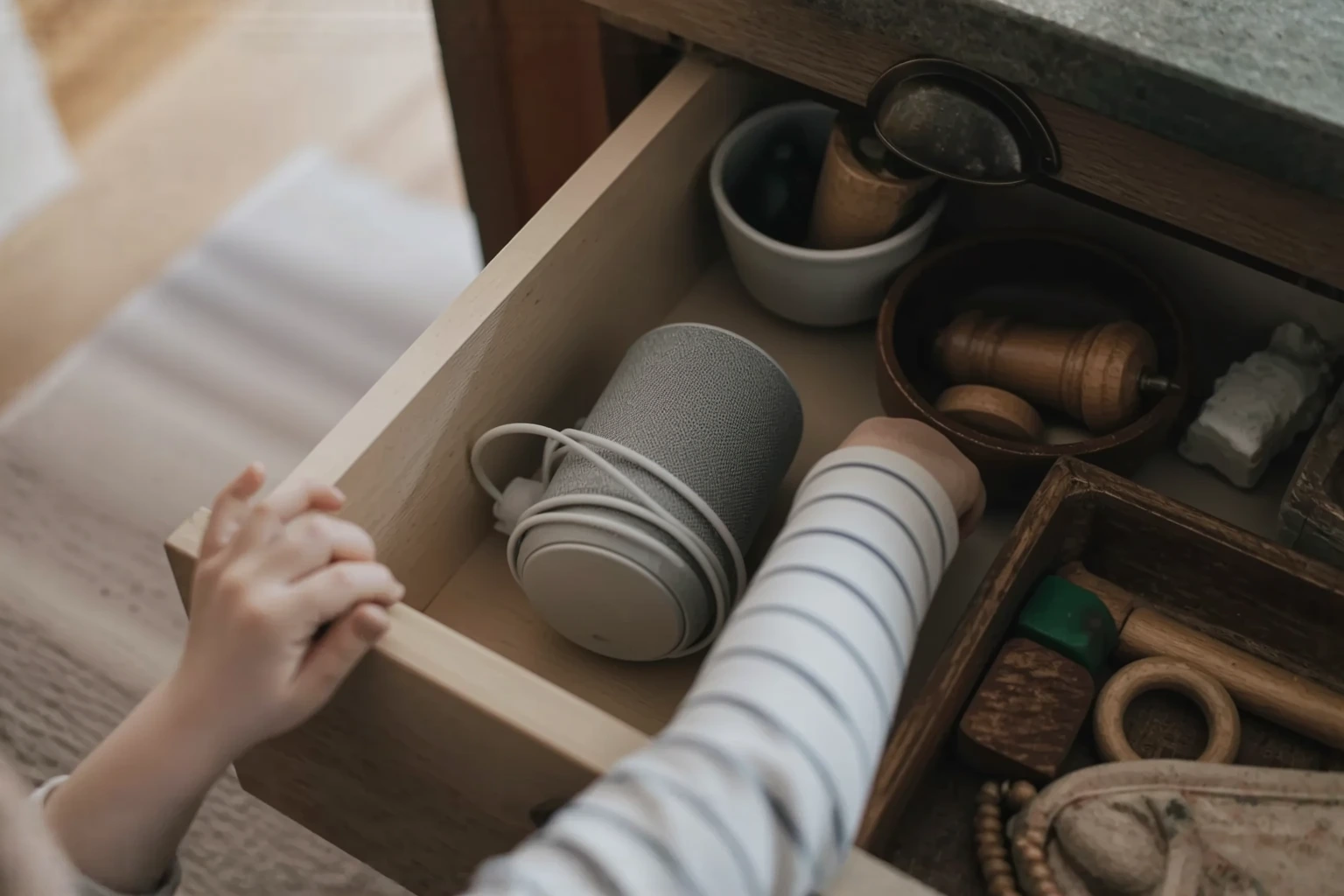

She found the old Bluetooth speaker on a shelf last Tuesday — the one we use for music, no assistant enabled — and said “Hello?” to it. Just like that, casually, the way you’d greet a person. Then she waited. I watched her face cycle through something: expectation, then confusion, then a small, philosophical shrug before she walked away to find the dog instead. She’s two. She’s already learned that some objects might answer back.
That moment is, in miniature, why I wanted to write this post. Not to alarm anyone, and not to perform virtue. But because “we limit AI” is a sentence that means nothing without specifics, and I keep realizing that even I hadn’t fully mapped the edges of what we’re actually doing. So this is the honest inventory. The definitions. The asterisks. The things I’m still working out.
A note on timing: this landscape shifts fast, and everything here reflects what I know as of July 2026. Links go to primary sources. If something has changed since I published, I’d genuinely want to know.
What I mean when I say “AI” in the context of a toddler
For the purposes of our house and this site, I’m talking about systems that generate responses, personalize content, or simulate relationship in real time — and that are designed to be interacted with directly by a child, or that passively shape what a child sees and hears. That includes: voice assistants, AI companion toys, algorithmically-driven autoplay video, and AI chatbots or tutors. It does not include: the spam filter on my email, the autocorrect on my phone, or the navigation app on our drive to the lake. That distinction — ambient AI in the infrastructure versus AI positioned as a presence for my child — is the line I’m drawing.
The no list, with reasons
No smart speakers where she can interact with them
We have a Google Home in our bedroom, disabled. The reason is less about the technology itself and more about what children believe about it. A 2023 University of Edinburgh study published in Computers and Education: Artificial Intelligence studied children aged 6 to 11 and found that about 3 in 10 believed a smart speaker could think for itself, while about 4 in 10 were unsure. The researchers described kids placing these devices in an “in-between” category — not alive, exactly, but maybe able to think or feel. The authors specifically warned that human-like design misleads children about what they’re dealing with. My daughter is two. The 6-to-11 crowd has years of context she doesn’t have yet. I’m not willing to let her form her first intuitions about minds and responsiveness around a device that mimics understanding without having any.
No AI companion toys
This one surprised me when I started looking into it. Curio’s AI plushies — marketed for children ages 3 and up — were reported in August 2025 to stream audio continuously to company servers while switched on, including background household conversation. The company says transcripts are retained for 90 days and made available to parents. I’m not saying every AI toy works this way. I’m saying that “always-listening plushie” is a category that now exists, and that I don’t want a device in my daughter’s bedroom whose core function is logging what she says and learning from it. The intimacy of a stuffed animal is precisely what makes it the wrong vessel for this kind of data relationship. We have plenty of stuffed animals. None of them are waiting for a server response.
No autoplay video, and how I spot AI-generated kids’ content
AI-generated children’s video is now being produced at industrial scale. One channel called “Jo Jo Funland” posted more than 10,000 videos in roughly seven months beginning August 2025 — about 50 videos a day. For context, Sesame Street has posted approximately 3,900 videos over 20 years. The autoplay algorithm does not distinguish between these. We don’t use autoplay. When she does watch something, I’ve learned to check for the tells: malformed hands and teeth, text on screen that’s garbled or morphs between frames, details that change inexplicably from shot to shot, narration that sounds slightly off-rhythm, and channels uploading at template-thumbnail volume every single day. These aren’t foolproof, but they’ve become part of my habit.
No AI chatbots or “learning” apps with AI backends
Common Sense Media’s guidance is clear: no AI chatbots for children 5 and under, and for ages 6 to 12, only with supervision. ZERO TO THREE, in a June 2026 FAQ specifically on AI in early childhood, put it simply: “It’s okay to wait to introduce your child to AI,” noting minimal learning benefit from AI apps and toys for children ages 0 to 3. That’s the current evidence base. We’re waiting.
The yes list — what we actually keep
Yes to video calls with grandparents
This is the most research-supported exception in our house. A 2016 study by Myers et al., published in Developmental Science, found that children aged 22 to 25 months learned new words from live, responsive video-chat partners — but not from pre-recorded video of the same content. The responsiveness is the mechanism. A grandparent who reacts to her, calls her by name, laughs at what she says — that’s a real relationship conducted over a screen, not passive consumption. The AAP’s current guidance explicitly carves out video chat as the exception to their no-screens-under-18-to-24-months recommendation. We follow that. Sunday mornings with her grandmother in Edinburgh are not screen time in any sense I’m trying to limit.
Yes to curated, co-watched video in short stretches
She’s two now, which puts us in the AAP’s guidance zone of up to one hour per day of quality content for ages 2 to 5, co-viewed with a parent. We’re usually well under that, and I’m always in the room. We pick things deliberately rather than letting an algorithm pick for us.
If you’re reading this at midnight wondering whether you’ve already made too many wrong choices — I want to ask you honestly: does any of this actually feel like the hill worth dying on in your house, with your kid, in your particular circumstances?
The honest asterisks — what we don’t claim
My husband uses AI tools at work daily. I have used AI to help outline posts, though I research and write them myself. Our car has driver-assistance features. The 2025 Common Sense Census found that 40% of U.S. children have their own tablet by age 2. I am not trying to suggest that families making different choices are harming their kids. The evidence for harm from most of these technologies in toddlers is thin — the concern is more about what we don’t yet know, and about what habits and intuitions are being formed in a period when they form fast and deep. That’s a judgment call, not a verdict.
Purity is not the point. The point is that the choices in our house are deliberate, and I can explain each one. That’s all I mean by “without AI.” Not a sealed room. An examined approach.
What this actually looks like day to day — and where I fall short
In practice: no smart speakers in any room she uses freely. The AI plushies she was gifted at her birthday are in a box in the closet — I haven’t figured out how to explain that to the relatives who gave them yet. I check YouTube channels before I let her watch anything, which adds about three minutes of friction that I sometimes resent at 6am. Autoplay is always off. Video calls are open and frequent.
Where I’m inconsistent: I sometimes hand her my phone with a music app running, and I don’t always know what algorithmic logic is behind its recommendations. I haven’t audited every app on the tablet we use for her sleep sounds. There are edges I haven’t fully examined, and I’m naming that here because the alternative — presenting this as a solved system — would be both dishonest and unhelpful. We’re making considered choices inside an infrastructure we don’t fully control. Most parents are.
Questions I keep getting
Isn’t it hypocritical to use AI yourself while keeping it from your kid?
I’ve thought about this a lot. My answer is that I distinguish between tools I use as an adult with full context about what they are, and an environment I’m creating for a two-year-old who is still forming her first intuitions about minds, relationships, and what it means for something to respond to you. I drink coffee. She doesn’t drink coffee. That’s not hypocrisy — that’s developmental appropriateness. The University of Edinburgh research finding that even children aged 6 to 11 are genuinely confused about whether smart speakers can think suggests to me that the gap between adult understanding and toddler understanding here is real and significant.
What about AI toys that are educational? Aren’t you missing out?
ZERO TO THREE’s June 2026 guidance on AI in early childhood addresses this directly, finding minimal learning benefit from AI apps and toys for children ages 0 to 3. The honest answer is: the evidence for meaningful educational benefit in this age group isn’t there yet, and the evidence for what continuous audio streaming from a child’s bedroom does to a family is also still being gathered. In that uncertainty, I’m comfortable waiting. She learns language from us, from books, from her grandmother on Sunday video calls. The gap I’d be filling with an AI toy is not obvious to me.
How do I tell if a kids’ YouTube video is AI-generated?
Look for: hands or teeth that are malformed or shift between frames, on-screen text that’s garbled or changes mid-scene, details that morph inexplicably, narration with a slightly robotic or off-rhythm quality, and physically impossible scenarios treated as normal. Channel-level red flags include uploading dozens of videos a day with template thumbnails — the “Jo Jo Funland” channel posted roughly 50 videos per day for seven months. No human creative team works at that pace. If the channel has thousands of videos and launched recently, that’s worth a second look before autoplay takes over.
Is video chat really different from other screen time?
Yes, and this is one of the better-supported findings in this whole space. The Myers et al. study in Developmental Science specifically tested children aged 22 to 25 months and found word-learning from live, contingent video chat — but not from pre-recorded video of the same content. The responsiveness is what makes it work: a real person reacting to your specific child in real time. The AAP treats video chat as a categorical exception for children under 18 to 24 months, not a loophole. For us, it’s one of the things we actively protect rather than limit.
About This Article

Written by Lucy Bamboo. Lucy Bamboo is a parent of two who decided her kids would grow up without AI assistants doing their thinking for them — then spent the next four years finding out how hard that actually is. She writes about homework without ChatGPT, creative projects without image generators, and the kitchen-table arguments that come with drawing those lines. Not anti-technology, just paying attention. More about this site.
Verify this against a primary source
Specifics change, and your situation may differ from the one described here. These are the authorities worth checking directly:
- AAP HealthyChildren — pediatric screen time and development guidance
- Common Sense Media — age ratings and family technology research