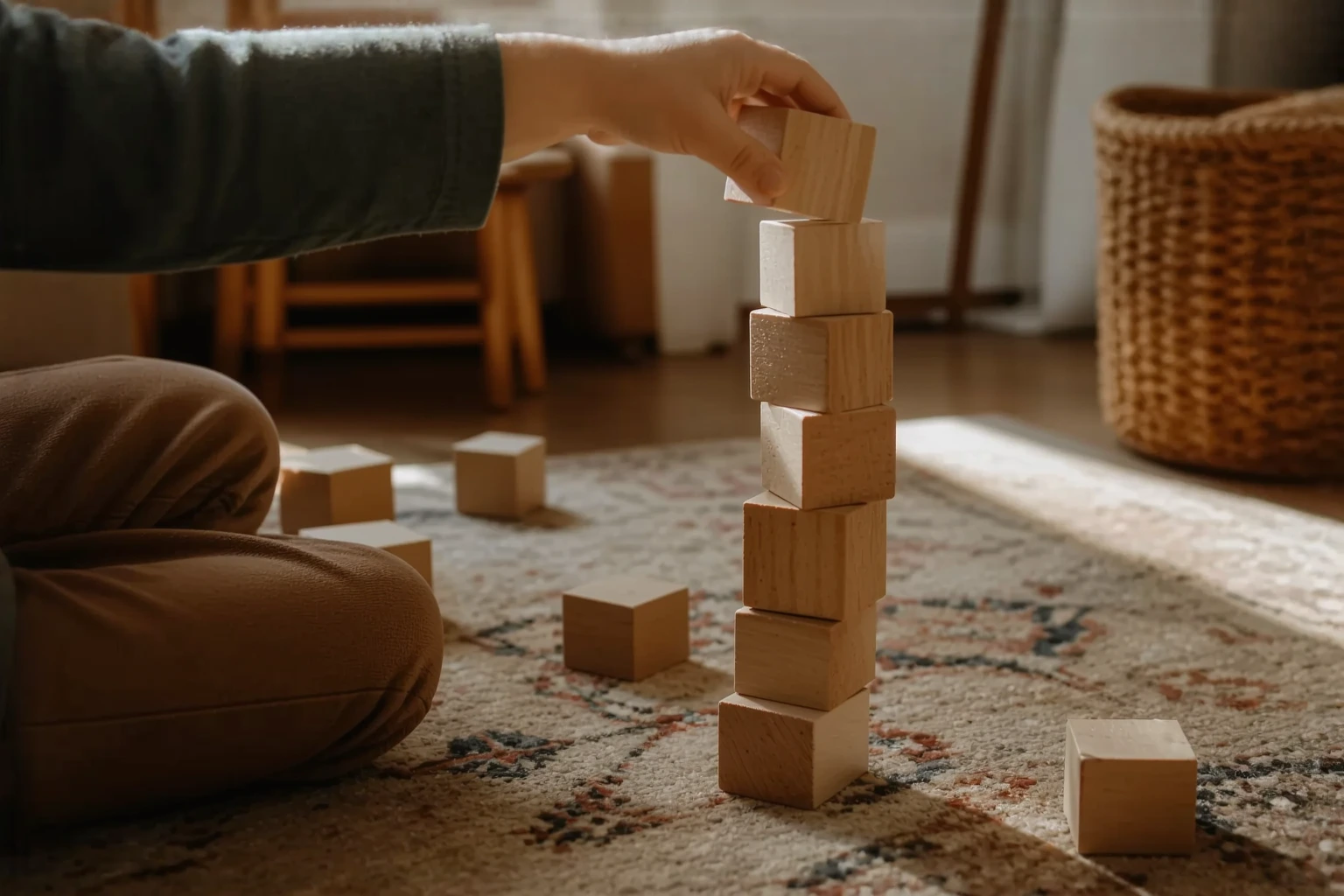

The blocks had been on the floor for three days before she touched them. They sat in the corner of the living room where I had arranged them — hopefully, a little foolishly — into a low tower, an invitation. She walked past them to get to the laundry basket, which she was very interested in at the time. She walked past them to reach the dog’s water bowl. She walked past them approximately forty times over the course of those three days, and I stood in the kitchen doorway watching her not play with them, thinking about the money, thinking about the reviews I had read.
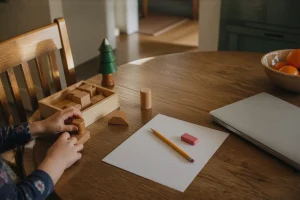
On the fourth morning she sat down beside them without any apparent reason and picked one up. A plain rectangular hardwood block, unfinished maple, the size of a deck of cards. She turned it over in both hands. She put it on the floor, picked up another, put that one on top of the first. Then she looked up at me with the expression she uses for things that have surprised her, which is the same expression she uses for things that have not surprised her at all, and I still cannot always tell the difference.
That was four months ago. The blocks are now one of maybe three things in this house that consistently work.
I want to be honest about what I mean by “work,” because it’s not what the packaging promises. It’s not sustained independent play for stretches of time long enough to finish a cup of coffee. It’s not developmental leaps I can point to. It’s more modest than that: she comes back to them. Day after day, she finds something new to do with the same objects. That, in our house, is the whole definition of a good toy.
I spent a long time before buying trying to figure out what kind of blocks to get, and the information available is genuinely confusing. There are sets with letters, sets with numbers, sets with animals carved into the sides, sets that are pastel and round-edged and look like something from a Scandinavian design catalog, sets made of foam, sets made of plastic that technically call themselves blocks. What I eventually landed on, after a lot of reading and second-guessing, was plain hardwood unit blocks — the kind that have no decoration whatsoever, just the weight and the grain and the fact of the wood itself. No faces. No themes. Nothing telling her what to imagine.
This was not immediately popular. For those first three days she ignored them entirely while showing sustained enthusiasm for a cardboard toilet paper tube she found under the bathroom sink. I kept my mouth shut about that.
What actually gets used
The pieces she reaches for most are the basic rectangles and squares. In unit block sets these are usually proportional to each other — two squares make one rectangle, two rectangles make a longer one — so they stack and balance in ways that reinforce each other without her knowing that’s what’s happening. For a two-year-old, I think the proportional thing matters less than the weight. These blocks are heavy enough to feel like something real. They clack against each other when they fall. They don’t bounce. When the tower goes over, it goes over with a sound and a consequence, and she finds this completely satisfying in a way that foam blocks simply cannot replicate.
Size matters more than I expected. The standard unit block rectangle — roughly five and a half inches by two and three-quarter inches — is almost exactly right for her hands right now. She can grip one in each hand without dropping it, can carry two or three stacked against her chest. The smaller pieces, the little cubes, mostly get ignored unless she’s filling something in, closing a gap. The largest pieces — the long boards, the double-unit planks — she uses differently, as roads mostly, or as walls, laid flat on the floor rather than stacked.
Finish: the set I bought is lightly sanded but not sealed or painted. There’s a faint smell of raw wood that’s mostly faded now. The blocks pick up small dents and dings from being dropped on our hardwood floor, and she seems unbothered by this, and I have become unbothered by this. If you want something that will stay pristine, get something sealed. But for actual daily use, the unfinished wood has held up better than I expected, and I like that she can feel the grain under her fingers.
Do you find yourself buying things you need them to love, rather than things you’ve watched them actually reach for?
I ask because I did this badly with the themed set I bought first — a wooden animal safari collection, each block printed with a bright painted creature, clearly designed to catch a child’s eye in a photograph. She picked up the giraffe block once, mouthed it briefly, and set it down. That was the full engagement. The painting, I think, closed something off. The block was already something. It didn’t need her to make it into anything.
What I’d tell you about quantity
Fewer than you think. This is the piece of advice I wish someone had given me plainly, without hedging. We have thirty-two pieces total. That sounds like a lot written out, but it fits in a canvas bin and doesn’t take over the room, and she has never once seemed to need more of them. What I’ve noticed — in our house, with our kid — is that more pieces don’t extend the play, they just extend the setup and the cleanup. Thirty-two is enough to build something real. It’s not so many that the getting-out-of-the-bin part defeats her before she starts.
A note on cleanup and safety: she is two, which means the blocks go in her mouth sometimes. The unfinished ones I bought are certified non-toxic and I checked that specifically before purchasing. Wooden blocks are a choking risk for children under three depending on piece size — the small cubes in some sets are genuinely small enough to be a concern. Check piece sizes before you buy, watch your specific child, and make your own call. I am not going to pretend I have this perfectly managed. I am in the room. That’s mostly what I’ve got.
What got ignored
The themed safari blocks, as mentioned. A set of small colored cubes that were too light — they slid instead of stacking, and she lost patience with them in under a minute. A set of cardboard blocks that arrived slightly crushed in shipping and never quite recovered their shape. Two large foam cubes that she sat on, then used as a step stool, then stopped acknowledging as objects at all.
The pattern in the failures, if there is one: anything too light, too decorated, or too soft. She seems to want things that behave predictably. That push back a little. That require something from her hands.
Last week she built a low flat enclosure out of the rectangular blocks, arranged them carefully in a rectangle on the living room rug, and then went and got her small stuffed rabbit and put it inside. She stood back and looked at it. Then she got a second stuffed animal and put that inside too. Then she sat down next to the enclosure, not touching it, just being near it, the way you sit next to something you made when you want to stay in the world of it a little longer.
I was standing in the kitchen doorway, again. The afternoon light was coming through the front window at that low winter angle that makes everything look more significant than it probably is, and I let myself think it was significant anyway. She had built a place. She had decided what belonged inside it. Nobody had told her what to make.
That’s what I was hoping for when I bought the blocks. It took four months and a little faith and a lot of walking past them to get there. I think that’s probably about right.
About This Article

Written by Lucy Bamboo. Lucy Bamboo is a parent of two who decided her kids would grow up without AI assistants doing their thinking for them — then spent the next four years finding out how hard that actually is. She writes about homework without ChatGPT, creative projects without image generators, and the kitchen-table arguments that come with drawing those lines. Not anti-technology, just paying attention. More about this site.
Verify this against a primary source
Specifics change, and your situation may differ from the one described here. These are the authorities worth checking directly:
- AAP HealthyChildren — pediatric screen time and development guidance
- Common Sense Media — age ratings and family technology research