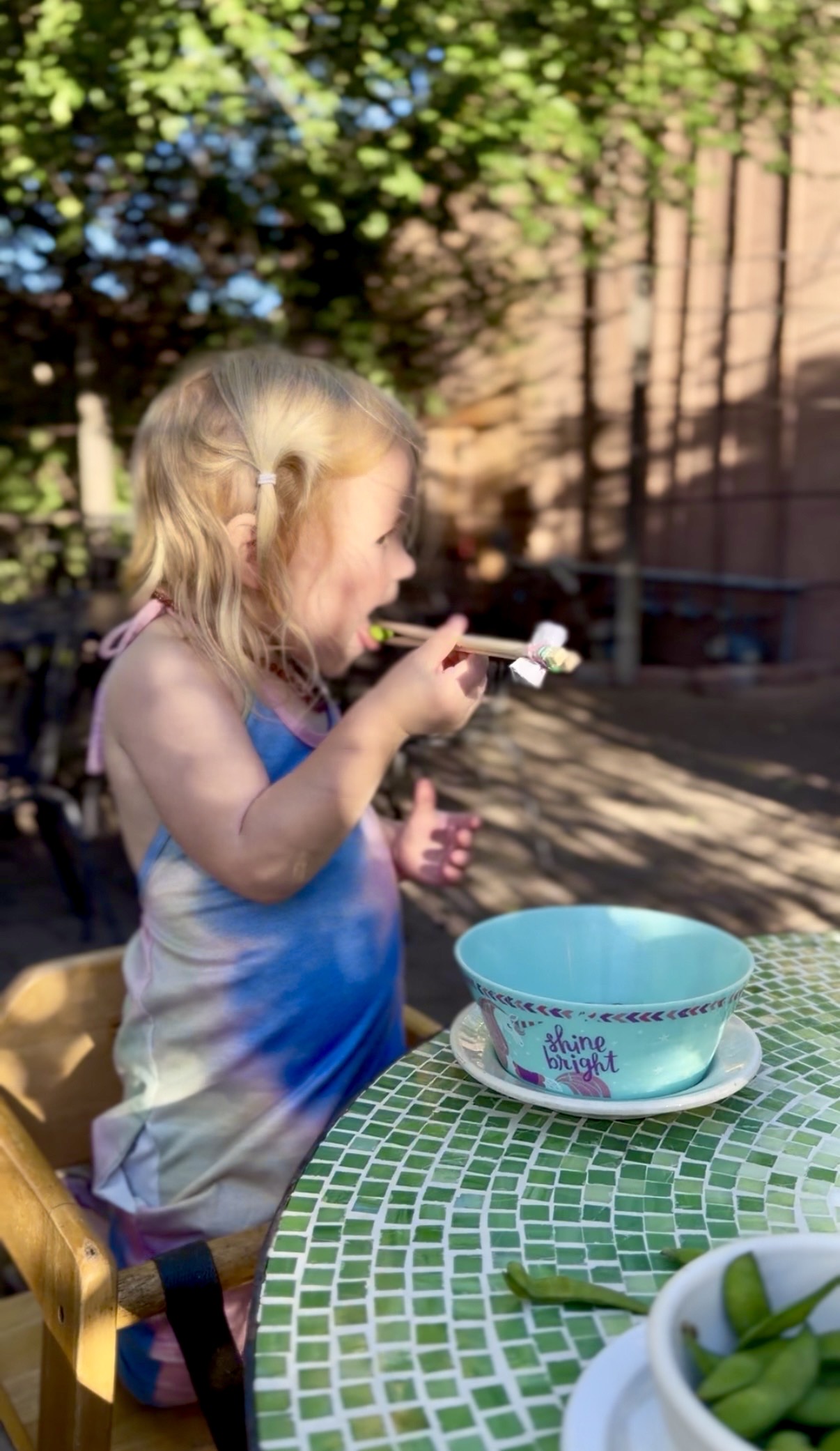

We were at Pho King Good, the Vietnamese restaurant where my daughter has eaten since she was four months old, strapped to me in a carrier. She’s two now — right in the middle of the most intense phase of toddler motor development she will ever experience. That night, she reached across the table for my chopsticks.
This is what she always does: reaches for what the adults have. It’s not a request. It’s an assertion. That’s mine now.
I gave her a child-sized pair. She grabbed one in each hand. Wrong. She stared at them for maybe five seconds, dropped the right one, watched me hold both in one hand, and shifted both into her left. Thumbs underneath. Not the way you’d teach it.
Then she tried to close them on a piece of soft tofu.
She didn’t pick it up. But the closing motion — the coordinated flex of thumb and two fingers, the timing, the whole sequence — was right. Completely self-taught. Ninety seconds from first grip to a recognizable chopstick-closing.
I watched her set the chopsticks down and felt something I didn’t expect: awe at the sheer work her brain was doing. Not effort — she looked relaxed, concentrated. Construction. A nervous system literally building the neural pathways for this thing, in real time, with no instruction available to her.
This is what development looks like from the inside.
The Motor Cortex at Age Two Is Not Finishing—It’s Beginning
We talk about motor milestones like they follow a neat template: gross motor first, fine motor settles in, and by school age you’re done. That’s half the story, told at the wrong time. The truth is messier and more interesting. At two, your child’s brain isn’t wrapping things up — it’s in the wildest, most explosive phase of building movement skills it will ever have.
Synaptogenesis — the explosive formation of connections between neurons — in the motor cortex peaks in the first two years of life. At age two, a child’s brain is still in the most volatile, most plastic phase of motor development. The pruning of unnecessary synapses has barely begun. What’s happening is pure addition: the brain is building the hardware for precise movement at a rate that will never be this fast again.
Myelination and the Speed of Early Learning
At the same time, the corticospinal tract is rapidly myelinating during the second year of life. Myelin is the fatty coating that turns a rough sketch of a motor pathway into a functioning circuit. At two, your child’s motor pathways are being wrapped in that insulation right now, in response to what her body is actually doing.
When my daughter figured out chopsticks in 90 seconds, her corticospinal tract was actively myelinating around the specific movement patterns she’d just asked her body to perform. The motor cortex reorganizes around repeated new skills over days and weeks of practice — not the years it takes an adult. That night was the beginning of that process.
What kinds of movement challenges are already in your home that your two-year-old watches you do without thinking about it?
The Pincer Grip Is Not Consolidated—It’s Emerging
My daughter developed a pincer grip around 13 months. She’s been using it for nine months now — which means she’s still refining it. Every time she picks up a pea or scribbles with a crayon, she’s not using an established skill. She’s building it.
In-hand manipulation develops progressively through the toddler years — the ability to hold something stable with one or two fingers while moving the others is not something a two-year-old has yet. She’s in the middle of acquiring it.
Chopsticks are a genuinely advanced challenge for this reason. They require:
- Opposition of the thumb to multiple fingers simultaneously
- Stabilization of one stick (the anchor) while the other moves (the active stick)
- Finger individuation—the ability to move fingers independently rather than as a unit
- Coordinated flexion and extension across multiple joints at different rates
These are leading-edge challenges for a two-year-old nervous system. She attempted them because she wanted to do what the adults were doing, and her brain was plastic enough to extract the pattern in real time.
Have you noticed your toddler getting frustrated with a motor task one week, then suddenly able to do it the next — with no practice from you?
The Role of Imitation in a Pre-Language Motor System
My daughter didn’t learn to use chopsticks in isolation. She’s watched us use them monthly for her entire conscious life — the hand position, the wrist angle, the opening and closing motion, hundreds of times. Her mirror neuron system has been encoding that pattern since she was an infant.
At two, a child is almost entirely learning through imitation, because explicit instruction isn’t neurologically available yet. You cannot tell a two-year-old, “Keep the anchor stick still while you move the other one.” She can’t translate words into motor commands that way.
Implicit Learning: How Toddlers Actually Acquire Motor Patterns
Children acquire motor patterns entirely implicitly — without conscious awareness, without being able to articulate what they’re learning. She watches, her mirror neurons fire, her motor cortex registers the pattern, and when she tries, her brain attempts to reproduce what it observed.
This is why her grip corrected itself when she looked at my hands. She wasn’t thinking about it. She was seeing it, and her motor system was adjusting to match. At two, you are a creature of observation and imitation, and your nervous system will extract patterns from the world faster than explicit instruction could ever deliver them.
Where in your daily life does your child see you doing something with genuine focus and intention — not for performance, just because you’re actually doing it?
What This Moment Reveals About Childhood Development
Sitting in that restaurant, I wasn’t watching a cute milestone. I was watching her nervous system encounter a new motor challenge, extract the pattern from observation, and begin encoding it into her neural tissue — no instruction, no language, just a two-year-old brain in full construction mode.
What This Means for Intentional Parenting
This is relevant to parenting, and to intentional technology use, in a specific way: a two-year-old’s job is to observe and imitate. To be around people doing real things with real tools. To watch closely, try clumsily, fail without shame, and try again.
She doesn’t need a video about chopsticks. She needs to sit at a table where chopsticks are being used, often enough that the pattern becomes part of her implicit knowledge. Then she needs to reach for them and fail and adjust and try again.
That work cannot be rushed, optimized through instruction, or delivered by a screen. It has to happen in the body, in real time, in response to real challenges, under the child’s own direction.
When’s the last time you let your toddler watch you do something difficult, without narrating it or teaching it, and just… let her figure it out if she wanted to?
My daughter didn’t lift the tofu. That will take months. But in 90 seconds, her brain had begun the work of making her capable of it — not the polished skill, but the raw moment of construction. That’s what a two-year-old brain, in the middle of its most explosive developmental period, actually does.
If you want to try this at home, we tested four sets of training chopsticks and put together a short buying guide — what to look for, what we skipped, and which ones a two-year-old will actually want to use: Training Chopsticks for Toddlers: A Buying Guide.