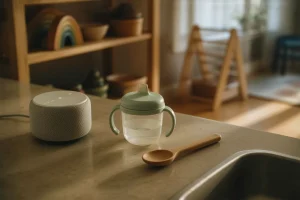

She was standing at my knee, holding a wooden spoon she had carried from the kitchen for reasons known only to her, and she was watching my face. Not asking for anything. Not making a sound. Just watching the light from my phone move across my eyes while I stood at the counter and scrolled through nothing, through absolutely nothing — a cascade of images I could not have described four seconds after seeing them. The wooden spoon hung at her side. She waited.
I don’t know how long she’d been there. That’s the part I keep returning to.
We made a decision, before Nora was born, to keep screens out of her life for as long as felt honest and possible. No shows on the iPad to get through dinner. No YouTube in the car. No phone propped in front of her on the high chair tray so we could have five uninterrupted minutes of a meal. I believed in this. I still believe in it. I wrote about it here, earnestly and at length. What I somehow failed to fully account for was the screen I was already holding in my hand approximately six hundred times a day, pressing to life with one thumb while I half-watched her play.
The wooden spoon moment was November. She was twenty-six months old. I put the phone face-down on the counter and crouched to her level and she offered me the spoon very seriously, as if it were the thing we had both been waiting for, and I took it, and I thought: she has been trying to reach me. Through the glass of me.
I want to be careful here, because it is very easy to write this kind of essay in a way that feels like performance. Look how I noticed. Look how I changed. That is not what this is, or at least I’m trying for it not to be. The truth is messier: I am still a person who depends on her phone in ways I haven’t fully mapped, and the fact that I’ve made one structural adjustment does not mean I’ve solved anything. I’ve just moved the problem to where I can see it.
But let me stay in the scenes for a moment, because the scenes are where the actual information lives.
She caught me twice more before I made the change. Once when I was sitting on the floor of her room during what was supposed to be free play, my back against the toddler bed, theoretically present, actually somewhere inside my phone reading an article I cannot remember about a topic I cannot name. She climbed into my lap, reached up, and physically turned my face toward hers with both her small hands. The gesture was not aggressive. It was just precise. Here, it said. This way.
The second time was at the park. She had done something with the wood chips — built some small pile that mattered enormously to her — and she looked up to show me and I was standing eight feet away looking at my phone and she said Mama in the specific tone that means she has been saying it for a while already.
I keep using the word caught because that is exactly what it felt like. Not guilty, exactly. Caught.
What I Actually Did
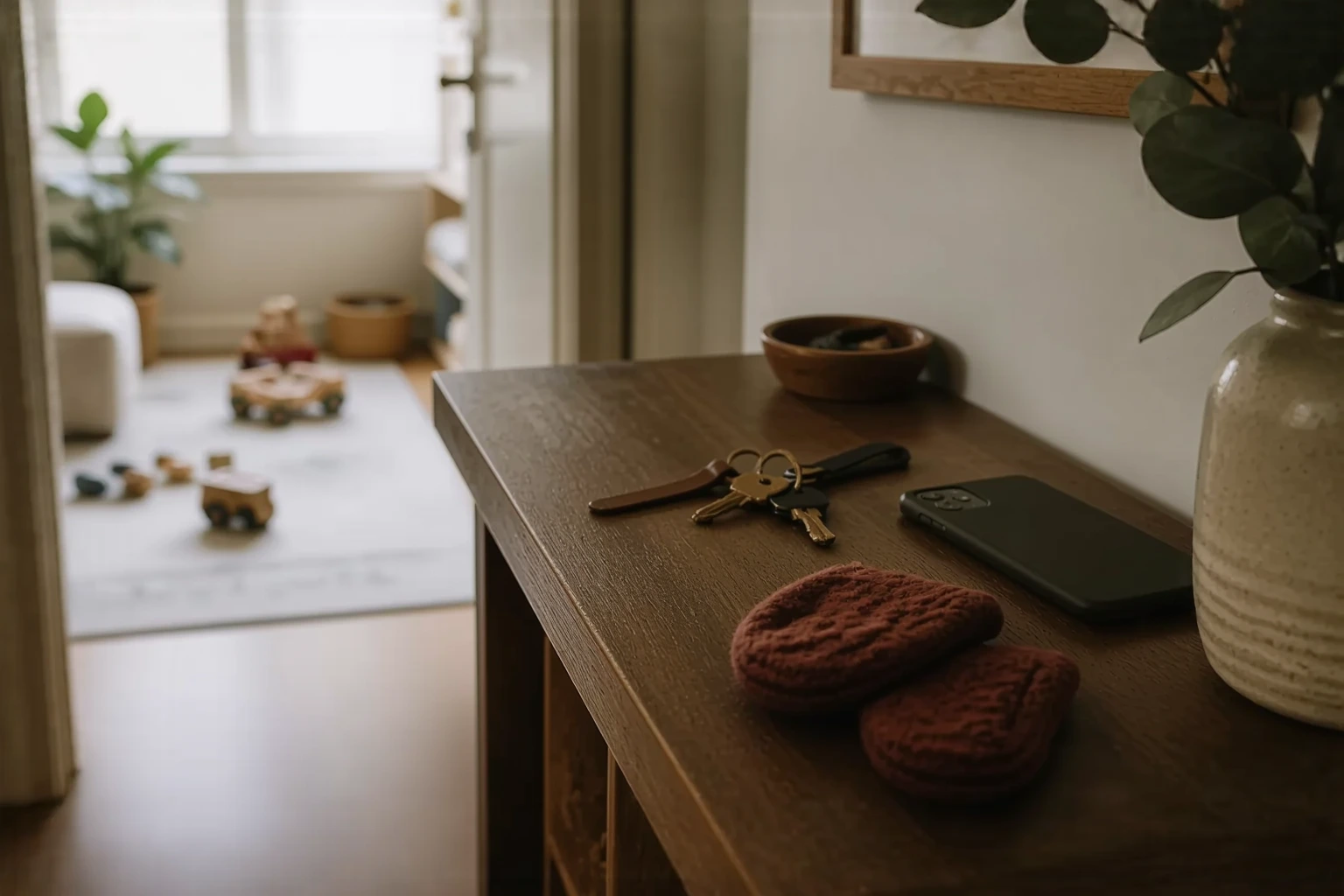
There is a small shelf just inside our front door, at adult height, where keys live and the ceramic dish where my husband drops his wallet. In December I started leaving my phone there when I came home. Not in my pocket. Not on the kitchen counter. On the shelf by the door, like something that belongs to the outside, the way shoes do.
This sounds very small. It is very small. But the physics of it matter. When the phone is in my pocket it requires no decision to check it; checking it is the default, and not checking it is the effortful choice. When it is on the shelf by the door, the math reverses. I have to walk away from whatever we are doing, across the kitchen, down the short hall. I have to actually want it. And it turns out there are very few moments when I actually want it enough to do that, when the alternative is my daughter showing me what she has discovered about how wooden spoons fit inside plastic cups.
What would it mean, honestly, to add up all the minutes you’ve spent scrolling in the same room as your child — and then sit with that number?
I did not calculate this. I could not bear to. But I thought about it long enough to feel the weight of it, and that was sufficient motivation.
The shelf system is not perfect. I forget. I get tired and I want to sit on the couch and disappear into something small and lit, the way all tired people do. Some evenings after she is asleep I realize I have been craving the phone all afternoon without admitting it to myself — that the mild distracted itch I kept scratching by reorganizing the pantry or refilling my water glass was actually just phone-wanting in disguise. This is useful information about me. I try to receive it without drama.
What changed, in our house, was not that I became a more enlightened person. What changed was that Nora stopped watching my face for the light. I noticed the absence of it before I could name what it was — just a quality shift in how she played near me, something more settled, the way a room feels different when a sound you’ve tuned out finally stops. She started bringing me things with more confidence, I think because she had some accumulated evidence that I would be there when she arrived.
In our house, for our kid, presence seems to be less about grand gestures and more about the aggregate of small available moments. The twenty seconds when she is deciding what to do next and I am actually watching her decide. The minute on the back step where we both look at the same bird on the fence and neither of us says anything. I can’t tell you this is true across the board. I can tell you it seems true here.
I still have the phone. I still use it. I am writing this on a laptop right now while she naps, and I will post it with my phone and respond to comments with my phone, and there is no version of this life where the device disappears. I’m not interested in the fantasy of the device disappearing. I’m interested in what happens when I treat it like a thing with a place — the shelf, the door, the outside — instead of a thing that lives in my body.
She still carries the wooden spoon around sometimes. Her reasons remain her own. The other morning she came and stood at my knee with it again, and I was already looking at her, hands empty, and she seemed briefly surprised by this — recalibrating — and then she handed me the spoon anyway, and I took it, and we stood in the kitchen together in the ordinary light, and nothing happened that anyone would call remarkable.
It was the best part of the day.
About This Article

Written by Lucy Bamboo. Lucy Bamboo is a parent of two who decided her kids would grow up without AI assistants doing their thinking for them — then spent the next four years finding out how hard that actually is. She writes about homework without ChatGPT, creative projects without image generators, and the kitchen-table arguments that come with drawing those lines. Not anti-technology, just paying attention. More about this site.
Verify this against a primary source
Specifics change, and your situation may differ from the one described here. These are the authorities worth checking directly:
- AAP HealthyChildren — pediatric screen time and development guidance
- Common Sense Media — age ratings and family technology research