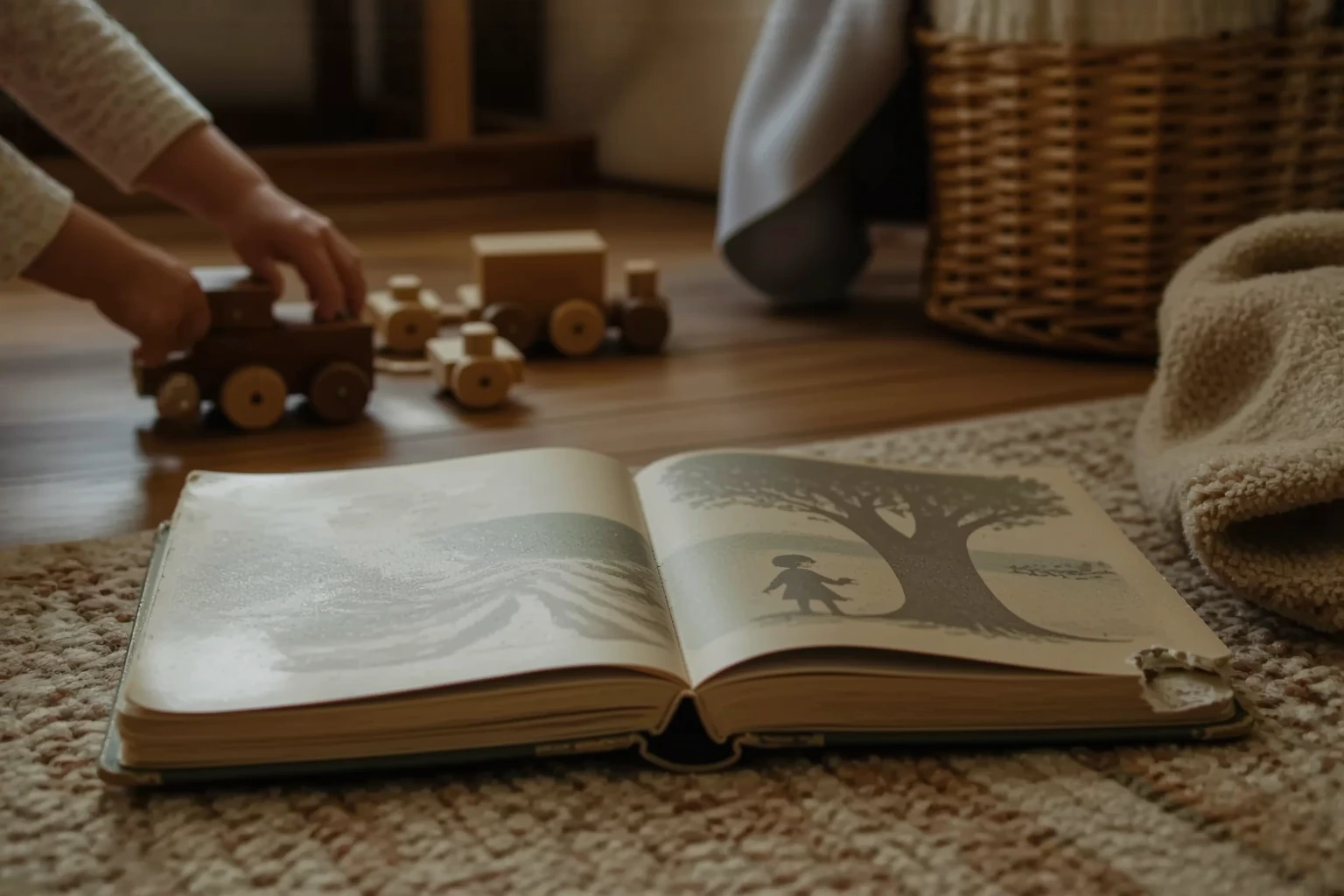

The book is called Where Is Baby’s Belly Button? and by eleven o’clock this morning I had read it aloud eight times. It is a lift-the-flap board book, twenty-two pages, and several of the flaps have been lifted so many thousands of times that they no longer lie flat — they curl up at the edges like little dried leaves, showing the answers before you get to ask the questions. Baby’s belly button is visible before we even reach the page. This bothers me. It does not bother Maren at all.
She brings it to me the same way every time: walking with the slightly drunk forward lean of a two-year-old moving with purpose, the book held flat in both palms like an offering, or like someone carrying something liquid they are afraid to spill. She deposits it in my lap, then immediately begins climbing into position herself — a whole separate project involving one knee on my thigh, a small fist grabbing my sleeve, a moment of real physical uncertainty, and then finally she is seated and leaning back into my chest and saying, with the authority of a person who has made a reasonable request, again.
Again. Before we have started. Again, already.
I want to tell you I find this enchanting every time. I want to write that essay. But the honest version is that somewhere around reading five this morning I felt something go slightly flat in me — a small, quiet dimming, the way a light behaves when the power in a house flickers. I kept reading. I did the voices. I lifted the flaps she already knew were coming and said there she is! with what I hope was convincing warmth. But I was also, at some level, elsewhere. Thinking about the dishes. Thinking about nothing in particular, which is sometimes worse.
The book itself is not bad. I want to be fair to it. It has a good rhythm, the kind that lands in the body rather than just the ear — short declarative questions, a beat of suspense, resolution. Where is baby’s hand? There it is! It was clearly written by someone who understood that toddlers are not reading for plot. They are reading for the experience of the thing, which is a different project entirely.
What I’ve come to understand, slowly, mostly by watching Maren’s face rather than from anything I’ve read, is that she is not asking to hear the book again because she has forgotten it. She has not forgotten it. She knows this book the way I know the layout of my childhood kitchen — not as something I have to think about, but as something that simply lives in me. She knows the belly button is under the third flap. She knows that baby’s eyes are closed on the last page, sleeping. She lifts the flaps before I prompt her, says there! before I do, fills in the last word of each question like she’s finishing my sentences.
She asks to hear it again, I think, because knowing what comes next is its own specific pleasure. The word for this, I’ve started to think, is not repetition but confirmation. The world is so new and so large and so continuously surprising for a two-year-old — a dog barking three houses away, the way ice behaves in a glass, the fact that sometimes Mama leaves and sometimes Mama comes back and the timing of this is not always clear. Against all of that, here is a thing that always goes the same way. Here is a sequence that keeps its promises.
When did you last let yourself experience something so reliably — something that went exactly as you expected, every time, and felt better for it?
I watch her mouth when we read. Not to check whether she’s following along, but because I can’t help it — there is something that happens to her face that I don’t have a clean word for. A settling. The jaw relaxes. The small furrow she sometimes carries between her brows, the one that makes her look briefly like a worried accountant, goes smooth. She is working, but the work has the quality of something pleasurable, the way certain kinds of physical effort feel good in the body while you’re doing them. She is predicting. She is confirming. She is filling the familiar shape of the story with herself, again, and finding that it holds her, again.
In our house, at least, this seems to be how language actually lands — not through introduction but through repetition so deep it becomes internalization. She doesn’t know she’s learning the word elbow. She knows that this is the page where you lift the flap on the left and find the thing she will later be able to name at a doctor’s office when they ask her to point to her elbow. The knowledge comes in through the body, through routine, through the ritual of the same words in the same order arriving in the same warm place against someone’s chest. I don’t know how to prove that. I only know that she uses the words now, correctly, in other contexts, with the confidence of a person who has known something a long time.
Around reading eleven today — I counted, I admit it, not proudly — she did something she hadn’t done before. On the last page, the one where baby is sleeping, she put her own small finger on the illustration and said, quietly, like she was pointing something out to herself and only incidentally to me: tired. Not the word the book uses. Not a word I had said. Just a word she had decided fit, placed against the page with a kind of calm certainty.
I didn’t make a production of it. I’ve learned not to — she startles if she senses she’s being observed too directly, goes shy, retreats. I just said yeah, baby’s tired, and turned back to the first page because that is what you do, apparently, when you live in this house and it is eleven o’clock in the morning.
But I held it, the moment. Filed it somewhere. Thought: there it is, the whole argument for why we keep doing this. Not that it’s morally correct or developmentally optimized or anything else I could put into a headline. Just that she is building something, in there, reading by reading, flap by flap. Some structure that belongs entirely to her and that she’s been quietly constructing while I was thinking about the dishes.
The book is on the floor now. She’s asleep. The curl-edged flaps have come to rest as flat as they’ll ever lie, which is not very flat, but that’s fine. We’ll do it again tomorrow. I’ll try to be there for more of it. I won’t always manage that, and I’ve stopped expecting to — the goal now is just to catch as many moments as I can, read by read, and let the rest proceed without me while I trust that she’s doing the work regardless. The book keeps its promises. So, it turns out, does she.
About This Article

Written by Lucy Bamboo. Lucy Bamboo is a parent of two who decided her kids would grow up without AI assistants doing their thinking for them — then spent the next four years finding out how hard that actually is. She writes about homework without ChatGPT, creative projects without image generators, and the kitchen-table arguments that come with drawing those lines. Not anti-technology, just paying attention. More about this site.
Verify this against a primary source
Specifics change, and your situation may differ from the one described here. These are the authorities worth checking directly:
- AAP HealthyChildren — pediatric screen time and development guidance
- Common Sense Media — age ratings and family technology research