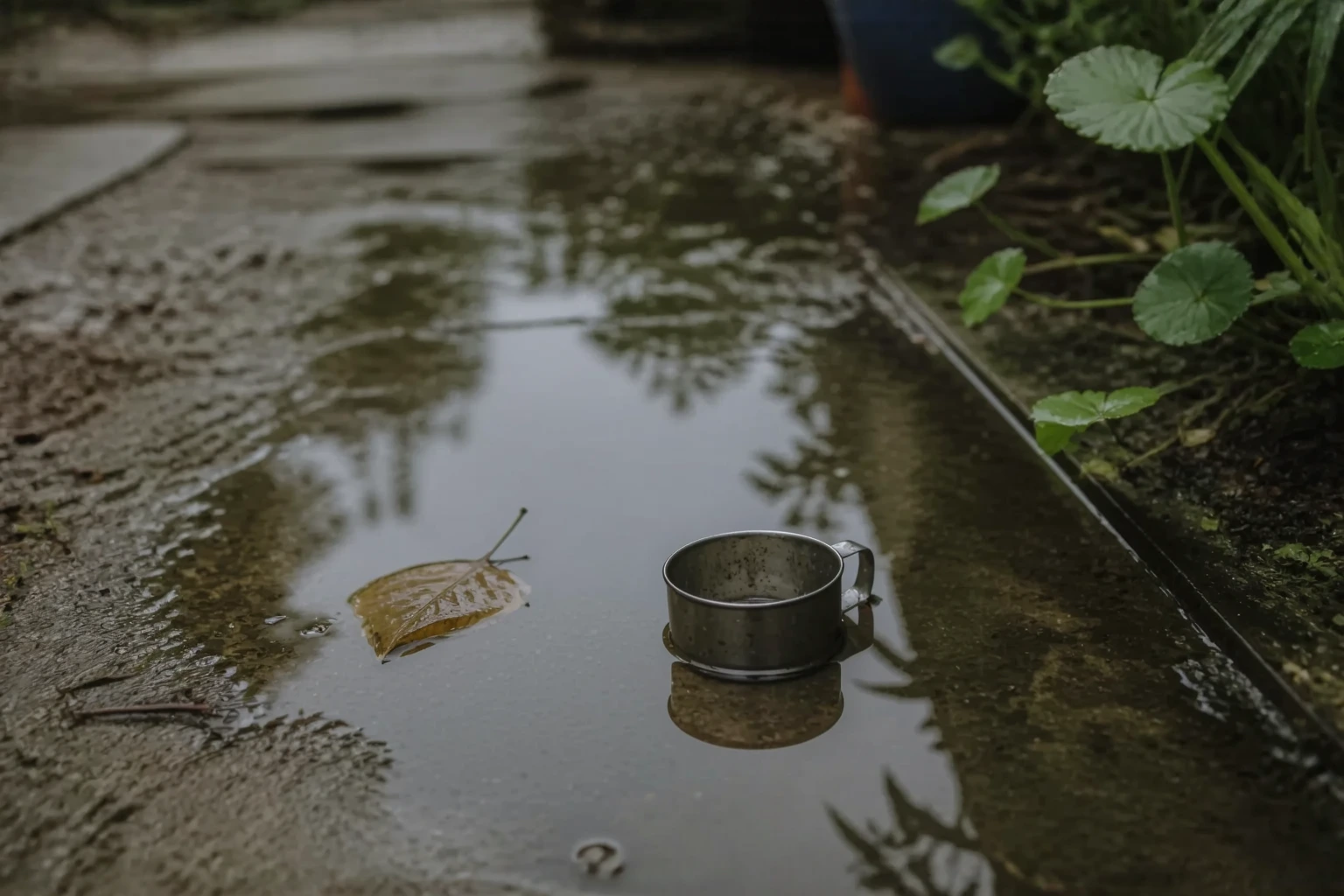

The puddle was approximately the size of a welcome mat and located directly at the end of our front path, where the concrete dips slightly and the rainwater likes to collect. Mara found it before I had fully registered that we were outside. One second she was beside me, hand in mine, and then she was in it — both feet, no hesitation, the splash reaching the hem of her yellow raincoat and speckling her chin.
It was the kind of Tuesday that arrives in late October already tired of itself. Low sky, cold coming in sideways, leaves pasted flat against the pavement. I had been inside since morning and so had she, and we had run out of the particular energy required to keep playing at things indoors. The duplo blocks had been built into a tower and knocked down enough times that even Mara looked bored by the falling. We needed weather. We put on the coats.
She stood in the center of the puddle and looked down at her feet with the expression she gets when something is going exactly the way she hoped. Then she jumped. Not high, but deliberate — both feet leaving the ground together, landing flat, a proper two-footed commitment to maximum displacement. The water flew outward in a ring. She looked up at me. I was already wet.
We went back inside for bowls.
This is what the morning became: Mara on the front step with a blue plastic bowl, a yellow plastic cup, and a red measuring cup I stopped using for actual cooking sometime after she was born. The puddle as source material. She would fill the yellow cup — submerging it completely, fishing it out heavy and dripping — and then transfer the contents, very carefully, into the blue bowl. Then she would pour the blue bowl back into the puddle and start again. The procedure had a quality of deep seriousness. She was not playing, exactly. She was working.
At some point she discovered that the red measuring cup, being smaller, required more trips to fill the blue bowl to the same level as the yellow cup had managed in one. She tested this. She poured. She looked into the bowl, then back at the cup, then across at me with a frown that contained real intellectual frustration. I did not explain it. I watched her work it through — the repeated pours, the growing conviction that something was operating here by rule rather than by chance.
I don’t want to overstate what I observed. She is two. She was not deriving volume equivalencies. But something was accumulating in her, some bodily sense of more and less and again that felt prior to language, prior to number, prior to anything I could have taught her directly. In our house, this is what math looks like at the beginning: cold hands and a puddle and a frown of concentration.
She found a stick. Of course she found a stick. The stick went into the puddle and floated, which she greeted with the kind of satisfaction that suggests confirmation of a theory. Then she fetched a pebble from the garden border and placed it carefully on the surface of the water and watched it go straight to the bottom. She placed another. Another. She looked at the stick still floating and looked at the stones and said, very clearly, no. To the stones. As if they had failed her.
I have no idea what she understood in that moment. I know what I saw: a child running an experiment and noticing that the results were consistent. The same thing, every time. The stick stayed. The stones went. Water is honest in this way — it behaves the same whether you are watching or not, whether you are two or forty, whether anyone is keeping score.
When was the last time you let something take as long as it actually needed to take?
We were outside for an hour and forty minutes. I know this because I checked my phone twice — not for anything specific, just the ambient checking, the reflex — and the timestamp was the only information I retained. The rest of the time I was watching her work. She filled and poured and splashed and dragged the stick in slow circles and placed stones with the gravity of someone conducting a ceremony. Her nose ran. She didn’t notice. Her boots had a leak somewhere and her left sock was soaked by the end, which I did not discover until we were back inside and she sat down on the hallway floor with one wet boot in her lap, looking at it with what I can only describe as philosophical acceptance.
The Part Nobody Tells You
Here is the honest version: I was cold for most of it. I had not dressed adequately — I had dressed for a quick trip outside and then it became a long one, because that is how it always goes, and I did not want to break the spell by going inside for my proper coat. So I stood in my thin fleece with my arms crossed and my jaw slightly clenched, watching my daughter conduct her investigations into the nature of water and trying to look like a person who was fully present and not thinking about coffee.
I mention this because the version of outdoor, screen-free, intentional parenting that circulates online tends to be photographed in golden light with everyone in coordinated knitwear. That is not Tuesday. Tuesday is a leaking boot and a runny nose and me, cold and caffeinated only in theory, standing at the end of my own front path while my kid pours water from one container into another for reasons that are entirely her own. It is good. I mean that genuinely. It is also just a regular kind of hard, and I think it’s worth saying so.
A note worth including here: we stayed close while she was at the puddle. Two is young, and even shallow water requires a present adult. The puddle itself was no danger, but this is habit — we don’t drift far when water is involved, at any depth, in any context.
There are apps for this, I know. Water table games, pouring simulations, interactive math toys where you drag virtual cups between virtual containers and a cheerful sound plays when you get the level right. I understand why they exist and I understand why parents use them on difficult days. I have had difficult days. The difference I keep coming back to is not moral — it is physical. The apps can show Mara a picture of water. The puddle gave her water. Cold and actual, surprising in its weight, honest about where it goes when you tip the cup too fast. You cannot get wet from a screen. The education lives, I think, in the getting wet.
By the time we came inside, she was pink-faced and damp and thoroughly satisfied in the way that only comes from having done something real with your body in the actual world. She ate her lunch in approximately four minutes. She was asleep within twenty of being put down, the cartoon animal blanket pulled up to her ears for once, covering exactly what it was meant to cover, everything where it should be.
Outside, the puddle was still there. Patient, cold, waiting for tomorrow.
About This Article

Written by Lucy Bamboo. Lucy Bamboo is a parent of two who decided her kids would grow up without AI assistants doing their thinking for them — then spent the next four years finding out how hard that actually is. She writes about homework without ChatGPT, creative projects without image generators, and the kitchen-table arguments that come with drawing those lines. Not anti-technology, just paying attention. More about this site.
Verify this against a primary source
Specifics change, and your situation may differ from the one described here. These are the authorities worth checking directly:
- AAP HealthyChildren — pediatric screen time and development guidance
- Common Sense Media — age ratings and family technology research