
The sound started at 9:14 in the morning, which I know because I had just looked at the clock above the stove and thought, with some desperation, that there were still four and a half hours until her nap. Then she found the cupboard.
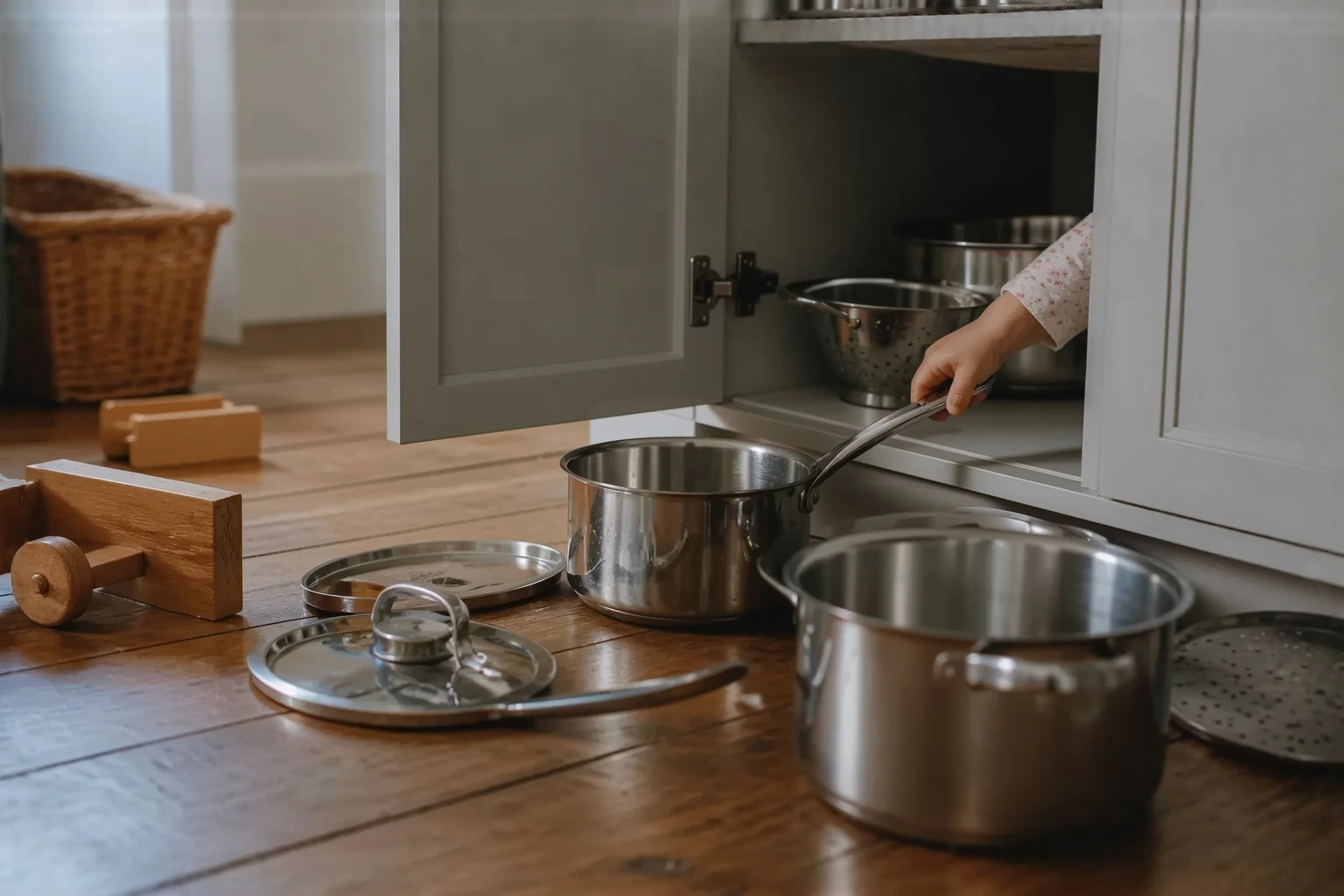
It’s the low one to the left of the sink, the one with the broken magnetic latch I’ve been meaning to fix for a year. Inside: two cast iron skillets, a Dutch oven that probably weighs more than she does, a colander, four nesting stainless steel pots, and, living in the chaos between the pots and the wall, an assortment of lids — glass, metal, one with a handle that wobbles because a screw has gone loose. She opened the cupboard with both hands and the door swung wide with that particular wooden thwack that sounds very much like something has gone wrong.
Nothing had gone wrong. She stood there for a moment, just looking in. Her hair was still matted slightly from sleep on the left side, and she was wearing the orange top with the small pineapples. Then she reached in and pulled out a lid — the large glass one, both hands around the handle — and set it down on the tile floor with a sound that I felt in my back teeth.
And then she did it again. And again. Within about two minutes she had arranged five lids in a rough arc across the kitchen floor, each set down with the full deliberateness of someone laying out tools before important work. The pots came next: dragged one at a time to the edge of the cupboard and lowered, with great concentration, onto the tile. The smallest one slipped from her hands on the way down and the clang was enormous, the sound bouncing off the cabinet doors and the window and coming back at us from multiple directions at once. She looked up at me. I made a face that I hoped communicated interest rather than alarm. She turned back to the pot.
What followed was thirty minutes I wasn’t expecting.
I have read, in the general ambient fog of parenting content that finds you whether you seek it or not, that toddlers have short attention spans. And in some moods and some contexts, ours absolutely does — three minutes with a puzzle before it’s abandoned, a book that holds her completely and then, mid-page, simply doesn’t. But the pots held her in a way I’ve only seen a few other things do. She was not passively watching something happen. She was making things happen, observing what happened, and then adjusting. There is a difference, and that morning I could see it plainly in her face.
She spent a long time on the lid problem. The lids don’t match the pots in any obvious one-to-one way — the collection has grown over years and moves and one marriage, and there is no system. She seemed to find this interesting rather than frustrating. She picked up the large glass lid and moved it from pot to pot along the row, setting it on each one, looking, lifting it off. The wobble-handled lid she discovered made a different sound depending on which surface she set it on — a flat ring on tile, a lower thud on the rubber mat in front of the sink — and she went back to this comparison four or five times, placing it one place, then the other, then the first place again. Her face during this had the expression I’ve come to think of as her real face: open, attentive, slightly apart from herself, the way you look when you’re actually thinking rather than performing thinking.
When did you last see a child look at something the way they look before they’ve learned what they’re supposed to notice?
She discovered nesting by accident. She’d placed the smallest pot inside the medium one to free up her hands, and then looked at what she’d done, and then placed that combined unit inside the large one. She looked at me. I looked back. She picked up the lid to the medium pot — not the right lid, as it happens, but close enough in size — and placed it on top of the entire tower. The tower was unstable and tipped. The clang was tremendous. She startled, recovered, and then, with a kind of professional remove, began again.
I want to be careful here, because I’m her mother and I’m prone to finding her extraordinary, and I know that. I’m not saying she invented physics or demonstrated unusual genius. What I’m saying is that in our house, with our kid, this was sustained self-directed engagement — real experimentation, consequence, revision — and I don’t think she would have done it if something else had been competing for her attention. The screen, when it’s present, doesn’t just take up time. It seems, in our experience, to raise the threshold for everything else. It makes the pots not enough.
I stood at the counter and drank my coffee, which had gone lukewarm. I did not intervene, which took more self-restraint than I’d like to admit. There was a moment when she was reaching deep into the back of the cupboard for the Dutch oven and I almost said something, almost moved toward her — but she couldn’t tip it onto herself from that angle, and I made myself stay put and watch. This is part of the practice I keep having to re-learn: that helping before she needs help isn’t kindness, it’s just noise. It interrupts whatever she’s actually doing, which is something I cannot fully see from the outside and should probably not assume I understand.
She never did get the Dutch oven out. It defeated her — too heavy, too far back — and she moved on without apparent grief. The colander became briefly interesting; she put her fingers through the holes and then wore it on her head for approximately four seconds, which was funny, and then she set it down and returned to the lids.
The thing about noise, I’ve decided, is that it has to be tolerated. The banging is real and the kitchen is small and the acoustics are unkind. There is no version of this that is peaceful for the adult in the room. I am not going to pretend that thirty minutes of lid percussion is a transcendent experience, because it isn’t — it’s loud, it’s slightly chaotic, and there is now a very faint scuff on the tile that I noticed this morning. But I was present for something, and that feels like the right word. Not managing, not redirecting, not finding an alternative to myself in the form of a glowing rectangle. Just standing there in the kitchen with my lukewarm coffee, watching her work.
When she was done — and she decided when she was done, not me — she left the pots exactly where they were and walked out of the kitchen toward the living room. I started putting them back one at a time. The tile was cold under my feet. The house had the particular quiet that follows a lot of sound, the kind where you’re still expecting the next bang and it keeps not coming.
The latch on that cupboard is still broken. I’ve decided to leave it.
About This Article

Written by Lucy Bamboo. Lucy Bamboo is a parent of two who decided her kids would grow up without AI assistants doing their thinking for them — then spent the next four years finding out how hard that actually is. She writes about homework without ChatGPT, creative projects without image generators, and the kitchen-table arguments that come with drawing those lines. Not anti-technology, just paying attention. More about this site.
Verify this against a primary source
Specifics change, and your situation may differ from the one described here. These are the authorities worth checking directly:
- AAP HealthyChildren — pediatric screen time and development guidance
- Common Sense Media — age ratings and family technology research