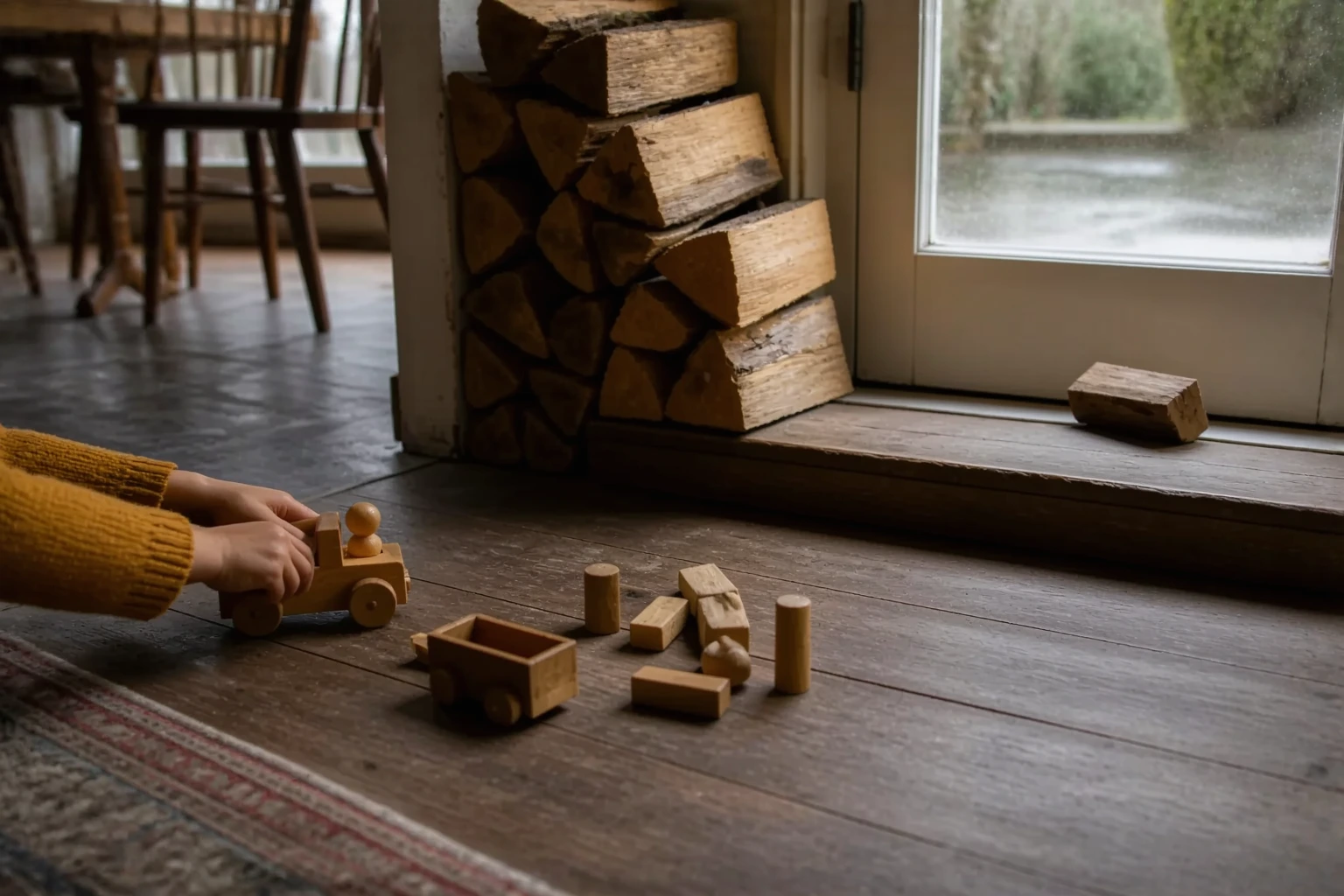

The log was not large. That’s the thing I keep coming back to. By any adult measure, it was a modest piece of firewood — a round of birch maybe eight inches long, split once, the pale wood still holding a little of the cold from the porch where we stack them. But Wren spotted it from across the kitchen the moment I brought it in, and she said, with complete authority, mine, and walked toward it with her arms already open.
I set it on the floor. She crouched, got her hands under it the way she gets her hands under everything — palms flat, fingers spread, deeply serious about the procedure — and she lifted. Or she tried to lift. What happened instead was that she rose slightly and the log stayed, and her face registered this information with genuine surprise, the way faces do when the world declines to cooperate with a reasonable assumption. She tried again. The log came up maybe two inches before she had to set it down. She looked at me.
“Heavy,” I said. Not a lesson. Just the word that was there.
She looked back at the log. She tried a third time, and this time she got it, really got it — both arms wrapped around it, the wood pressed against her chest, her whole body recruiting itself for the job, knees bent, back straight in that instinctive way children sometimes have before anyone teaches them. She took three steps. Four. She was breathing hard. Then she set it down near the fireplace, stood up, and said clearly, as if reporting the outcome of a long negotiation: heavy.
Not as a question. As a fact she now possessed.
We have a woodstove, which means we have a log basket, which means firewood moves through our house all winter in a steady, unglamorous procession. It is not a pedagogical project. Nobody planned it as a vocabulary exercise. It is simply what happens when your heat source requires physical tending — you carry things in from the cold, you stack them, you feed them one at a time into the fire while a two-year-old stands at a careful distance because the stove is hot and we say careful and hot and we don’t touch with the same flat certainty every single time. (Worth saying plainly: toddlers and woodstoves require constant, close supervision. We keep a fixed boundary she’s learned to respect, but we never assume that learning is permanent or that a moment of inattention is safe. It isn’t.)
But that afternoon, the log. And the word that arrived in her mouth already carrying its full meaning.
I’ve been thinking about this for weeks now, the way you turn something small over and over and find it has more surface than you expected. Because she knows other words — she knows hot from touching the radiator once, knows sharp from a corner of the coffee table, knows stuck from a zipper on her coat that catches every single morning without fail. And these words sit differently in her than words that arrived through other routes. When she says heavy now, she says it with her body slightly braced, as if she’s still holding the birch log. When she says hot she pulls her hand back before she’s finished the word.
Compare this to elephant. She knows elephant. She can say it, she can point to pictures of elephants, she can do the trunk thing with her arm. But elephant is a kind of beautiful fiction for her right now, a story we’ve told in books and in sounds, and she holds it loosely the way you hold borrowed things. Heavy is hers. She earned it with her arms.
What did you learn from your body that you couldn’t have learned any other way?
I’m not making an argument against elephants, or against books, or against the ten thousand things children learn without direct physical contact. I want to be careful here — I notice the temptation, in writing about any of this, to tip into a kind of smugness about physicality, as if carrying a log is morally superior to watching a nature documentary. It isn’t. Both are true. Both matter. In our house, we just try to make sure the log gets to come first when the log is available, because for our kid, in this season, the word that enters through muscle seems to go somewhere the other words don’t quite reach. Whether that holds, whether it matters in any lasting way — I genuinely don’t know. I’m a parent with a theory, not a researcher with data.
The Words That Cost Something
There’s a whole category of vocabulary in our house that I think of, without much precision, as words-that-cost-something. Heavy cost her effort. Cold cost her the January morning I let her put her hand briefly into the snow pile at the edge of the path, just long enough. Scratchy cost her a sweater she hated and suffered through for fifteen minutes before I admitted she was right and changed her. These words have receipts. You can see them reaching for the memory when they use the word — there’s a tiny delay sometimes, like they’re checking.
I notice the words that cost nothing slide around more. Sad, for instance, which she uses now to describe everything from a dropped cracker to a book whose cover has a blue color she associates with crying. The concept is there, is real, is developing — but it hasn’t been fully inhabited yet. It’s still a costume. Someday something will happen and she’ll know sad the way she knows heavy, and I’m not in a rush for that particular education.
But the principle holds, and I find myself arranging our days around it in ways that would look eccentric if I explained them. I let her carry her own cup to the table — the small ceramic one, which is heavier than plastic and breakable, and yes, sometimes breaks. I let her drag her jacket out of the coat closet herself even when we’re already late, because the resistance of the hanger and the weight of the sleeve are telling her something I cannot tell her faster. Last week she insisted on helping me carry a bag of apples in from the car and she had to stop twice and her face was entirely focused and at the end she said, again, satisfied: heavy.
She’s adding to the word. It’s growing. It now means birch logs and bags of apples and possibly more things I don’t know about yet, experiences she’s cataloguing privately.
That night I built the fire with the log she’d carried. She watched from the couch, which is the safe distance, with the cartoon animal blanket pulled up to her chin. The birch caught fast — birch does — and the light moved across her face in that particular firelight way that no screen has ever quite replicated, warm and unsteady and alive. She was quiet for a long time. Then she pointed at the stove and said something that might have been heavy or might have been something new entirely, some word still assembling itself in her mouth from whatever she was seeing and feeling and slowly, bodily, coming to know.
I didn’t reach for anything to record it. I just sat there and watched the fire and let it be a moment that would live only in us.
About This Article

Written by Lucy Bamboo. Lucy Bamboo is a parent of two who decided her kids would grow up without AI assistants doing their thinking for them — then spent the next four years finding out how hard that actually is. She writes about homework without ChatGPT, creative projects without image generators, and the kitchen-table arguments that come with drawing those lines. Not anti-technology, just paying attention. More about this site.
Verify this against a primary source
Specifics change, and your situation may differ from the one described here. These are the authorities worth checking directly:
- AAP HealthyChildren — pediatric screen time and development guidance
- Common Sense Media — age ratings and family technology research