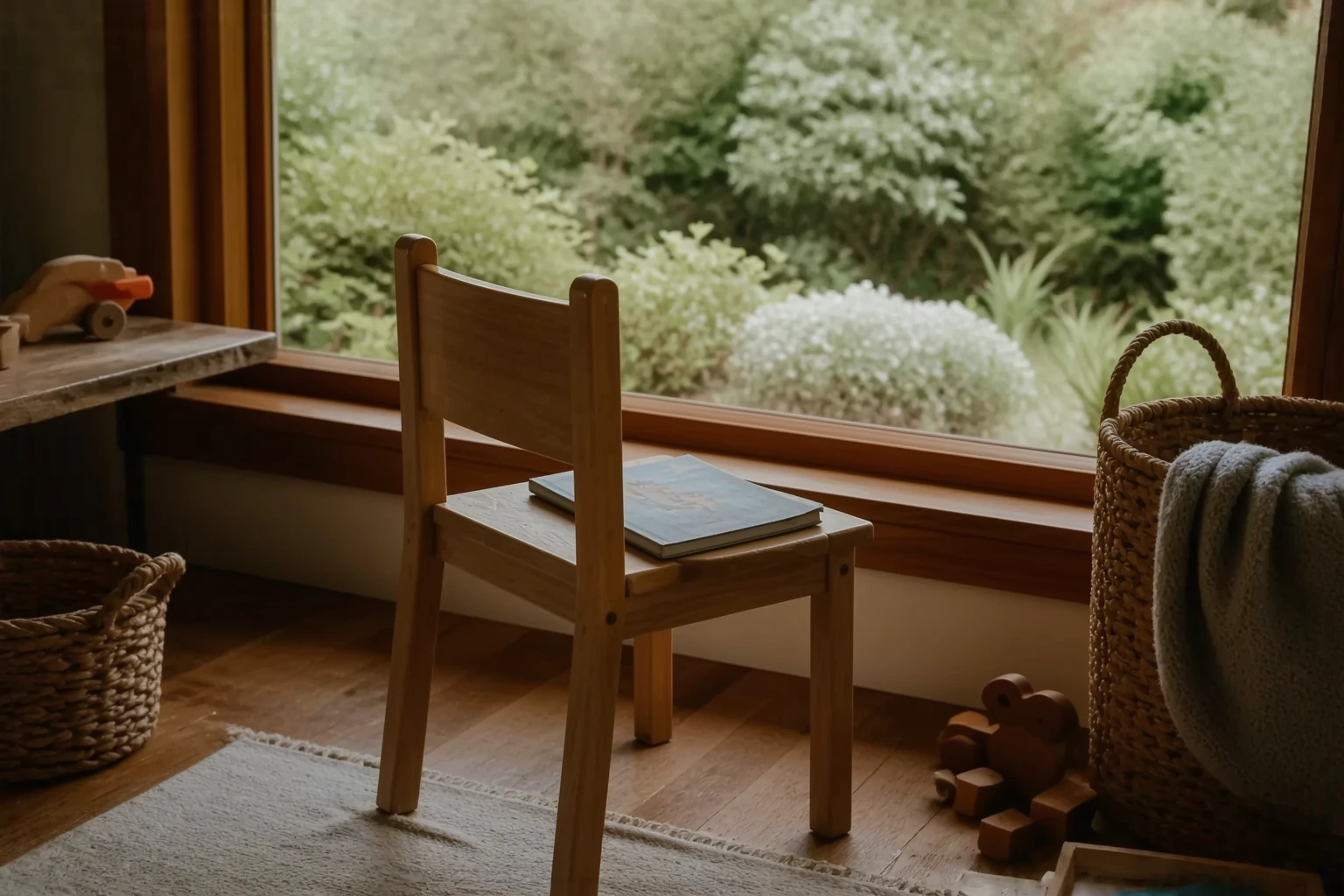

She found a roly-poly bug on the back step this morning and spent — I am not exaggerating — twenty-two minutes with it. I was watching from the kitchen window, hands in dish soap, half-waiting for the moment she’d lose interest and come back inside asking for something. The moment never came. She crouched on her heels with her dress bunched up around her thighs, one finger extended, perfectly still in the way that toddlers almost never are, watching the bug do its slow and purposeless work across the concrete. At one point she said something to it. Quietly, to herself, in that register she uses when she’s not performing for anyone. I couldn’t hear what it was through the glass.
I kept thinking: this is the thing. This right here. Not because it’s precious, though it is — God, it is — but because of what it requires. What it costs her, neurologically, to stay there. Twenty-two minutes is enormous when you are two. The bug offers her nothing. No sound effect, no color change, no reward for sustained attention. It just moves, slowly, in its indifferent bug way, and she watches it like it’s the most important event of her life so far.
I am not keeping her away from screens because I think screens are evil. I want to say that plainly, because I know how this can read — as a kind of performance, a moral stance dressed up as a parenting philosophy, the 21st-century equivalent of announcing you don’t own a television. That is not what this is. Or at least I’m trying, imperfectly, for it not to be.
She is going to live in a world that is saturated with screens. She is going to live in a world of AI that makes our current moment look quaint. The algorithms will be more patient than I am, more responsive, more precisely calibrated to the exact texture of her attention and desire. They will know, in ways I cannot, what keeps her engaged. This is not a future I can protect her from. I’m not sure I would if I could.
What I’m trying to do — clumsily, without a blueprint — is something more like preparation. I want her to arrive at that world having already built something inside herself that the world cannot build for her. An ability to be bored without it being an emergency. An ability to stay with something slow and unrewarding long enough for it to become interesting. An ability to exist in her own body, in a particular place, on a particular afternoon, without the anxious reaching toward somewhere else.
Here is the obvious objection, and I want to meet it honestly: sheltering backfires. Kids who are kept away from something often become kids who cannot moderate it. The teenager who grew up with no sugar who now eats cake in the bathroom. The college freshman whose parents never let her out who arrives on campus with no idea what her own limits are. I have heard this argument from people I love and respect, and I do not think it is wrong.
But I think it applies to a different kind of restriction than what we’re doing. Or what I’m trying to do. The sheltering-backfires model describes prohibition — the locked cupboard, the shameful secret, the thing that is bad and therefore hidden. That’s a story about shame and control. What I’m aiming for is something else, though I’ll be honest that the line between them is not always obvious from inside the house, at 5pm, when I’m tired and she’s tired and the tablet is right there and I know it would buy me twenty minutes of peace.
The distinction I keep returning to — in our house, for our kid, at this particular age — is between absence and deprivation. Screens aren’t hidden from her. They’re not forbidden or discussed with whispered seriousness. When she sees my phone, I don’t lunge for it or flip it face-down. She has seen screens. She knows they exist. She is simply not, at two, spending hours inside them every day. The hope is that by the time she’s old enough to have a relationship with technology that includes real choice, she’ll have years of proof that she can entertain herself, sit with difficulty, move through boredom to the other side of it — proof that lives in her body, not just her head.
Can you actually build that kind of inner resource in a child, or is it just something some kids come with and others don’t, and all we’re really doing as parents is telling ourselves a story about our own influence?
I don’t know. I hold that question and I cannot answer it. She may simply be a child who has always been able to watch a bug for twenty-two minutes, screen time or no screen time. I may be confusing cause and effect. The uncertainty is real and I’m not going to paper over it.
What I do know is what I can see. Last week she was sick — fever, the real kind, the kind where you check and recheck and make sure she’s drinking enough water and staying cool enough, the kind where you don’t let them out of your sight for long. She spent most of two days on the couch under her blanket, and I sat beside her, and we were just there together. She wasn’t asking for anything. She watched the shadows move across the wall from the window. She pressed her face against my arm. She fell in and out of sleep. At one point she spent a long time examining a loose thread on the blanket’s edge, working it with her fingers, not to pull it free, just to understand it.
I don’t think she was learning patience in any conscious way. I don’t think she was developing anything. She was just a sick kid on a couch, doing what sick kids do. But something about watching her — the quality of her attention, the way she didn’t seem to need rescue from the quiet — made me feel, for a moment, not anxious about the future. Not because the future isn’t coming. It is. The screens are coming, the AI is coming, and some version of it will probably be stranger and more immersive than I can currently imagine.
But she is coming to it too. And she is coming to it as a person who knows how to watch a bug. Who spent a whole sick morning in a room with nothing but a loose thread and her own mind and found that sufficient. Who once stood at a window for so long watching rain that I had to go and stand beside her just to understand what she was seeing.
The goal was never to keep her innocent of the world. The goal — my goal, fumbling toward it — is for her to be sturdy enough, and present enough, and sufficiently acquainted with the texture of her own attention, that when she does arrive at the screen, she is the one using it. Not the other way around.
The roly-poly had moved off the step and into the grass by the time she came back inside. She was satisfied in the way she gets after she’s done something real. She washed her hands without being asked, which she almost never does, and then she stood at the kitchen window for a while looking back out at the step, at the spot where the bug had been, as if checking whether it had returned.
It hadn’t. She seemed okay with that.
About This Article

Written by Lucy Bamboo. Lucy Bamboo is a parent of two who decided her kids would grow up without AI assistants doing their thinking for them — then spent the next four years finding out how hard that actually is. She writes about homework without ChatGPT, creative projects without image generators, and the kitchen-table arguments that come with drawing those lines. Not anti-technology, just paying attention. More about this site.
Verify this against a primary source
Specifics change, and your situation may differ from the one described here. These are the authorities worth checking directly:
- AAP HealthyChildren — pediatric screen time and development guidance
- Common Sense Media — age ratings and family technology research