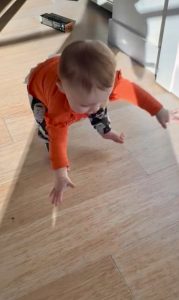


She was sitting in a patch of afternoon sun, talking to a wooden spoon. The spoon was named Gerald. Gerald had opinions about the dog next door and strong feelings about applesauce. I stood in the kitchen doorway for probably three full minutes just watching her build an entire world out of nothing — no prompt, no response, no interface. Just a two-year-old and a utensil and the gorgeous, inefficient engine of her own imagination.
That moment isn’t why we decided to raise her without AI. The decision came earlier, and it came from reading. But Gerald does crystallize something I keep coming back to: what, exactly, would an AI add to that scene? And what might it quietly displace?
This post is my attempt to answer that honestly — with sources, not just instincts. As of July 2026, the research landscape has gotten clearer in the past year, and I want to share what I’ve found, where the evidence is genuinely thin, and — this part matters — what would actually change my mind.
What the evidence actually says about AI and kids under five
Let me start with the most clarifying thing I read. ZERO TO THREE, the early-childhood nonprofit, published an FAQ on June 5, 2026 that said plainly: “It’s okay to wait to introduce your child to AI.” Their position is that there is minimal learning benefit from AI apps and toys for children ages zero to three, and that an engaged adult matters more than any technology. They note that children can begin grasping what AI can and cannot do around ages four to five — but even then, it is “not necessary for learning.” I read that and felt something loosen in my chest. Not vindication exactly. Relief that the question had a real answer.
Common Sense Media’s guidance is equally unambiguous: no child five and under should use any AI chatbot. For ages six through twelve, supervised use only. And for no one under eighteen should AI be used for companionship or emotional support. These aren’t vague cautions. They’re specific thresholds from an organization that has spent years trying to be calibrated rather than alarmist.
The AAP’s current screen guidance — no screen media under roughly eighteen to twenty-four months except video chatting, and up to one hour per day of high-quality programming for ages two to five, ideally co-viewed — doesn’t address AI directly, but it establishes the baseline. And the video-chat exception is instructive. A Developmental Science study by Myers and colleagues, published online in 2016, found that children twenty-two to twenty-five months learned new words from live video-chat partners but not from pre-recorded video. What drove learning wasn’t the screen. It was the responsive human on the other side of it. A chatbot mimics responsiveness without the thing that makes responsiveness matter.
The risks I’m watching for in older kids — and why they shape my thinking now
My daughter is two. The harms documented for adolescents aren’t her harms yet. But I think about them as a trajectory, not a separate category.
Common Sense Media’s national survey from July 16, 2025 found that 72% of U.S. teens ages thirteen to seventeen have used AI companions at least once, and about half — 52% — use them regularly. About a third have chosen an AI over a human for a serious conversation. I want to be fair here: 80% of those same teens still say real friendships are their priority. This isn’t a story of mass replacement. But a third choosing AI for serious conversations is not a small number, and serious conversations are exactly where kids build emotional vocabulary and relational trust.
Common Sense Media, in a joint assessment with Stanford Brainstorm published April 30, 2025, concluded that social AI companions pose “unacceptable risks” to users under eighteen. The American Psychological Association issued a health advisory in June 2025 calling for safe-by-default design, reduced persuasive design, repeated reminders that the AI is not human, and urging society not to “repeat the mistakes made with social media.” That last phrase is doing a lot of work. It suggests we already know what the mistake looks like and are choosing whether to make it again.
In November 2025, Fairplay published an advisory signed by more than 150 organizations and experts — including MIT’s Sherry Turkle and pediatric media researcher Dr. Jenny Radesky — urging parents not to buy AI toys, arguing they run on models already shown to harm kids and displace creative, relational play. That coalition is not fringe. Those are names I trust.
If the risks for adolescents are real and documented, and the benefits for toddlers are minimal by every major early-childhood organization’s reckoning — what, precisely, are we waiting for?
Steelmanning the other side
I want to take the counterargument seriously, because some thoughtful people make it.
Some educators argue that AI-literacy instruction should start before kindergarten, citing research suggesting even preschoolers can learn AI’s strengths and limits. The argument, reported in The 74, is essentially: the technology is already ambient in children’s lives, and early conceptual exposure builds critical frameworks before kids are using AI unsupervised. I don’t dismiss this. Digital literacy has historically worked better when it’s taught alongside introduction rather than before or after.
ZERO TO THREE’s response to this argument is useful: conceptual understanding of what AI can and can’t do can start around ages four to five without any hands-on AI use. You can teach a child that some things are made by computers and some things are made by people. You can talk about how robots don’t have feelings. None of that requires a child to have a conversation with a chatbot. The literacy argument doesn’t actually require the tool.
The other counterargument is the access one: families without my resources may rely on AI tools for educational support, and blanket skepticism from people like me can read as privileged. That’s fair. I try to hold my position lightly enough to acknowledge that this conversation looks different depending on what else a family has access to. My choice is a choice, not a verdict on anyone else’s.
What would actually change my mind
I want to be specific here, because “I’m open to changing my mind” means nothing without thresholds.
- Her age. ZERO TO THREE and Common Sense Media both point to four to five as the earliest age where conceptual engagement with AI makes developmental sense. When she gets there, I’ll revisit. Supervised AI-literacy conversations — what is this, how does it work, what can’t it do — feel different to me than open-ended chatbot use.
- Better evidence. If peer-reviewed longitudinal research showed measurable learning benefits from AI tools for children under five that outweighed documented risks, I would update. So far, that evidence doesn’t exist. “Minimal learning benefit” is ZERO TO THREE’s phrase, not my editorializing.
- Changed risk landscape. If the design of AI companions shifted — genuinely — in response to the APA advisory and Common Sense Media’s standards, if persuasive design features were removed and emotional dependency was actively discouraged by the products themselves, I’d weigh that. I’m not holding my breath, but I’m watching.
- Her asking. She’s two. She doesn’t know what AI is. When she’s old enough to be curious, that curiosity is data. I don’t want to raise a child who is mystified and anxious about something that will be part of her world. Curiosity-led, supervised, age-appropriate introduction is not the same as ambient exposure.
What we actually do in our house
We follow AAP guidance as our baseline. She watches some television — co-viewed, which is to say I’m usually on the couch next to her making comments about the characters like a color commentator. We video call her grandparents and her aunt, because the Myers study’s logic makes intuitive sense to me: the responsive human is the point. We don’t have AI toys. When a relative bought one, I exchanged it without a lot of drama and got her a set of wooden blocks instead. She has not noticed the deficit.
What’s hard: consistency at other people’s houses. She’s been handed a tablet by well-meaning adults, and I’ve had to make quick, low-drama decisions about how to handle it without being the parent who makes everyone uncomfortable. I’m not always graceful. I’m also aware that the 2025 Common Sense Census found that kids ages zero to eight average about 2.5 hours of screen time per day and that 40% of kids have their own tablet by age two. Our household is a real outlier. I know that. I’m not trying to make anyone else feel bad about their numbers; I’m just trying to be honest about ours.
What’s easy, or easier than I expected: she doesn’t miss what she doesn’t know. Gerald the wooden spoon remains fully employed.
Questions I keep getting
Isn’t AI just like any other screen? Why treat it differently?
Not quite. Passive screens — a show, a video — don’t respond to your child. AI chatbots do, and that responsiveness is specifically what makes them engaging in a way that can mimic human relationship. The Myers study’s finding that responsive interaction is what drives toddler learning is actually an argument against AI, not for it: what toddlers need is a real responsive human, and AI produces a simulacrum of that. For older kids, Common Sense Media and Stanford Brainstorm assessed social AI companions as posing “unacceptable risks” to under-eighteens — a much stronger warning than you’ll find attached to a Netflix queue.
Won’t she be behind if she doesn’t grow up using AI tools?
ZERO TO THREE’s position, published June 5, 2026, is direct: early AI exposure is “not necessary for learning.” Children can begin understanding what AI can and can’t do around ages four to five — without any hands-on use before that. The AI-literacy argument is real and I take it seriously, but the evidence doesn’t support starting hands-on use at two. The tools are also changing fast enough that the specific interfaces she’d use at two are unlikely to resemble what she’ll encounter at twelve. Building her capacity for focused attention, language, imaginative play, and human relationship is the foundation. The tools sit on top of that, not the other way around.
What about AI toys — are they different from AI chatbots?
Functionally, many are not. The Fairplay advisory from November 20, 2025 — signed by over 150 organizations including researchers Sherry Turkle and Dr. Jenny Radesky — specifically warned parents against AI toys, arguing they run on the same underlying models already shown to carry risks and that they displace the kind of open-ended, creative, relational play that actually serves child development. A toy with a chat interface is still a chat interface. The packaging doesn’t change the mechanism.
When will you actually introduce AI to her?
My current thinking: conceptual conversations about what AI is and isn’t, probably around four to five, in keeping with what ZERO TO THREE identifies as the developmental window for grasping those ideas. Supervised, curious, demystifying — the same way I’d want to introduce anything that will be part of her world. Hands-on use with a chatbot, only with me present and only when I’m confident she can hold the “this is a computer, not a friend” distinction. No AI for emotional support or companionship, which is Common Sense Media’s guidance for under-eighteens and which I intend to hold as a firm line for much longer than most guidelines require. That last one isn’t about fear. It’s about what I watched happen with social media, and the APA’s explicit warning that we’re at risk of repeating exactly those mistakes.
About This Article

Written by Lucy Bamboo. Lucy Bamboo is a parent of two who decided her kids would grow up without AI assistants doing their thinking for them — then spent the next four years finding out how hard that actually is. She writes about homework without ChatGPT, creative projects without image generators, and the kitchen-table arguments that come with drawing those lines. Not anti-technology, just paying attention. More about this site.
Verify this against a primary source
Specifics change, and your situation may differ from the one described here. These are the authorities worth checking directly:
- AAP HealthyChildren — pediatric screen time and development guidance
- Common Sense Media — age ratings and family technology research