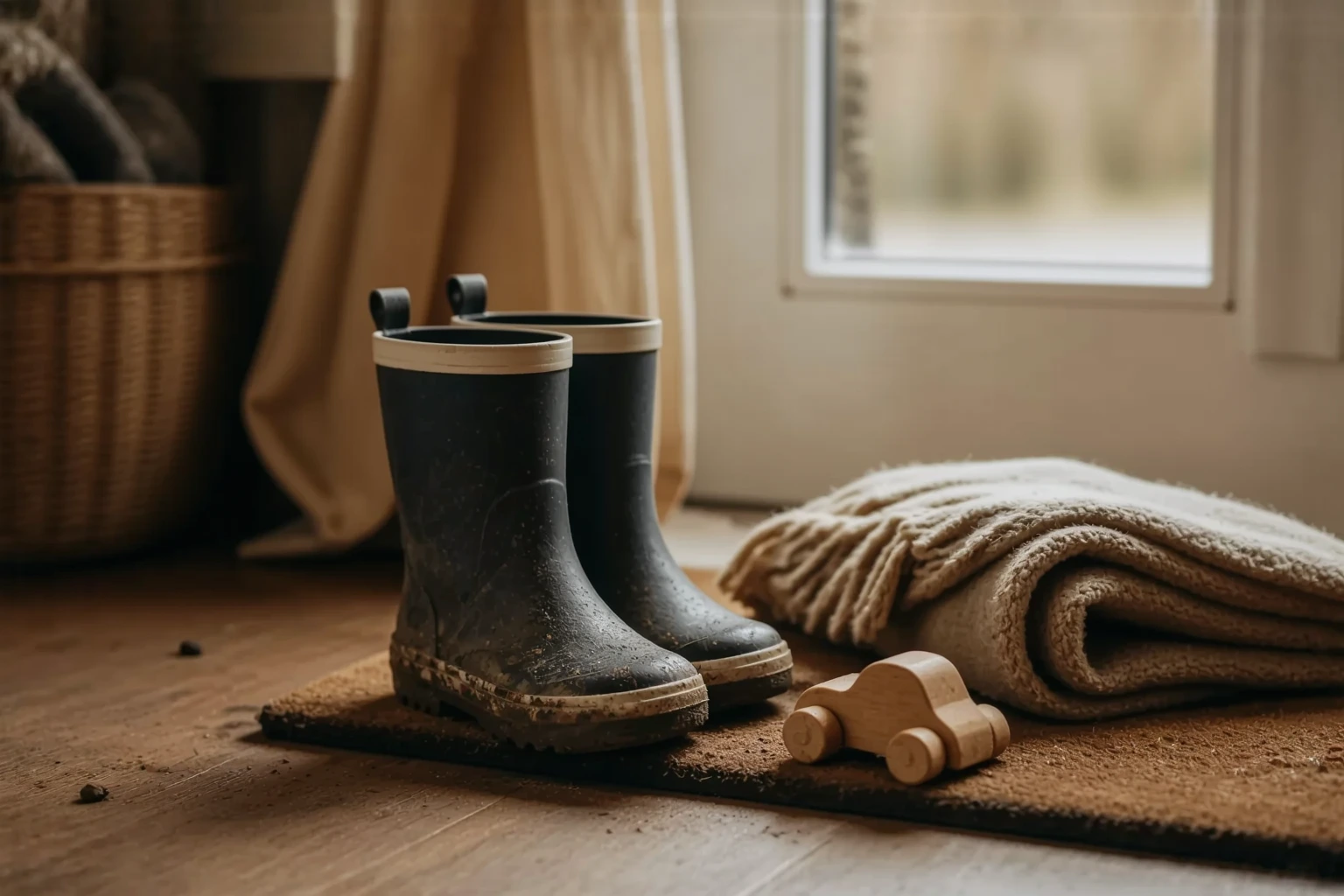

There is a puddle at the end of our driveway that has been there for three days. It appeared after Tuesday’s rain and has been slowly, reluctantly evaporating, and my daughter has visited it every single morning with the seriousness of a scientist checking on an experiment. She crouches down beside it — her whole body folding at the middle the way only toddlers can manage, completely hinged, heels flat on the ground — and she pokes it with a stick. She watches the ripples move out to the edges. She pokes it again. Yesterday she found a leaf and set it on the surface and watched it drift, and the watching took a long time, longer than I expected, long enough that I had to consciously keep my mouth shut and not name what was happening, not explain surface tension or boats or anything at all.
I just watched her watch the leaf.
That puddle is more or less the entire philosophy of this website.
I want to say something clearly, because I think it gets misread: we are not afraid of technology. I use a laptop every day. My husband works in software. We have a dishwasher, a washing machine, a car with a backup camera and lane assist, and a blender we use almost every morning to make a smoothie that our daughter then refuses to drink. We are not off-grid. We are not survivalists. We do not think screens are poison or that parents who use them are doing something wrong. What we are — and this is a harder thing to say simply — is interested in something else. Specifically interested in it. Choosing it on purpose.
What we’re choosing is boredom. Mud. Waiting. Repetition. Things that are slow and textured and don’t respond to touch.
The boredom is the hardest sell, even to myself. On the days when she is spinning in the kitchen making a sound that is not quite crying and not quite singing, some unhappy in-between sound, and I’ve already suggested the blocks and the crayons and a walk and all of them have been declined or thrown — on those days I have to hold something in my chest like a weight and not fix it. Not hand her a phone showing animated bears, which would work, I know it would work, which is almost the whole problem with it. The fix is so available. It is right there in my pocket and it would take eleven seconds and the sound would stop.
But in our house, for our kid, we’ve noticed that the sound stopping is not the same as the thing resolving. When the boredom is allowed to just sit there, something else eventually happens. Not always dramatically. Sometimes she finds a plastic cup and fills it with water from her play table and pours it into another cup for twenty minutes. Sometimes she drags a couch cushion onto the floor and climbs on and off of it until she’s satisfied. Once, memorably, she spent a long time carrying a single sock from room to room, apparently with intent, though the intent was never made clear to me. These are not enriching activities in any way I can point to. They’re just what happens when there’s nothing else to do and you’re two and the world is still genuinely, extravagantly interesting if you let it be.
When did waiting become something we treat as a problem to be solved rather than a skill to be practiced?
We wait in lines now. We wait at the doctor’s office — recently a long one, nearly forty minutes in a beige room with a too-loud HVAC system and exactly four board books, two of which she’d already eaten the corners off during previous visits. I had nothing to offer her but the board books and myself. We read all four. We named everything on every page. She found a button on my jacket she’d apparently never noticed and worked at it with her fingers for a while. I answered questions about the fish in the wall painting that were not really questions, more like observations phrased upward. Fish. Yes, a fish. Fish swimming. Yes, it’s swimming. Where fish go? I don’t know, baby. The fish lives in the painting. This was apparently acceptable. We made it through.
Waiting, it turns out, is something you get better at if you do it. For her and for me both.
The mud is non-negotiable
I want to be precise about the mud, because I think the mud is actually doing something. Not in a way I can prove or cite — this is just what I observe, in our yard, with our particular child. When she is outside with access to dirt and water and sticks and the occasional unfortunate earthworm, she is in a state I can only describe as calibrated. Her body knows what to do. Her hands know what to do. Everything is interesting and nothing is too much. She comes inside with it ground under her fingernails and caked in the creases of her knuckles and requiring a bath that is its own small adventure, and she sleeps like something that has genuinely used itself up.
A note here, because it matters: we watch her closely outside. She’s two. Two-year-olds eat mud, put rocks in their mouths, approach standing water with no caution whatsoever. If you are doing this kind of outdoor time with a small child, you are with them — not scrolling on the porch steps, actually with them. The freedom is supervised freedom, which is a different thing from danger. We check what goes in her mouth. We know where the water is.
But within those limits: we let her be in it. We don’t narrate it constantly. We don’t redirect toward cleaner activities. We let her figure out that wet dirt behaves differently than dry dirt, that a stick is good for poking but not great for scooping, that worms are distressing and fascinating simultaneously and that both of those feelings are allowed to exist at once.
We let her be bored and muddy and waiting and sometimes frustrated and sometimes deeply, quietly absorbed in nothing we chose for her.
We give her real things. A wooden spoon and a pot. Dried pasta to sort. A watering can that is actually connected to plants that actually need water. A dustpan, because she saw me sweep and wanted one, and so she has one, and she sweeps. Badly and with great commitment. The floor is usually worse after she sweeps it than before. This is fine. The point is not the floor.
I’m not going to tell you this is easy, or that I always get it right, or that there aren’t evenings when I am very tired and she is very not-tired and the pull of the tablet in the drawer is almost gravitational. Some nights I’ve given in. I’m not writing this from some position of perfect consistency. I’m writing it because choosing the slower thing, even imperfectly and irregularly, has changed how I see what she needs — and probably what I need, too. The quality of the attention in a house with less screen noise in it is different. Harder to describe than to feel.
And this morning she visited the puddle again. The leaf from yesterday was gone, which required some processing. She poked at the spot where it had been. She stood up and looked at the water and then looked at me. I did not explain evaporation. I did not explain anything. We just stood there together at the end of the driveway in the particular pale light of a morning that hadn’t fully decided what it was going to be yet, and she poked the puddle one more time, and then she was done, and we went inside for breakfast.
That’s the whole thing, more or less. That’s what we’re trying to make room for.
About This Article

Written by Lucy Bamboo. Lucy Bamboo is a parent of two who decided her kids would grow up without AI assistants doing their thinking for them — then spent the next four years finding out how hard that actually is. She writes about homework without ChatGPT, creative projects without image generators, and the kitchen-table arguments that come with drawing those lines. Not anti-technology, just paying attention. More about this site.
Verify this against a primary source
Specifics change, and your situation may differ from the one described here. These are the authorities worth checking directly:
- AAP HealthyChildren — pediatric screen time and development guidance
- Common Sense Media — age ratings and family technology research